


A 70 meter stone mound lies beneath the Sea of Galilee. Its construction date is unknown
A large basalt structure was found on the floor of the Sea of Galilee. Jewish tradition also places Miriam’s well in the lake. What is known about the structure, and is there any evidence connecting it with the tradition?
Avi Moas, Researcher and Editor-in-Chief · Produced with an AI-assisted newsroom
From a sonar trace to the stones
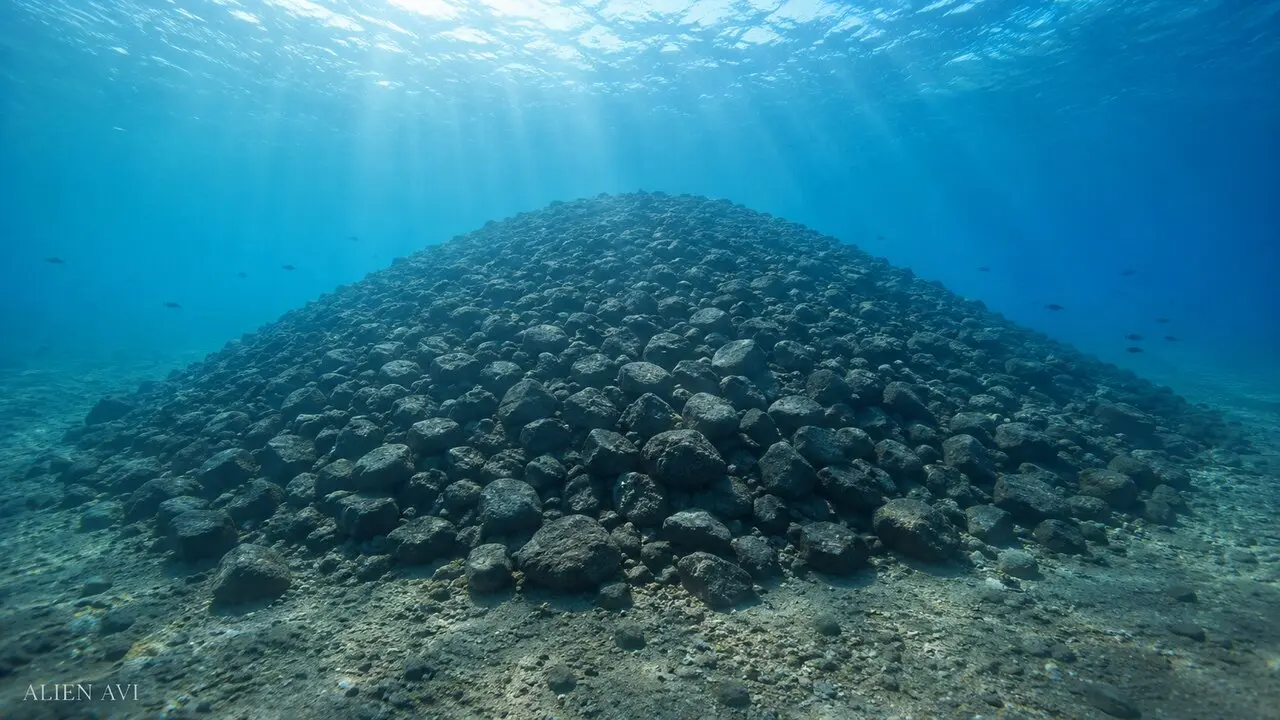
Shmuel Marco went diving to investigate a heap of stones detected by sonar. The survey had taken place in the southwestern Sea of Galilee in the summer of 2003. Underwater inspection revealed natural basalt boulders, some about a meter long, without visible cutting marks. Tilapia gathered between the stones, which offered shelter amid the sandy lakebed.
Tel Aviv University described Marco’s dive in its announcement. The stones and fish appear in the paper he and his colleagues published in the International Journal of Nautical Archaeology in 2013. An unusual shape on an instrument had become a place that could be approached, photographed and measured. The researchers could not yet identify its builders or explain their purpose.
Seventy meters across
The mound measures roughly 70 meters across, with an estimated mass of 60,000 tonnes. Its outline resembles a slightly uneven cone. The combination of shape and basalt stones surrounded by sand led the researchers to interpret it as a human construction.
The reported heights differ. In their November 2012 account for the Prehistoric Society’s newsletter, the team described a peak rising 6 to 7 meters above the lakebed. The university announcement in June 2013 gave a height of 39 feet, roughly 12 meters. The sources consulted do not explain the difference.
Archaeologist Yitzhak Paz compared the structure with ancient burial sites in Europe. That was a proposed interpretation of its form; it did not report an excavated grave inside the mound.
Sand makes an uncertain clock
About 2 to 3 meters of sand cover part of the base. The team tried estimating the mound’s age from the sediment thickness and its rate of accumulation. The result was a broad interval, between two thousand and twelve thousand years before the study. Their earlier report cautiously suggested construction around five thousand years ago, during the Early Bronze Age, while calling for excavation to test the idea.
Comparisons with regional stone monuments and settlements pointed toward the fourth or third millennium BCE. They offered a direction for investigation. This research record still lacked a construction layer or an object from the site that could establish a firm date. The time of its submergence remained uncertain too.
A dry shore, or a place for fish
The researchers considered two routes to the mound’s present setting. It might have been built on dry ground during a lower lake level, then submerged by rising water or movement of the ground. In that scenario, the stones belonged to a landscape quite different from the shore visible today.
The fish suggested another possibility: perhaps the stones were placed underwater for an installation connected with fishing. Smaller stone features around the lake had been interpreted as ancient fish nurseries, although this mound was much larger. Tilapia swimming between its boulders reveal how fish use the structure. Their presence alone cannot tell us what its builders intended.
Miriam dies, and the water disappears
Miriam’s well enters the story through a different kind of record. Numbers 20 describes her death and burial at Kadesh. The next verse reports a shortage of water and the people gathering against Moses and Aaron. Rabbinic tradition gave that sequence a connection: the water supplied to the community depended on Miriam’s merit.
In Taanit 9a, Rabbi Yosei, son of Rabbi Yehuda, associates three gifts with three leaders: the well with Miriam, the cloud with Aaron and manna with Moses. In this account, the well disappears when Miriam dies and returns through the merit of her two brothers. The biblical episode takes place in the wilderness. Those verses contain no description of a stone mound in the Sea of Galilee.
A sieve seen from the shore
In Rashi’s commentary on Numbers 21:20, the well has a location in the Sea of Tiberias. He relates a tradition that it was hidden in the lake and that someone looking from the Jeshimon could see a shape resembling a sieve. It is a vivid image: a person on land looks into the water and recognizes the well from the desert journey.
The traditions do not all provide the same viewpoint. In Shabbat 35a, Rabbi Hiyya directs anyone wishing to see Miriam’s well to the top of Mount Carmel and a shape like a sieve in the sea. These place names and descriptions belong to the texts themselves. They provide no measurement or identifying feature that connects them with the basalt heap detected by sonar.
Below the sand
The records examined contain no inscription or find connecting the mound to the well tradition. Nor is there a date establishing whether the structure was visible when those traditions were told.
At the end of their 2013 paper, the researchers called for investigation of its foundations and a search for evidence that could date it. Beneath the stones and sand, the surface on which construction began may survive. It could help establish when the stones were placed, and whether construction began on a dry shore or underwater.
Editorial clarification ·
Clarification, 8 October 2026: the height of roughly 12 meters appeared in Tel Aviv University’s June 2013 announcement. The researchers’ November 2012 report described the peak as 6 to 7 meters above the lakebed. Both figures are now attributed to their sources.
A 2003 survey identified a basalt mound roughly 70 meters across, with an estimated mass of 60,000 tonnes. The researchers considered construction on dry land followed by submergence, as well as an underwater installation. Their 2012 report gave an exposed height of 6 to 7 meters; the 2013 university announcement reported roughly 12 meters.
No inscription, securely dated object or excavated context identifies the structure as Miriam's Well. Its construction date and original function remain uncertain.
Found another source or a detail to correct? Let us know.
