


Hire Benakal: India's forgotten city of megalithic stone
Stone chambers with round openings cover a ridge in Karnataka. Hire Benakal connects burial and remembrance with the farming, herding and building communities that returned to the landscape over generations.
Avi Moas, Researcher and Editor-in-Chief · Produced with an AI-assisted newsroom
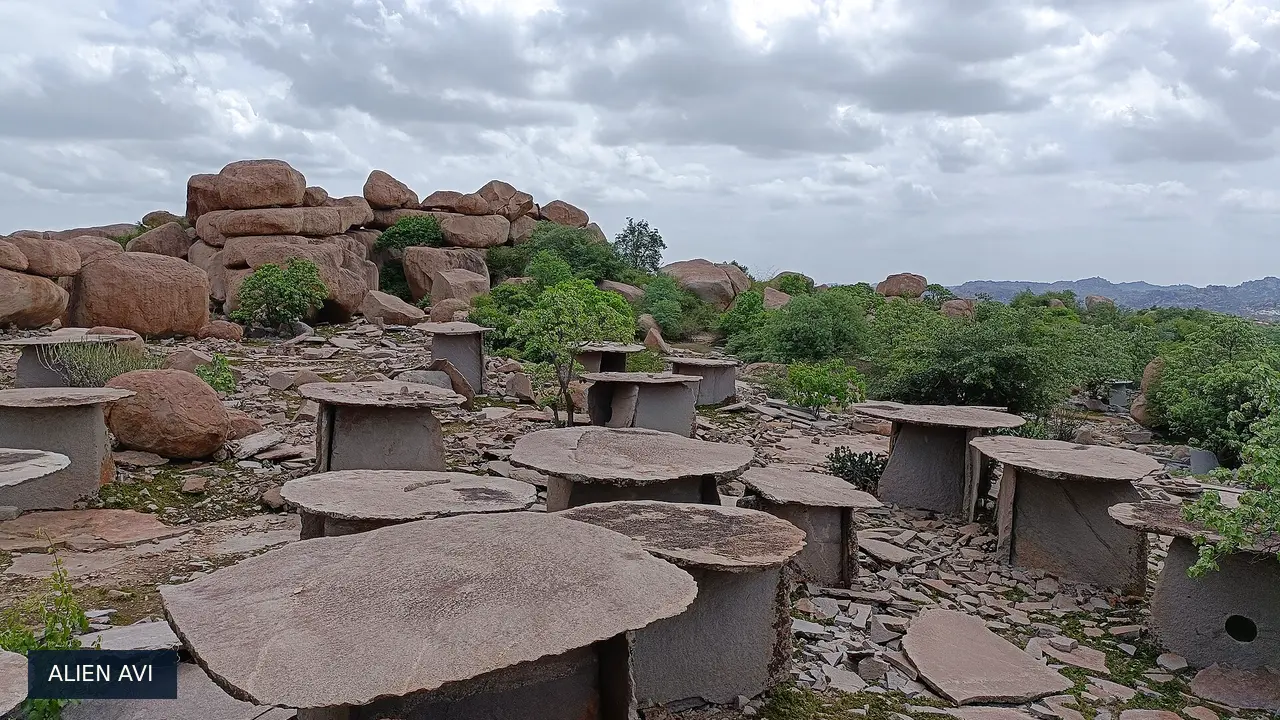
The megaliths of Hire Benakal
The round opening in the wall
The stone structures at Hire Benakal have walls, roofs and openings. Seen at a distance, they can resemble the remains of a village. On this granite ridge in Karnataka, southern India, however, most are identified as funerary or commemorative monuments. The people who built them lived in the surrounding landscape; here they invested in what they would leave behind.
Upright slabs carry heavy capstones. Some fronts have a circular opening; other structures have passages. Around them are stone circles, low chambers and monuments surviving only in fragments. The first glance finds something house-like. A second reveals that the same plan was not copied across the entire hill. Different forms and scales share the landscape.

Putting a roof in place
On paper, the basic method looks simple: stand slabs upright and place another across them. On the ridge it required quarrying, moving, fitting and stabilising stone, without mortar binding the pieces together. Weight and arrangement held the structure. Openings and passages added to the design of each chamber, while the uneven setting made the ground part of the engineering problem.
Koppal district’s official account uses the local name Morera Houses. It distinguishes below-ground burials from memorial structures on the rocks, describing fitted slabs and a roof extending beyond the walls. The variety matters. One building material could support different forms of remembrance; it does not establish an identical burial practice in every chamber.
Looking for the builders beyond the stones
When archaeology writer Samir S. Patel visited with researcher Andrew Bauer, he described work taking place beyond the largest monuments. In the 2010 account, Bauer explained how surveys had identified nearby settlements and connected the complex with farming and herding communities.
That changes where the investigation begins. Instead of imagining people appearing on the ridge solely to move stone, researchers can look for where they lived, processed food and made things. Whoever commissioned or built a large chamber belonged to a community that had to organise labour and resources. Differences between modest monuments and larger constructions offer a way to investigate social relationships, although the size of a stone cannot identify whom it commemorated. Patel reported in 2010 that no human remains had yet been found at the site.
A place used across generations
Many of the monuments belong to the Iron Age, but the chronological ranges differ between descriptions and surveys. Koppal’s page uses roughly 1200–200 BCE; Patel describes a longer building history extending into the Early Historic period. These broad ranges are not a shared construction date for every chamber.
Regional research by the University of Chicago team examines monuments alongside settlements, iron and ceramic production, farming and trade. It also asks about continuity: commemorative building, herding and cultivation could persist while other practices and connections changed. In that setting, Hire Benakal becomes a place people returned to over generations, rather than a brief construction campaign abandoned as soon as it was finished.
Water, paintings and a sounding stone
India’s submission to UNESCO’s Tentative List describes about twenty hectares containing close to a thousand structures and remains, clustered along the ridge. Water-collecting rock basins and paintings of people and animals belong to the wider setting. Counts also depend on what a survey includes: a standing chamber, a collapsed monument and a low surviving feature look very different on the ground.
A roughly hemispherical boulder is known as the kettledrum because striking it produces a resonant sound. Researchers have proposed ritual use or signalling, but no contemporary written record names the person who struck it or the occasion. The sound can be described. The gathering around it has to be reconstructed from archaeological evidence and the landscape.
What the stone houses leave open
Hire Benakal has appeared on UNESCO’s Tentative List since India’s submission of 13 April 2021. Tentative listing is a stage in a process, not an inscription on the World Heritage List. That distinction is worth keeping in view at a site whose names, dates and counts vary across publications.
Not every structure has an individual date, and the builders’ names have not reached us. Yet the circular opening and projecting capstone preserve decisions made by hand: which rock to use, how to position it and what to leave visible for those who would arrive later. The chambers cannot recover the community’s whole life. They retain the effort it put into remembrance.
Editorial clarification ·
Clarified Tentative List status rather than World Heritage inscription. Chronological ranges are attributed to their sources, and Patel’s 2010 report that no human remains had yet been found is included.
Hire Benakal is protected by the Archaeological Survey of India and has been on UNESCO’s Tentative List since 13 April 2021. Hundreds of monuments and diverse remains survive.
Individual monuments do not all have separate dates or identified occupants. Patel reported in 2010 that no human remains had yet been found at the site.
Found another source or a detail to correct? Let us know.
