


Anati saw the tablets of the Law in a carving. The dates pose a problem
A carving divided into ten fields and a group of twelve pillars led Emmanuel Anati to identify Mount Karkom with Sinai. The finds survive beside a seasonal light phenomenon, but his identification also requires a different chronology.
Avi Moas, Researcher and Editor-in-Chief · Produced with an AI-assisted newsroom
What the site actually looks like
Documentary photographs from the location, clearly separated from the editorial lead illustration.


Ten fields on a rock
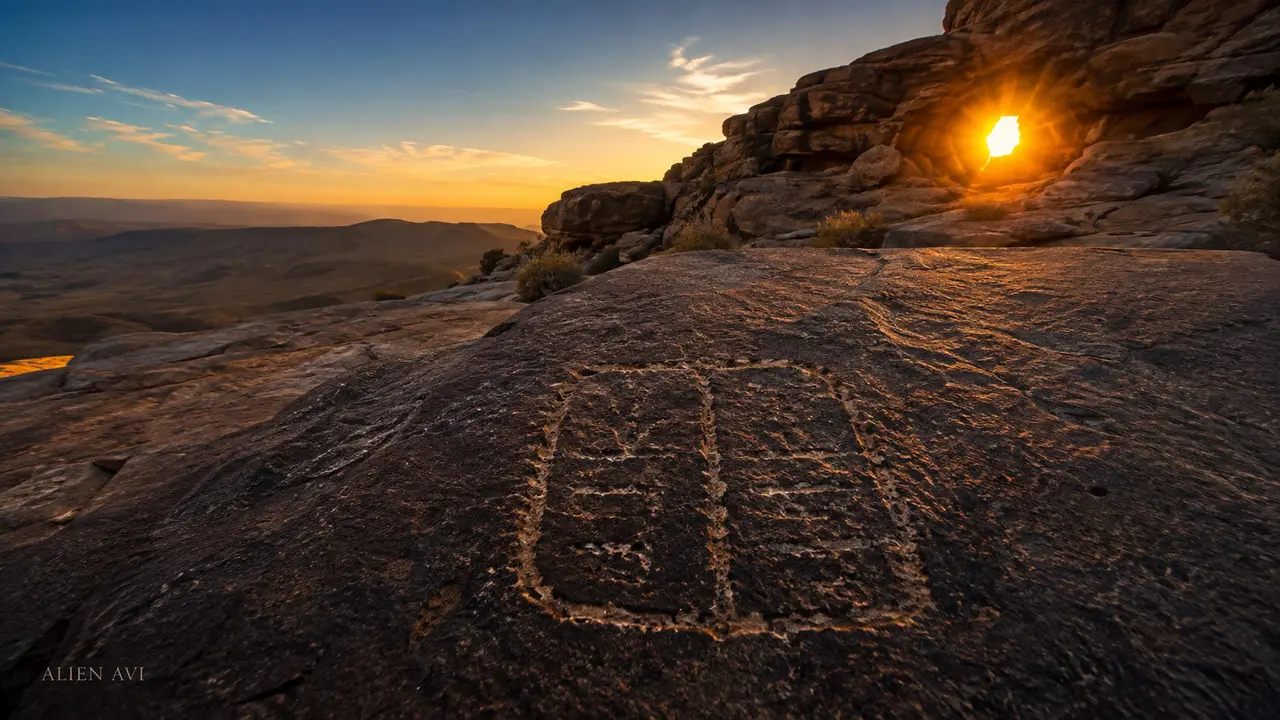
Emmanuel Anati stopped over a carving on Mount Karkom with two rounded tops and ten divisions. He thought of the tablets of the Law. No accompanying inscription tells us what its maker intended.
The research archive identifies the find as site HK 126b, a more useful starting point than its familiar nickname. Readers can compare the photograph with the drawing: two fields sit at the top, two at the bottom and six in the middle. The divisions are visible features of the engraving. Their association with the Ten Commandments is Anati’s interpretation.
The rock formation called the Tablets of Stone in our gallery is a separate feature. Similar names can make two different objects merge in a reader’s mind. The gallery preserves photographs from the location, while the main image is explicitly labeled as an illustration of the engravings and seasonal light.
Visitors across generations
Mount Karkom rises about 847 meters above sea level in the Negev. High quality flint lies across its summit plateau, and hunters reached the area hundreds of thousands of years ago. Later visitors left standing stones, altars, stone circles, platforms and burial cairns. Anati interpreted the concentration of installations as evidence of a sacred mountain visited for ceremonies.
More than a thousand sites and roughly 40,000 engravings have been recorded on and around the mountain. Ibexes and hunters appear alongside footprints, worshippers, eyes, snakes, abstract marks and later inscriptions. People from different periods worked on the same rock surfaces. A newer engraving may cross an older line, while the dark coating that gradually returns changes how clearly each figure stands out.
Generations have therefore left traces without supplying a single explanation for the entire mountain. Understanding one image requires looking at overlapping marks, nearby installations and its date, as well as the resemblance that first catches the eye.
Patina is the dark coating on the rock. Cutting through it exposes a lighter surface, and the coating gradually forms again. This helps explain why one figure stands out while another almost disappears. Colour alone is not a date; overlapping lines and nearby installations also matter.
Twelve pillars and an eleven day journey
At the foot of the mountain stands a group of twelve stones. Anati compared them with Exodus 24, where Moses builds an altar and erects twelve pillars for the tribes of Israel. He connected this visual comparison to geography: Deuteronomy 1 describes an eleven day journey from Horeb to Kadesh Barnea.
In his reconstruction, Mount Karkom fits that route by way of Mount Seir. The identification of those intermediate locations is itself part of the proposal. A journey described in a verse does not directly mark a route on a modern map. The comparison depends on the chosen places, the path between them and the reading of the passage.
The central difficulty is chronological. The mountain’s prominent ritual activity faded around 2000 BCE, centuries before the thirteenth century BCE date frequently associated with the Exodus. Anati proposed that the tradition preserved an older memory from the Early Bronze Age. Accepting his identification therefore also means accepting his proposed change in chronology.
The light returns in winter
Around the winter solstice, a rock opening takes on a golden glow that resembles a flame from a distance. Guide Yigal Granot identified the light phenomenon, and Haim Berger suggested its association with the Burning Bush. Sue Surkes’s illustrated report describes how it attracts visitors to the mountain.
The glow adds a striking experience to a landscape already crowded with ancient signs. Whether earlier visitors saw it and gave it religious meaning remains an open historical question. The available material does not connect that seasonal light to a particular carving or documented ceremony.
To examine Anati’s proposal, begin with the small find labeled HK 126b and open its photograph in the archive. Then compare his interpretation with the chronology he proposes. The ten divisions remain on the rock. Their date and setting determine how far the name “tablets of the Law” can take us.
More than a thousand sites and roughly 40,000 engravings have been documented. The mountain was an important ritual landscape, especially during the Early Bronze Age.
No inscription names Moses or Sinai, and the main ritual phase is earlier than the chronology commonly assigned to the Exodus.
Found another source or a detail to correct? Let us know.


