Credo Mutwa and the Greys: an African testimony larger than an alien story
Credo Mutwa, a South African sangoma, author, artist and keeper of oral traditions, described small grey beings with large black eyes and said he had encountered non-human entities. Alien Avi's video returns his voice to the centre of the discussion, while the fuller story runs through his life, his art, the traditions he narrated and the interviews that carried his personal account around the world.
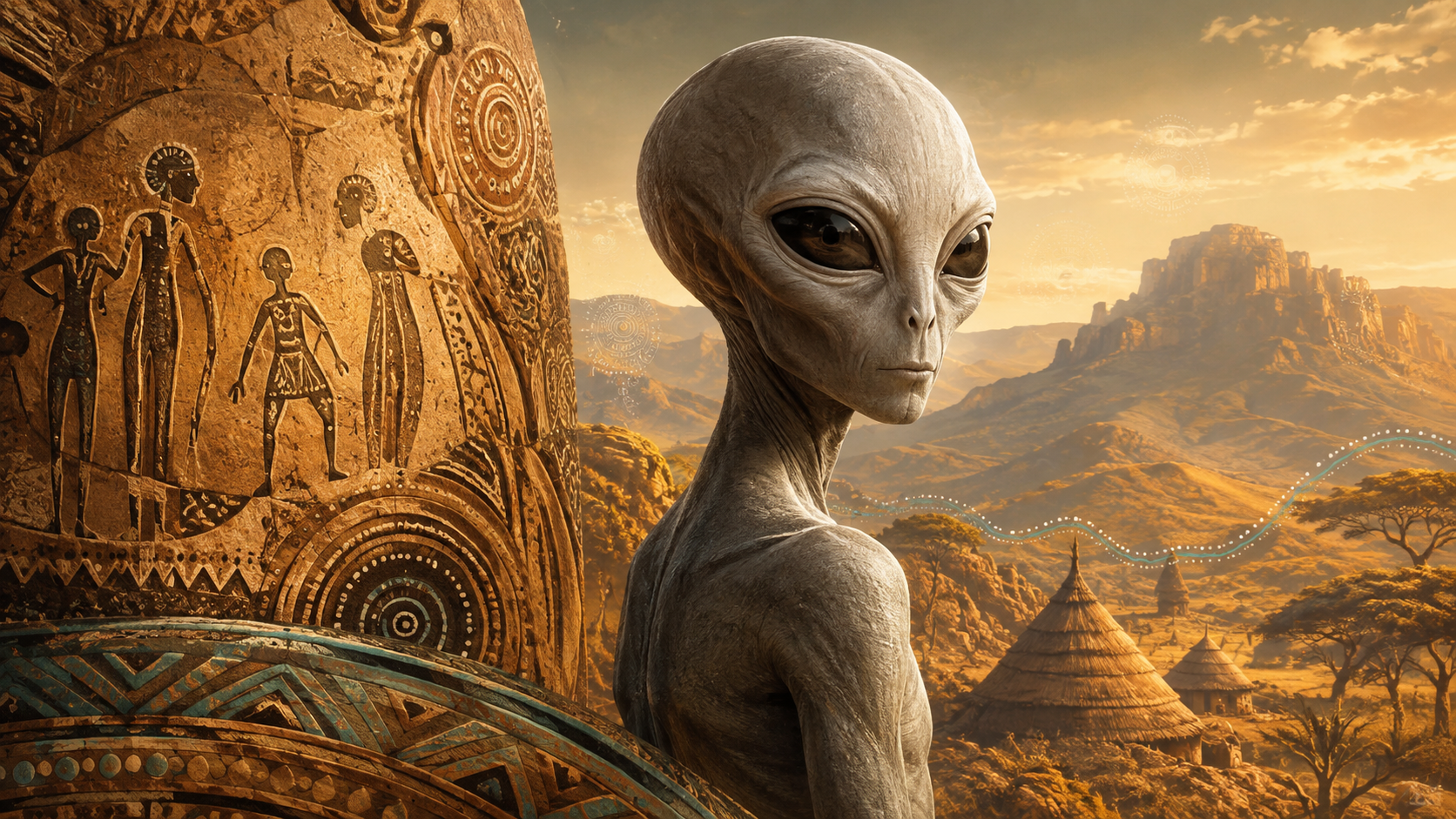
Credo Mutwa describes the Greys
The clip preserves Mutwa's account in his own words. The article distinguishes his testimony, its cultural context and the facts that can be independently verified.
Vusamazulu Credo Mutwa was born on July 21, 1921 and died on March 25, 2020. He was a traditional healer, storyteller, author, sculptor and artist. Indaba, My Children was first published in 1964. From 1974 to 1986 he created the Kwa-Khaya Lendaba cultural village in Soweto, with buildings and sculptures concerned with folklore, mythology, healing and beings from the traditions he recounted.
No contemporary medical record, biological material, file from the time or independent witness publicly verifies the personal encounter Mutwa dated to 1959. Nor is the claim that the Chitauri constitute one uniform ancient African tradition supported by an independent body of early sources from separate communities. The public record verifies his words and cultural standing, not the origin of the beings he described.
The man behind the filmed account
Vusamazulu Credo Mutwa was much more than an interview subject in an alien documentary. In South Africa he was known as an isanusi or sangoma, a traditional healer and keeper of knowledge, as well as an author, storyteller and sculptor. His central book, Indaba, My Children, first published in 1964, brought together stories, legends, beliefs and accounts of African community life. In 2018 he received a USIBA award for his work in indigenous wisdom. He died in 2020 at the age of 98 after a lifetime spent bringing African memory to the foreground rather than leaving it as a footnote to Western culture.
What he describes in the video
In the clip published by Alien Avi, Mutwa describes short grey beings with large heads and wide black eyes, speaking of the fear they inspired and the unusual smell associated with them. Their resemblance to the Greys described in encounter cases elsewhere is why the excerpt continues to attract attention. Its evidential status needs precision: the film records Mutwa saying these things in his own words. It is not footage of the event and does not provide physical evidence of the beings.
In longer interviews Mutwa said that in 1959, while in what was then Rhodesia, he was taken to an underground place and met small grey entities alongside a taller mantis-like being. He described bodily procedures, pain and an experience that changed him. The details entered the public record many years after the claimed event in interviews made for audiences already familiar with encounter and abduction narratives. No medical paper from that year, contemporary diary, physical item or second witness is publicly available for independent examination.
Mutwa used the name Chitauri for intelligent reptilian beings that he said interfered in human history, promoted division and operated behind centres of power. He also connected them with accounts of the Mantindane and underground entities. In some interviews he distinguished the reptilian beings from the Greys in his personal encounter. This became one of the most influential parts of his Western legacy, but it should not be presented as though every African people preserved an identical account. The accurate formulation is that these were traditions and interpretations transmitted by Mutwa, some of which overlap broader motifs of serpents, water beings, spirits and shapeshifters.
Filmed interviews with David Icke, together with a conversation published in 1999 with Rick Martin, made Mutwa familiar to an international UFO audience. They also create a research problem. Icke already promoted a theory of a reptilian ruling elite, so the interviews were not a neutral encounter between an uncommitted investigator and a witness. They preserved Mutwa's voice, but packaged it inside an existing framework and circulated the portions that fitted it best. Understanding Mutwa requires his books and African artistic work as well as the Chitauri excerpts that went viral.
In 1974 Mutwa began building Kwa-Khaya Lendaba in the Oppenheimer Gardens in Soweto. He filled the open cultural village with dwellings, human and animal figures, creation deities, tokoloshes and alien beings. South African History Online dates the construction of the sculptures and buildings to 1974 through 1986 and describes the site as an effort to preserve folklore, art, architecture and traditional healing knowledge amid growing Westernisation. After damage and neglect, it was restored in 2006 under his student Musa Ntanzi. The village is tangible evidence that Mutwa did not merely speak about his world. He built a complete physical space for it.
A large head, small body, black eyes and an involuntary medical experience recur in encounter testimony far beyond Africa. The similarity can be read in several ways: repeated experiences with a common source, recurring structures in human perception and memory, or cross-pollination among books, films and interviews. Mutwa's early claimed date would carry special weight only if the details could be shown to have been recorded before the modern image of the Grey became widespread. The publicly accessible material is a much later record of his testimony, making the parallel intriguing but not decisive.
Credo Mutwa deserves coverage because he joins personal testimony, indigenous knowledge, art and the global discussion of non-human beings. We do not possess external proof for the encounter he described, but reducing him to a caricature of a shaman who spoke about reptiles is equally inadequate. The video lets readers hear him directly, while his biography and cultural village show the personal and cultural world from which he spoke. The strongest story here is not that the Chitauri have been proven. It is that a complex African voice entered the debate and expanded it beyond American files and Western mythology.