The room you cannot see: a cat's hidden sensory world and the information around us
You sit in a quiet room and see nothing happening. The cat straightens, turns its ears and focuses on empty space. For you, nothing changed; for the cat, information arrived. The same room contains light and sounds outside our range, thermal radiation and fields we have no organ to turn into an image. Reality does not end where human senses stop.
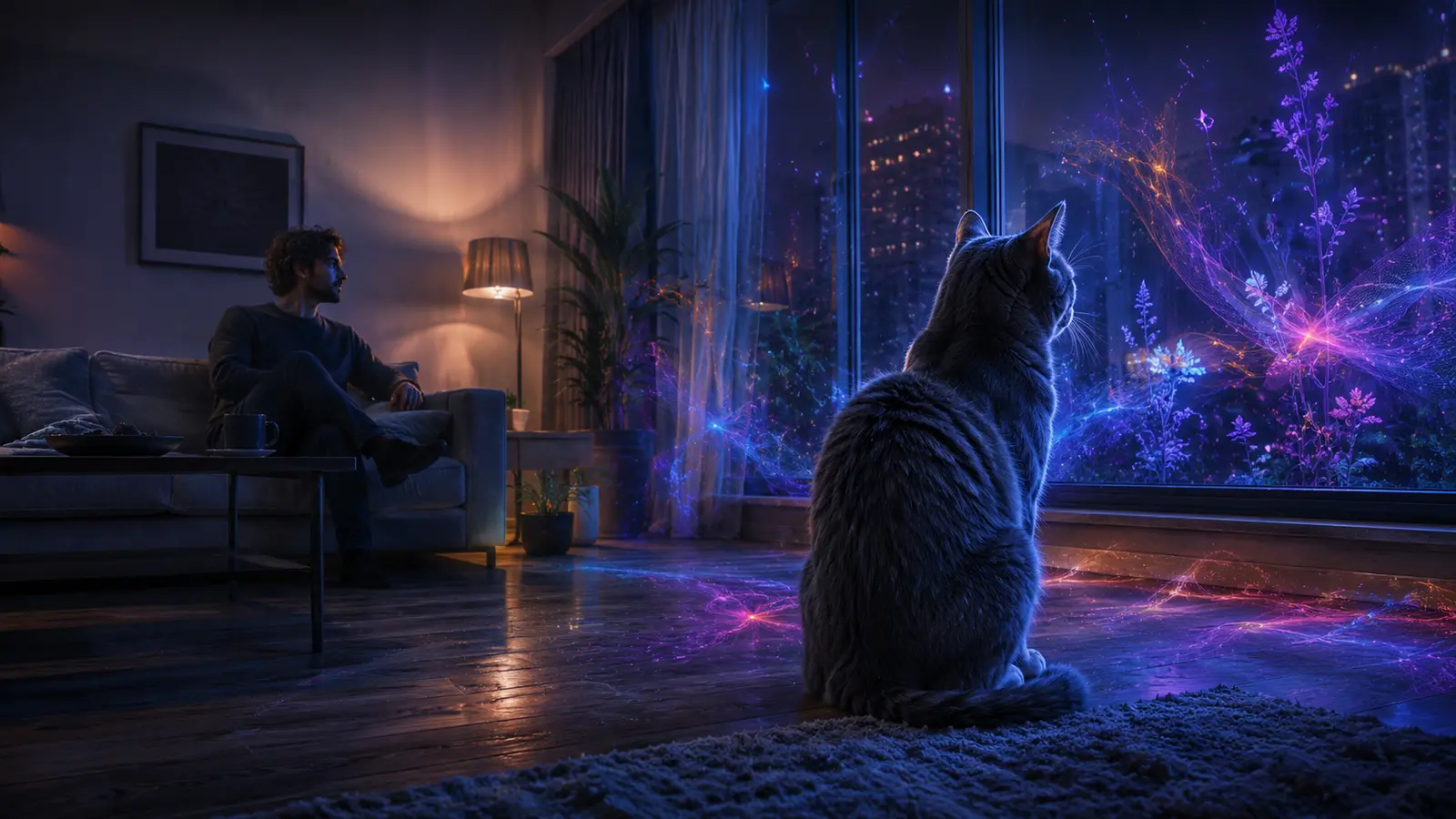
Human vision generally responds to wavelengths around 380 to 700 nanometres, while young healthy hearing spans roughly 20 hertz to 20 kilohertz. Domestic cats can hear up to about 85 kilohertz, and their eye lenses transmit some UVA filtered by human lenses. Other animals detect thermal radiation, ultraviolet light, ground vibration and magnetic fields.
We cannot directly experience how an animal's brain represents these signals or calculate a simple percentage of reality humans miss. Information beyond our senses is established, but that does not itself establish hidden entities or other dimensions.
An empty room full of signals
At night, a cat may detect high-frequency rustling within a wall, equipment vibration, tiny movement or faint reflected light. It need not be seeing a spirit: its sensory system gives it information human evolution did not make consciously accessible.
The narrow window of human vision
Visible light occupies a small part of the electromagnetic spectrum. Infrared, microwaves and radio lie on one side; ultraviolet, X-rays and gamma rays on the other. A remote control, a warm body and wireless equipment already produce signals without creating colours we can see. Receptors, rather than all of reality, determine the brain's input.
The conventional upper hearing limit of a young person is about 20 kilohertz and declines with age. Behavioural testing of domestic cats measured 48 hertz to 85 kilohertz at 70 decibels. Sensitivity to ultrasonic rodent calls offers a hunting advantage. A seemingly motionless wall may conceal audible activity for a cat.
Research on mammalian lenses found significant transmission of UVA from 315 to 400 nanometres through cat lenses. Human lenses filter most of it. Transmission does not establish what colour a cat experiences, but suggests access to shorter-wavelength signals. Cats also trade some acuity and colour discrimination for strong low-light and motion sensitivity.
Bees perceive ultraviolet patterns invisible to people. Many flowers reflect and absorb it in arrangements that guide pollinators towards pollen and nectar. The same flower can therefore present very different information to two observers.
Pit vipers and some other snakes detect thermal infrared radiation through specialised organs. Heating of a thin membrane activates neural pathways that help locate warm prey in darkness. This is a limited-resolution thermal map combined with visual information, not the colourful vision of a science-fiction film.
Some energy in elephant rumbles falls below the conventional human threshold of 20 hertz. Low frequencies travel far through air, and signals also pass through the ground as vibration. What seems quiet to a nearby human can carry social information between distant animals.
Migrating birds navigate using Earth's magnetic field. A prominent model involves light-sensitive retinal cryptochromes and field-sensitive quantum chemistry. Experimental evidence supports investigation of the mechanism, while its exact perceptual representation remains uncertain. An illustration of lines in the sky is not a literal account of avian experience.
Thermal cameras translate temperature differences into colour; ultraviolet sensors reveal floral patterns; radar provides position and speed; specialised microphones record ultrasound; radiation detectors register otherwise unnoticed energy. These instruments translate existing information into signals we can interpret.
A target can look different in infrared, visible light and radar because of emission, reflection, background contrast and processing. That difference alone does not demonstrate non-human technology. Combining independent sensors and telemetry is stronger than relying on one witness or instrument.
A cat may react to a rodent, pipe, electrical device, reflection or smell. A sensor may record weather, reflection, noise or an ordinary object. The known physical world already contains vast amounts of information outside ordinary human experience.
Our senses select information useful for survival rather than provide an unfiltered view of everything. Other animals select differently, and scientific instruments add channels. Discovering more requires new ways to measure, not an assumption that an unfamiliar signal has a particular extraordinary cause.
A phenomenon should not be dismissed solely because it was invisible to the eye, or identified solely because one sensor detected it. Independent measurements of the same event offer the best route from surprise to understanding.