Itzhak Bentov's notebooks: what his wife preserved and what reached the Gateway report
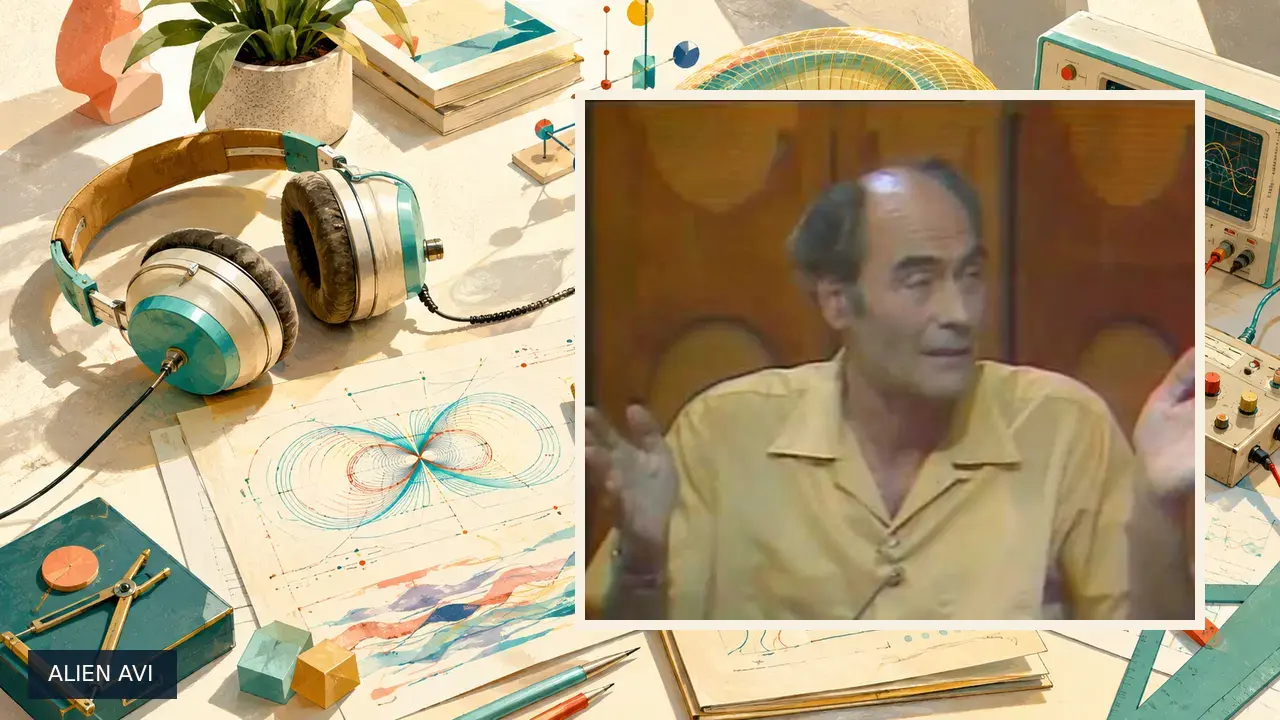
A short video connects Mirtala Bentov with the ideas and notebooks left by her husband, inventor and consciousness writer Itzhak Bentov. Its online headline alleges CIA theft. The documented story is more precise: Mirtala completed a manuscript from his papers, while a classified 1983 Army report drew on a book published during his lifetime to explain Gateway.
A Cosmic Book appeared in 1982 under Itzhak and Mirtala Bentov's names after she completed his surviving notes. Analysis and Assessment of Gateway Process explicitly cites Stalking the Wild Pendulum and uses some of its models. US Army Lieutenant Colonel Wayne McDonnell wrote the report, now held in the CIA Reading Room.
No public record located for this article shows the CIA taking, confiscating or stealing Bentov's original notebooks. The three-minute video lacks a complete provenance chain for its archival excerpts and identifies its narration and script as the channel's work. Theft remains an allegation, not an established fact.
Mirtala's account
Mirtala describes work on consciousness, resonance and reality broader than its later government citations, and her role in preserving it. Her account is first-hand testimony about her husband's work and papers. The clip connects that testimony with his sudden death and Gateway. This is a paraphrase, not an official transcript.
The manuscript she preserved
After Itzhak's death, Mirtala organised his notes, text and drawings into A Cosmic Book on the Mechanics of Creation. The 1982 illustrated, 105-page book bears both names. Its publication is evidence of preservation and completion, not of notebooks disappearing into an intelligence archive.
Bentov's US patent describes a control mechanism usable in a flexible, steerable catheter. He also explored heartbeat, bodily oscillation, brain activity and time through meditation. His 1977 Stalking the Wild Pendulum combined resonance, holograms and a cosmology of consciousness. Creative hypotheses should not be confused with controlled experimental results.
In the June 9, 1983 report, McDonnell uses Bentov's biomedical models to discuss meditation and Hemi-Sync, including bodily vibration, resonance, interference and holographic ideas. Bentov is named in the text and bibliography. This is open, documented influence and does not demonstrate copying from a private notebook.
The familiar label comes from the CIA Reading Room and its archival markings. The author was an Army intelligence officer writing for the military establishment at Fort Meade. The archive holding a document is not necessarily its author.
Page 25 was absent from the CIA copy released in 2003 and was located in the Monroe Institute archive in 2021. It continues discussion of the absolute, a holographic universe, consciousness and spiritual traditions. It contains no admission of taking notebooks and does not establish deliberate omission. The public record has not explained its absence.
Bentov died at 55 in the May 25, 1979 crash of American Airlines Flight 191, before completing his next book. The aircraft crashed after takeoff from Chicago following separation of the left engine and pylon. All 271 aboard and two people on the ground died. The later appearance of his ideas in a classified report has encouraged suspicion about the timing.
The NTSB traced the engine separation to damage from improper maintenance, followed by structural failure, left-wing leading-edge slat retraction and warning-system failures. The detailed engineering investigation provides no evidence that Bentov was a target. Suspicion about the timing is distinct from public evidence of sabotage.
An independent Israeli inventor's speculative book became a significant source for an Army officer evaluating consciousness training. Mirtala turned surviving notes into a further book. The traceable sequence runs from Bentov's work to publication, then to a military report later made public.
An inventory, custody records, a transfer or seizure document, verifiable direct testimony and a match between unpublished private material and later government work would be needed. The available material establishes government use of published ideas, not theft of notebooks.
Bentov connected medical engineering, meditation and cosmology in an influential way. Mirtala preserved his unfinished work. Readers can investigate that influence while maintaining the distinction between documented borrowing from a published book and an unproven theft allegation.