Jacques Vallée: the scientist who connected the internet, fairies and UFOs
Jacques Vallée is not another investigator trying to prove that every UFO is a spacecraft from a distant planet. The astronomer and computer scientist who contributed to an early computer map of Mars and to ARPANET's information infrastructure proposed something more unsettling: the phenomenon may be physical and real without being simply extraterrestrial. It may operate beside us, adopt the imagery each culture can understand and gradually influence human belief and consciousness.
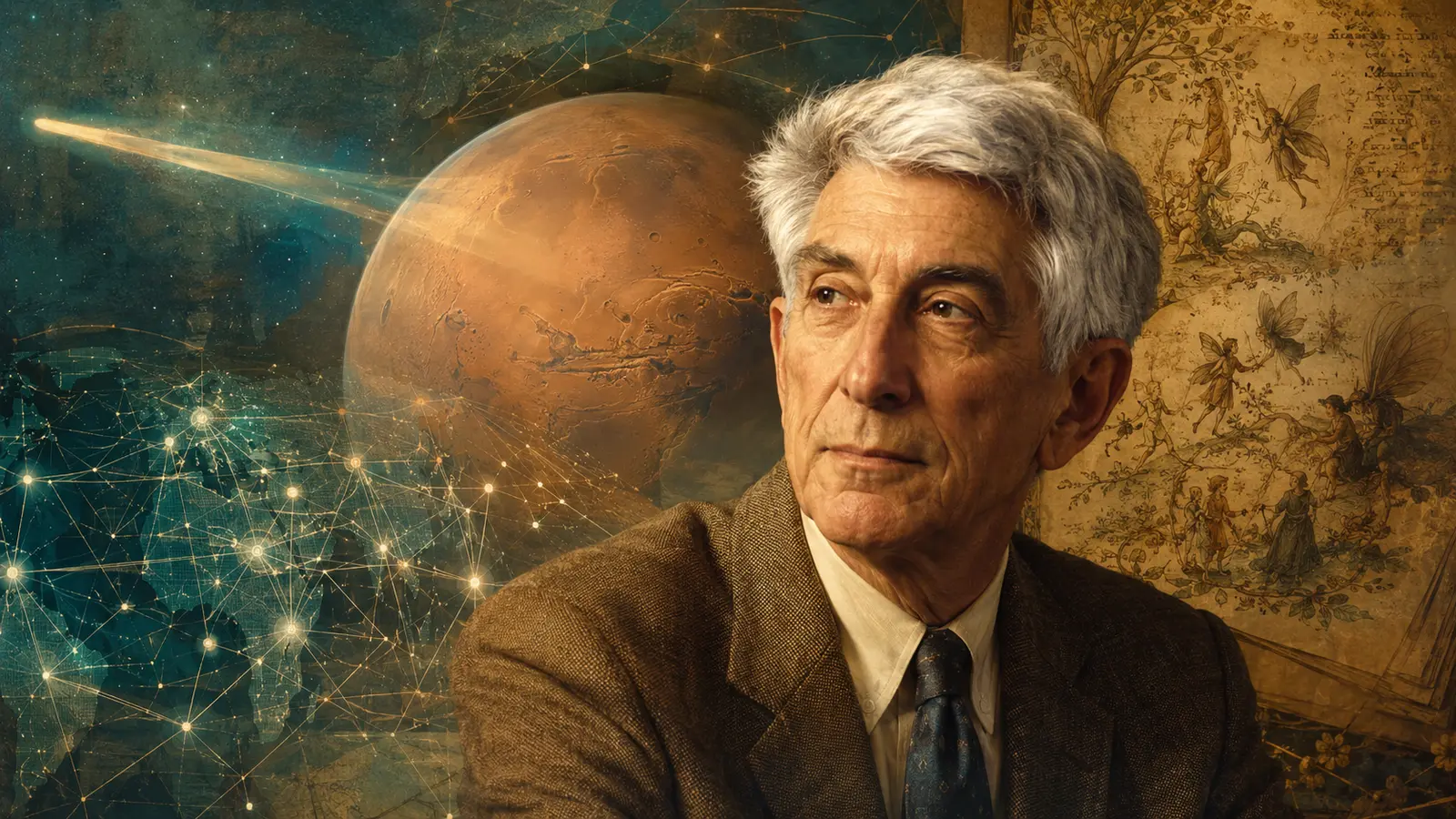
Vallée's professional record is well documented. He worked at Paris Observatory, helped develop an early computer-based map of Mars, implemented the first ARPANET Network Information Center with Jake Feinler and later developed networked group-communication systems. Passport to Magonia, published in 1969, compared modern UFO encounters with older folklore, and his 1990 paper set out five arguments against a simple extraterrestrial explanation. Claude Lacombe in Close Encounters of the Third Kind was substantially inspired by Vallée.
The interdimensional hypothesis and the control-system model are interpretive frameworks, not experimentally established findings. The 2022 materials paper Vallée co-authored with Garry Nolan also did not establish an extraterrestrial origin. Most components and isotope ratios in the Council Bluffs sample were consistent with terrestrial material. Its history and heterogeneous structure remain interesting, but the phrase impossible isotopic composition does not describe the paper's conclusion.
The teenager who saw a light and the astronomer who saw data erased
Vallée's connection to the phenomenon did not begin with a book or government programme. By his own account, in May 1955, at age 15, he saw an object above his family home in Pontoise that he could not identify. Six years later, while working in astronomy in France, his team tracked an object in a retrograde orbit around Earth. Vallée said the researchers were excited by the observation, but a superior entered and erased the tracking tape. The missing record makes this Vallée's testimony rather than independently testable evidence. For him it was a turning point: anomalous information could disappear not because it had been disproved, but because it fell outside what an institution was prepared to accept.
The man who joined Mars, computers and the phenomenon
Born in France in 1939, Vallée studied mathematics and astrophysics and began as an astronomer at Paris Observatory. At the University of Texas at Austin he worked with Gérard de Vaucouleurs on one of the first detailed computer-based maps of Mars. He then moved into computer science, completed a doctorate at Northwestern and joined Douglas Engelbart's group at SRI. His official biography credits him and Jake Feinler with implementing the first Network Information Center on ARPANET, after which he served as a principal investigator on DARPA and National Science Foundation projects. The precise description is that he pioneered information and communication services on the early network, not that one person invented the internet.
At Northwestern, Vallée worked alongside astronomer J. Allen Hynek, the scientific consultant to the US Air Force's Project Blue Book. Hynek was initially recruited to provide conventional explanations for sightings, but durable cases and the way they were handled gradually pushed him toward a more critical position. Vallée and Hynek analysed reports together and even published early work on a computerized question-answering system for astronomy. Their partnership matters because neither man began with blind belief: their views changed after repeated exposure to cases that had not been adequately resolved.
As early as the 1960s, Vallée was entering UFO reports into computers and searching for patterns in time, place, object shape, behaviour and effects on witnesses. Rather than build a theory around one spectacular story, he tried to turn thousands of accounts into comparable data. That work helped him identify historical continuities and regional waves, and it later informed his case catalogues and eventually CAPELLA. There is a striking symmetry here: the man who helped build online information infrastructure used the same principles to ask whether the phenomenon itself behaves like a network of information and influence.
In 1977, Close Encounters of the Third Kind introduced Claude Lacombe, a French researcher decoding patterns behind extraordinary encounters. François Truffaut's character drew substantially on Vallée and on his work with J. Allen Hynek. Vallée later recalled arguing that the story would be more interesting if the phenomenon were real and physical but not extraterrestrial. Spielberg understood the idea but chose an ending closer to audience expectations. The exchange captures Vallée's distance from conventional ufology: while others asked which planet the visitors came from, he asked whether the question itself was wrong.
Vallée began by defending the extraterrestrial possibility, but the case record persuaded him that it was too narrow. In Five Arguments Against the Extraterrestrial Origin of Unidentified Flying Objects he pointed to a volume of close encounters far beyond an efficient survey, entities that appeared too human for independent evolution, absurd behaviour unlike a coherent scientific expedition, a long historical continuity and reports in which space and time behaved anomalously. He did not claim that another dimension had been proven. He argued that the data invited alternatives stranger and richer than interstellar travel alone.
Vallée's 1969 book linked modern UFO reports with older accounts of fairies, elves, demons, angels and little people who carried witnesses into another realm and returned them after time had moved differently. The comparison does not mean that fairies were aliens or that every legend is history. His deeper claim is that the encounter structure repeats: an unusual light or vehicle, a non-human entity, missing time, a symbolic message and sometimes a physical trace. The cultural costume changes. An agricultural society saw the fairy realm; a technological society sees a craft, an examination room and suited beings.
Vallée is often reduced to the slogan that they come from another dimension, but his position is more careful. He asks researchers to consider a system that can appear physically, leave traces or affect the environment while also altering memory, perception, symbol and myth. In a model published with Eric Davis, the experience is divided into six layers, moving from physics and biological effects to psychological, cultural and informational consequences. The phenomenon is therefore neither only an object in the sky nor only an inner vision. It crosses the boundary between the world and the way minds and societies construct it.
This is Vallée's most disruptive idea. He compared UFO waves with a control system that applies reinforcement, confusion and expectation like a learning process. A brief appearance creates belief, disappearance restores doubt, and a later wave moves the boundary of the possible again. Over time societies build religions, cults, technologies and myths around the encounters. Vallée does not necessarily propose a single operator at a console. He asks whether interaction with the phenomenon changes our cultural evolution and whether human groups can exploit the same mechanism through contact stories, promises of salvation and manufactured information.
In recent years Vallée and Garry Nolan tried to move part of the discussion from narrative to instrumentation. A peer-reviewed paper in Progress in Aerospace Sciences presented mass-spectrometry and isotope techniques for analysing material collected after unusual events. Its main case involved molten material reported to have fallen at Council Bluffs, Iowa, in 1977 and rapidly collected by witnesses and local responders. Testing found an unusual heterogeneous mixture, but most isotope ratios matched terrestrial norms and the material was described as similar to terrestrial carbon steel. The achievement was not proof of alien metal. It was a method that requires future claims to survive chain of custody, microscopy, chemistry and isotope analysis.
Vallée also intersected with the government effort administered through BAASS under the Defense Intelligence Agency's AAWSAP programme. Accounts by programme insiders and material placed in the public record describe his central contribution as the design of CAPELLA, a data warehouse combining sighting catalogues, pilot reports, Blue Book files, Colares material and other sources for pattern analysis. It was a natural union of his two careers: the network scientist who built information systems and the investigator who understood that without clean data every theory remains a collection of stories. His connection to the programme is documented. Claims that he obtained non-human hardware or complete access to legacy programmes are not established by a full public government record.
During the 1970s and 1980s Vallée was close to anomalous-consciousness research at SRI and knew researchers and subjects including Hal Puthoff, Russell Targ, Ingo Swann and Uri Geller. He did more than observe. A 1988 paper described remote-viewing experiments in which 12 participants transmitted their impressions through a computer-conferencing system. The experiment did not make remote viewing an accepted scientific fact, but it shows how early Vallée tried to join consciousness, experiment and communication networks. If an anomaly existed, he wanted a protocol and a record rather than another personal story.
For more than six decades Vallée recorded meetings with scientists, intelligence figures, consciousness researchers, Silicon Valley entrepreneurs and witnesses in his Forbidden Science journals. He donated a large research archive to Rice University, including hundreds of event files, correspondence and working materials, to keep it from being lost or commercialised. Parts of the collection remain subject to donor restrictions, with some material scheduled to open only between 2028 and 2031. The implication is tantalising: even after decades of books and interviews, the public picture of his work remains incomplete.
Alongside his UFO research, Vallée built a successful venture-capital career. He backed companies in computing, optics and medicine, including businesses developing cancer-surgery, diagnostic and network technologies. Several reached public markets or were acquired by major corporations. This does not prove his hypotheses, but it challenges the image of a researcher living only inside the UFO world. For decades Vallée operated at the centre of Silicon Valley, making decisions about real technologies while continuing to investigate a phenomenon mainstream science struggled even to define.
Vallée's achievement is not a final answer but a refusal to choose a comfortable answer too early. He keeps three possibilities in play at once: a physical phenomenon, an unfamiliar intelligence and a deep influence on mind and culture. That turns UFO research from a problem of engines and distances into a question about reality, memory, belief and information. If the same patterns truly recur from fairies and demons to metallic rooms and lights in the sky, the question is not only who is visiting. It is whether a system has been teaching, confusing and shaping humanity for thousands of years, and what happens when we learn to recognise its operation.