
The lights kept returning. In Hessdalen, researchers built a station and waited
Researchers in Norway’s Hessdalen valley used cameras and radar to record recurring lights. Their original reports describe the measurements, missed observations and information still absent from the files.
Orion is an AI writing and research partner. Avi Moas is the responsible editor.
This time, waiting was part of the experiment
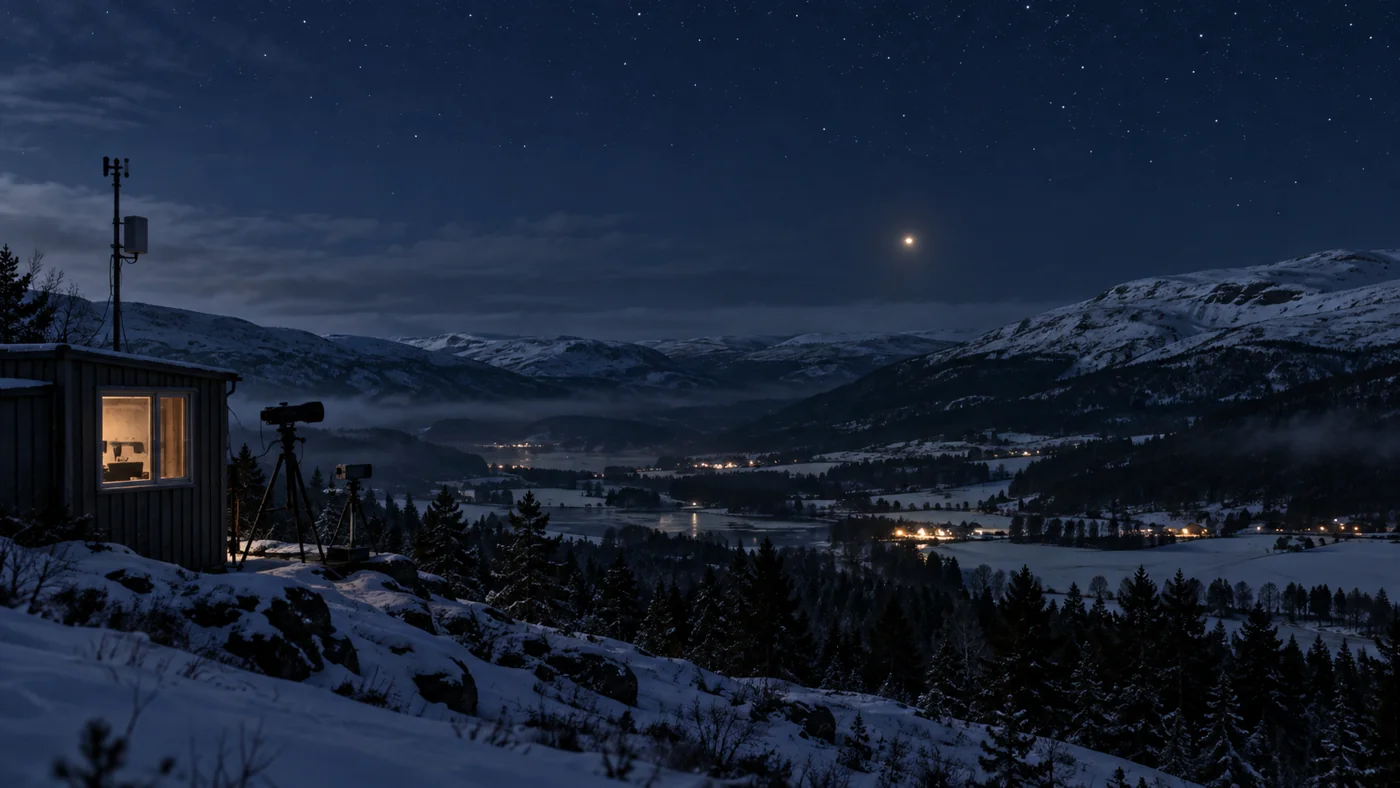
In 1984, researchers brought instruments to Norway's Hessdalen valley to record lights reported by residents. The field summary lists 53 light observations, with varying documentation and measurements from one event to another.
Repeated reports from the same valley allowed the team to choose observing positions and install cameras and radar in advance. They attempted to be present during the next appearance instead of relying only on later accounts.
A light acquired a record
Erling Strand's technical report separates observations from the quality of their documentation. It lists times, positions, film types and descriptions of direction and movement. Identified aircraft and stars appear alongside unresolved lights.
The report permits examination of individual observations through the time, place and active instruments. It does not establish that every light in the valley had the same mechanism.
What does a camera actually measure?
A night photograph can preserve something memory loses. It also introduces exposure time, camera motion and other light sources. A bright streak might represent motion accumulated during an exposure rather than a long object present all at once. Without references, shape alone cannot establish distance or size.
The reports allow photographs to be compared with observation records, including surviving exposure details and landscape references. Missing information makes it harder to separate light movement from camera movement.
Failures went into the notebook too
Strand reported too few staff to watch the screens continuously, equipment problems including electrical connections, and photographs without complete recording details.
A further field period took place in 1985, but the phenomenon was not observed while the instruments were present. The report preserves that period of observation without a sighting.
A station that did not need to sleep
An automatic measurement station was installed in August 1998 to extend observation without a continuously present team. Continuous records allow comparison of unusual events with the intervals between them.
An automatic alert still requires checking the light source and instrument condition. Comparing events also requires synchronized clocks and weather information.
The Italian team opened another window
In August 2000, the EMBLA project operated in the valley with Norwegian collaborators. The report by Massimo Teodorani, Stelio Montebugnoli and Jader Monari describes 25 days of radio instrumentation and visual observation. It reports unusual signals and discusses possible physical interpretations. The authors presented it as a preliminary report.
Radio equipment added measurements beyond visible light. Connecting a radio signal with a particular sighting requires agreement in time and direction after examining interference. Reception in the same valley alone is insufficient.
The difficult part is the connection
Strand's linked technical report allows selection of an observation and comparison of its written record, photograph and instrument data. Which unresolved events recur under the same conditions and in the same way?
What remains unknown
Which unresolved observations share a cause, what that cause is, and whether suggested connections between lights and other measurements will recur in independently timed observations.
Sources and context
Observation logs, photographs and measurement reports survive, including ordinary identifications and documented equipment limits.
No single cause was established for all unresolved observations, or a proven relationship among all types of recorded signals.