


Calvine 1990: the photograph that survived its journey into military files
A print preserved by an RAF press officer reconnects the Calvine story with its archive trail. A photographic analysis explains what the surviving image can—and cannot—establish.
Avi Moas, Researcher and Editor-in-Chief · Produced with an AI-assisted newsroom

The envelope that survived
For decades, RAF press officer Craig Lindsay kept an envelope containing a black-and-white print. It shows hills, branches and a wire fence. Above the landscape is a dark diamond-shaped form, with a much smaller aircraft-shaped object to its side. When researcher and journalist David Clarke traced Lindsay, a physical print finally reconnected the story of the Calvine pictures with an object that could be examined.
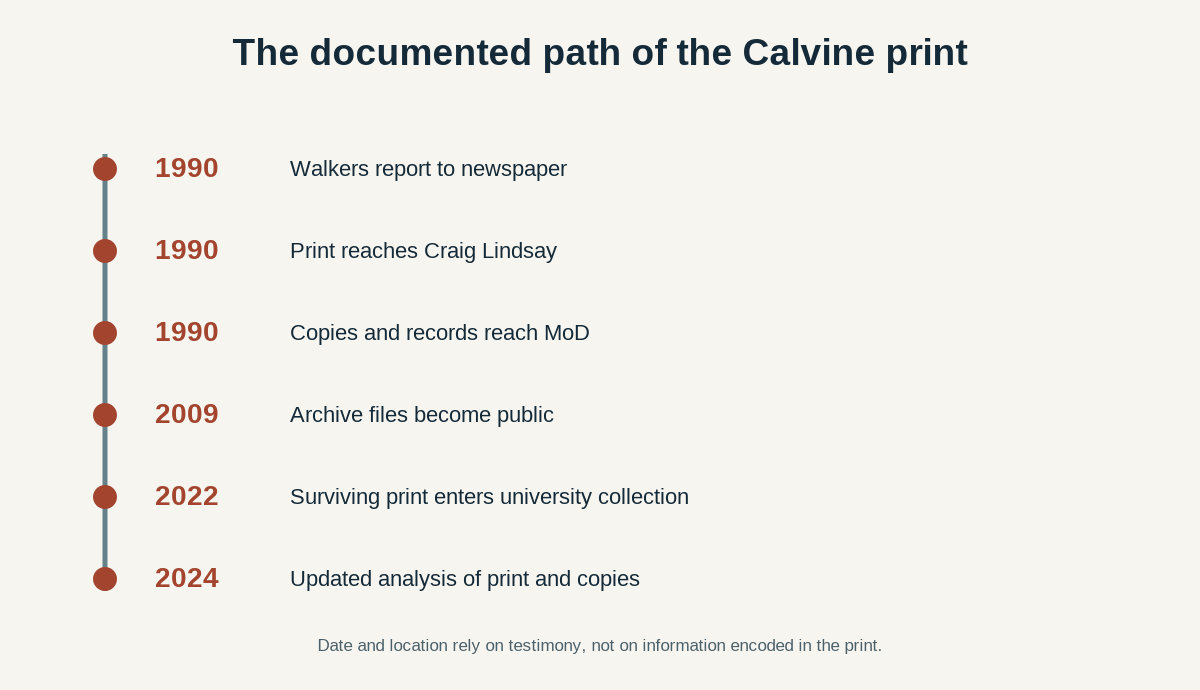
According to accounts given to Scotland's Daily Record and to Lindsay in 1990, two walkers took the pictures on the evening of August 4 on moorland near Calvine. The photographer’s identity was not established in the 2024 analysis. The date and precise location cannot be derived from the print itself. The first distinction in the case is therefore simple: there is a physical photograph with a documented trail, while time and place depend on testimony accompanying it.
Into the Defence Ministry
The Daily Record passed a print to Lindsay. He contacted a witness, prepared an account and sent a photocopy to the Ministry of Defence. In photographic specialist Andrew Robinson's reconstruction, the original negatives reached the ministry in September 1990. The UK's National Archives identifies material in files DEFE 31/179 and DEFE 31/180, including poor photocopies and inquiry papers. Its 2009 guide explicitly points to those records and the smaller aircraft visible in the picture.
Lindsay's own print survived outside that paper trail. In 2022 it entered Sheffield Hallam University's special collection. Robinson inspected the print, its reverse, the envelope and the period photocopies. The test mattered because it could establish whether the image published decades later matched the one that circulated in 1990.
What a physical print can tell us
Robinson compared small print defects and image features. He found that the surviving print and copies sent to the ministry matched. Paper and processing marks suggested that the surviving black-and-white print was probably made from a copy negative of an earlier color print rather than being the original camera negative. The name “Kevin Russell” was written on the back, but the photographer has not been identified; a person with that name located in the area denied any connection.
Examining the print, Robinson found no signs of negative or print manipulation. He did not have the original camera negatives. In his assessment, the image represents a scene before the camera. That finding does not supply the distance, size or identity of the dark form. It also cannot exclude an object arranged in front of the camera, although he found no evidence for such a setup in the print.
The smaller object is described as a Harrier in the National Archives guide. Identifying the aircraft still does not tell us how far either shape stood from the photographer. Relative size on a single photograph cannot be converted into the absolute size of the larger object without more information.
A case about the image's history
This article includes Lindsay’s surviving image and a diagram of its journey. Robinson’s linked report also reproduces the reverse, envelope and period photocopies. Each adds a different clue: a mark on paper, a name on the back or a defect repeated in an old copy. These are records of the image’s handling, not additional photographs of the sighting.
Open questions remain. Where exactly did the photographer stand? Who took the image? What happened to the color originals and camera negatives? What occupied the scene in front of the lens? The interest of Calvine lies in the surviving print and the unusually traceable path it took, even while those questions remain unresolved.
Found another source or a detail to correct? Let us know.
