


Official Night of the UFOs (1986): When Brazil Scrambled Five Fighter Jets
On the night of 19 May 1986 the tower operator at São José dos Campos saw colour-changing lights over the city, and São Paulo approach confirmed radar contacts. The head of the air-defence operations centre, Major Ney Antunes Cerqueira, scrambled alert aircraft from Santa Cruz and Anápolis. Five interceptors took off. On 23 May the Minister of Aeronautics, Octávio Júlio Moreira Lima, told a press conference: "Technically, I would say to you that we have no explanation." On 2 June the acting air-defence commander signed a confidential report. Its concluding opinion: the phenomena were "solid" and "in a certain way reflect intelligence."

By Avi Moas
Sources and editorial method
Avi Moas, Researcher and Editor-in-Chief · Produced with an AI-assisted newsroom
São José dos Campos tower, the lights, and aircraft PT-MBZ
The official file opens at 23:15 UTC, 20:15 Brasília time, on 19 May 1986. Brasília Area Control tells the military operations centre of CINDACTA I, COpM 1, that the São José dos Campos tower operator has seen lights moving over the city. In the original report the dominant colour is red, shifting to yellow, green and orange. The tower also tells São Paulo approach, APP-SP, which confirms radar contacts in the same area.
Later press and books identify the operator as Sergeant Sérgio Mota da Silva. The report itself does not name him. In interviews he has said he saw the lights before the time recorded in the report, and watched them through binoculars. Those details cannot be verified from the command's eight pages alone.
At 00:08 UTC, 21:08 local, already 20 May, the pilot of aircraft PT-MBZ reports lights on the 150-degree radial of the São José VOR, moving east to west, "like large red stars." He tries, on his own initiative, to close on them, and cannot. The report does not name the pilots. In later coverage, including G1 and the BBC in 2022, the aircraft is an Embraer Xingu, and the pilots are Ozires Silva, a founder of Embraer, flying from Brasília to São José, and co-pilot Alcir Pereira da Silva. The next day Ozires took office as president of Petrobras. Those names are not in the command report.
Five F-5E and Mirage F-103 interceptors scrambled
At 00:23 UTC the duty officer at CODA, the air-defence operations centre, is called in. At 00:39, on the centre chief's order, the alert aircraft at Santa Cruz Air Base, near Rio de Janeiro, is scrambled. The reason: radar "plots" in the São José area. The report states plainly that these detections were not defined radar echoes, and were used only to vector the interceptors so they could continue with their onboard radars.
Between 01:10 and 01:11 UTC, Anápolis approach, APP-AN, reports returns on its terminal radar that are not visible on COpM 1's equipment, but which have heading and speed. CODA scrambles the Anápolis alert, and asks Santa Cruz for two more aircraft: the command normally has only one alert jet, and the time airborne may exceed its endurance. That is what happened.
The five takeoffs, according to the clean summary attached to COMDABRA's 2004 letter (which clarifies times printed densely in the 1986 report):
- 01:34 UTC (22:34 local) — first aircraft from Santa Cruz. - 01:48 (22:48) — first aircraft from Anápolis. - 01:50 (22:50) — second aircraft from Santa Cruz. - 02:17 (23:17) — second aircraft from Anápolis. - 02:36 (23:36) — third aircraft from Anápolis. The last jet lands at 03:30 UTC, 00:30 on 20 May.
The official report does not name pilots, call signs or aircraft types. In the press, in the 2022 G1/BBC feature and in the Portuguese Wikipedia (drawing on later interviews and published tape transcripts), they are identified as follows. Two F-5E Tiger IIs from Santa Cruz: First Lieutenant Kleber Caldas Marinho in FAB 4848, call sign "Jambock 17"; and Captain Márcio Brisolla Jordão in FAB 4849, "Jambock 07." Three Mirage IIIEBRs, designated F-103 by the Brazilian Air Force, from Anápolis: Captain Armindo Sousa Viriato de Freitas in FAB 4913, "Jaguar 116"; Captain Rodolfo da Silva Souza, "Jaguar 98"; and Captain Júlio Cézar Rozemberg. Major Ney Antunes Cerqueira, the CODA chief, ordered the scramble and later appeared at the press conference. He was not one of the pilots.
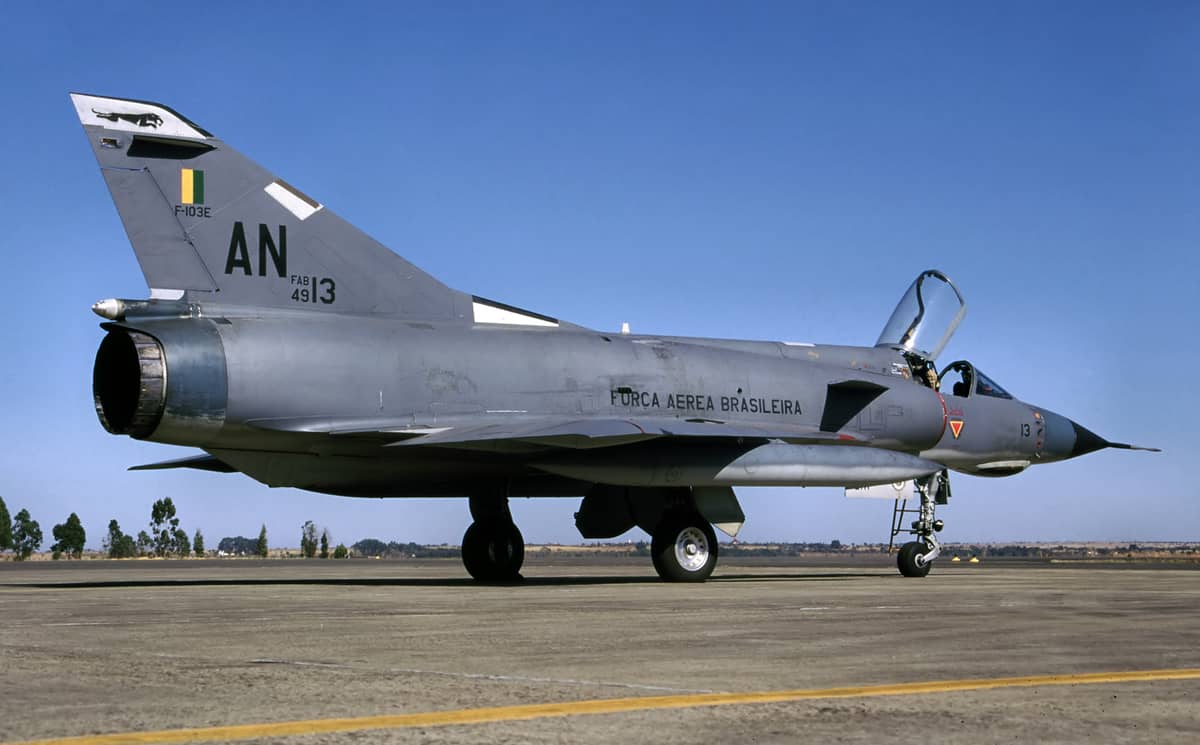
In 1995 Rob Schleiffert photographed a Mirage F-103 at Anápolis, serial FAB 4913. That is the serial later sources give for Viriato's jet that night. The photograph is from nine years later, not from the night itself, but it is the same aircraft, at the same base.
What happened to each interceptor, according to the report
The first Santa Cruz aircraft, at FL 170 (about 5,200 metres), sees a white light below its level. The light climbs and settles about ten degrees above the jet. The chase continues to FL 330 (about 10,000 metres). The colour goes white, red, green, and white again. The onboard radar shows a target at 10 to 12 miles, "confirming the visual contact." The pursuit runs toward the sea, to about 180 miles from Santa Cruz, and is broken off: there is no "positive" closing rate, and the aircraft has reached the fuel limit for return to base.
The first Anápolis aircraft is vectored using APP-AN's radar, because the air-defence radar at COpM shows no traffic. The pilot makes five intercept runs. He gets onboard-radar contact, with no visual. On one run he closes to two miles. The track is a zigzag or a tight right turn. The speed changes abruptly: sometimes a close is possible, sometimes the target pulls away even though the interceptor is already supersonic. Contact is lost, and the chase is abandoned.
The second Santa Cruz aircraft sees a red light at the position given by COpM 1, confirming the ground radar. After some minutes there is no closure; the light goes out, and the radar contact is lost at the same time. For a moment thirteen "plots" appear behind the interceptor. A 180-degree turn is ordered. There is no visual contact, and no onboard-radar contact.
The last two Anápolis aircraft, according to the report, obtain no contact at all, visual or radar. All five recoveries are normal.
Transcripts published later from the tapes (Rodrigo Visoni's 2019 Aeromagazine article, and quotations from it on Wikipedia) add details that are not in the eight pages: Marinho telling the controller it "does not appear to be an aircraft… given its speed performance, and also the place it is flying"; Anápolis controllers telling Rodolfo Souza that the "plot" stays at his six o'clock, passes above or below him, and reappears in front after a turn. I have not checked those quotations against the National Archives tapes themselves. The command report says only that the last two Anápolis jets had no onboard-radar or visual contact; that is consistent with being vectored from APP-AN plots alone, without a lock on the aircraft.
Timeline of 19 May 1986 (Official Night of the UFOs)
All times are from the report and the 2004 annex. Local time is Brasília, UTC−3.
| UTC | Local | What the report records | Ground radar | Airborne radar | Visual |
|---|---|---|---|---|---|
| 23:15, 19 May | 20:15 | SJC tower reports lights; ACC-BR tells COpM 1 | APP-SP confirms contacts in the SJC area | — | Tower: red, yellow, green, orange lights |
| 00:08, 20 May | 21:08 | PT-MBZ, 150° radial of SJC VOR, east to west | Not specified in the report | Not specified | "Large red stars"; tried to close, could not |
| 00:23 | 21:23 | CODA duty officer called in | |||
| 00:39 | 21:39 | Santa Cruz alert scrambled | Undefined "plots" in the SJC area | Not yet | |
| 01:10–01:11 | 22:10–22:11 | APP-AN reports returns with heading and speed; Anápolis scrambled | Returns on APP-AN; not on COpM 1 | ||
| 01:34 | 22:34 | First takeoff, Santa Cruz | Returns west of SJC | 10–12 miles, confirming the visual | White light that climbed from below the jet to 10° above it, to FL 330; white-red-green-white; chase out to sea ~180 miles |
| 01:48 | 22:48 | First takeoff, Anápolis | Vectored from APP-AN only | Five runs, once to two miles; zigzag, abrupt acceleration, including against a supersonic interceptor | None |
| 01:50 | 22:50 | Second takeoff, Santa Cruz | Confirms the red light's position; then 13 plots astern | After the 180° turn: none | Red light at the reported position, went out as radar was lost |
| 02:17 | 23:17 | Second takeoff, Anápolis | None, according to the report | None | |
| 02:36 | 23:36 | Third takeoff, Anápolis | None, according to the report | None | |
| 02:37–03:30 | 23:37–00:30 | Five normal landings |
Cross-checks: where it holds, and where it does not
Two points in the report are the strongest, because they are doubled. The first Santa Cruz jet has a visual and an onboard-radar contact together, at 10 to 12 miles, with a light that changes colour and height. The first Anápolis jet has no visual, but five onboard-radar runs, once to two miles, with acceleration against an already-supersonic interceptor. The two events are independent: different bases, different pilots, almost 800 kilometres apart.
There are also gaps, and the report itself admits some of them. The ground radars were mainly for air-traffic control, not designed for air defence. Contacts were sometimes too weak to initialise a stable track, a "pista inicializada." COpM 1 did not always see what APP-AN saw, and APP-AN did not always line up with the airborne radars. The second Santa Cruz jet was told of thirteen plots behind it on ground radar, turned, and found nothing, including on its own radar. The last two Anápolis interceptors, according to the report, launched and touched nothing.
And there are gaps between the report and the story told later. The figure of "21 objects" recurs in coverage of the press conference; it is not itemised that way in the eight pages. Later press mentions Mach 15, a "mothership" kilometres long, and 2,000 cadets at Guaratinguetá; those are not in the report. Viriato, in the report, closes to two miles; later versions also say one nautical mile. The Portuguese Wikipedia, as of November 2026, opens the case by mistake on "the night of 18 May." The date in the official file is 19 May, running into the 20th.
The Minister's "no explanation" briefing and the secret COMDA report
On 23 May 1986, at 16:30, Moreira Lima called a press conference. According to the coverage, pilots and controllers from that night were there. The sentence that has been preserved, and was repeated by G1 on the 40th anniversary, 19 May 2026:
"It is not a matter of believing or not [in extraterrestrials or flying saucers]. We can only give technical information. There are various assumptions. Technically, I would say to you that we have no explanation."
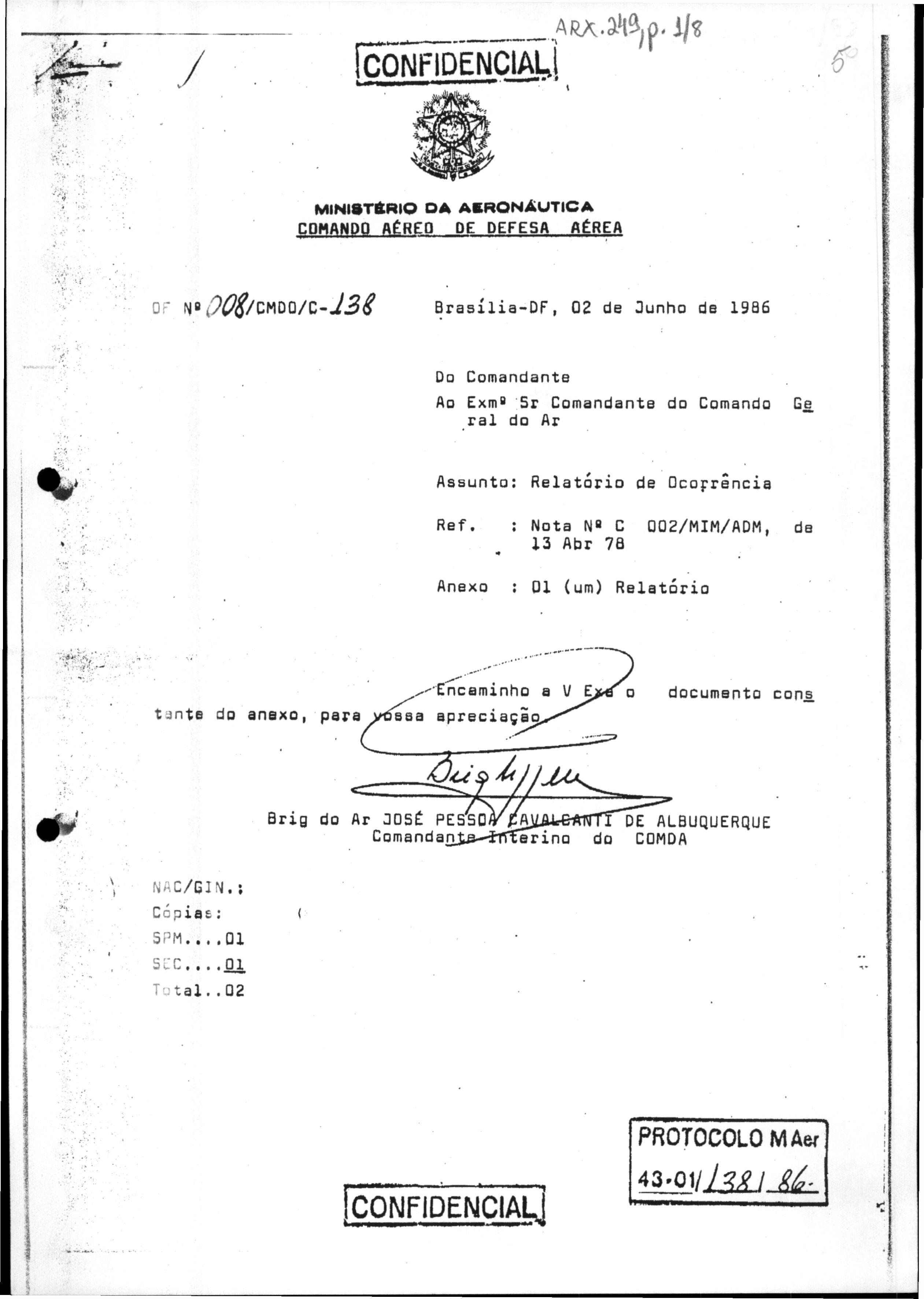
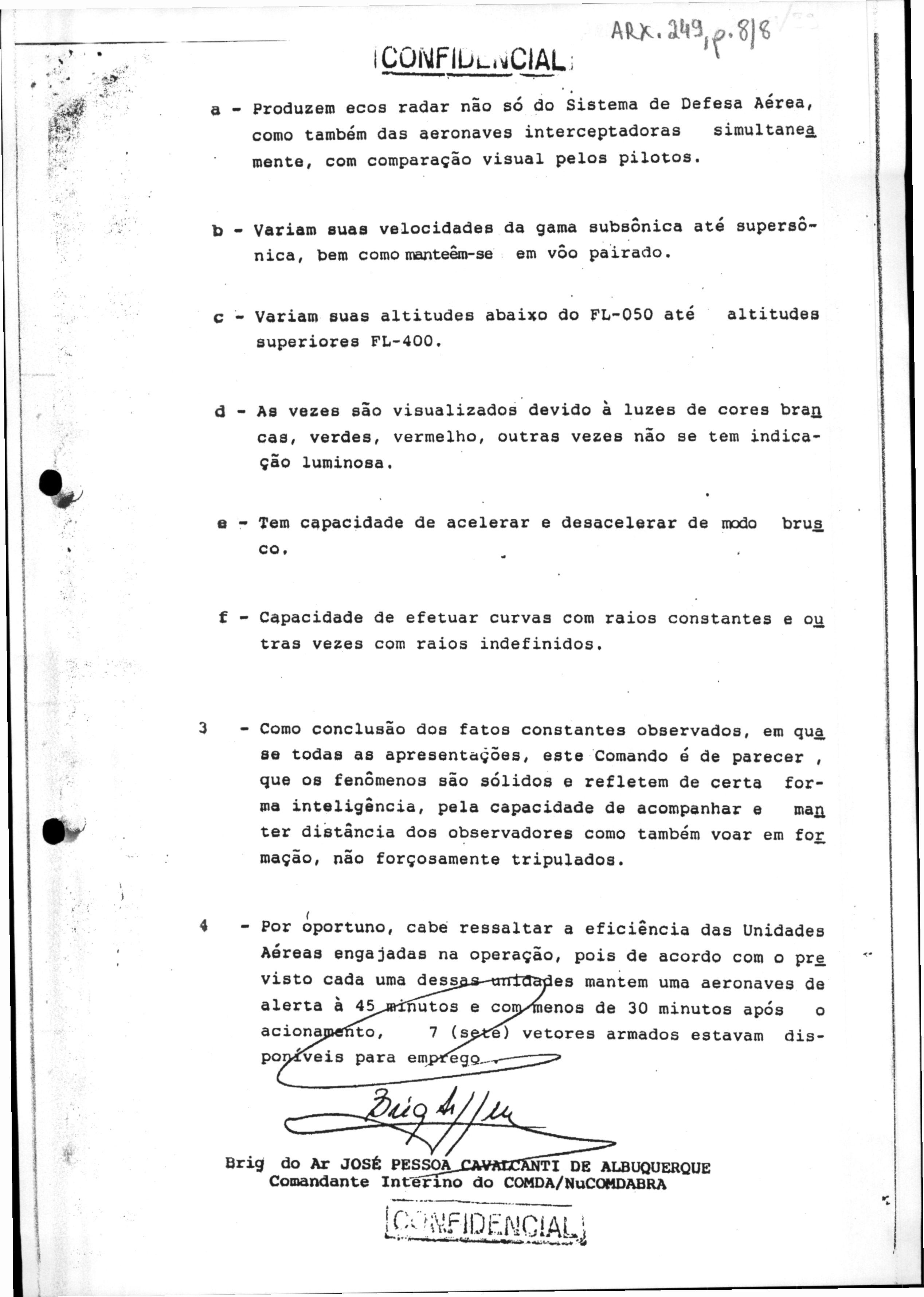
He promised a dossier within thirty days. On 2 June, in Brasília, an eight-page "Occurrence Report" was signed, stamped CONFIDENCIAL, by Air Brigadier José Pessoa Cavalcanti de Albuquerque, acting commander of COMDA. The report says plainly that it will confine itself to "a simple narration of the facts," without speculation that would involve the ministry.
In its "final considerations" the command lists recurring features, from the controllers, the pilots and CINDACTA I reports: radar echoes not only on the air-defence system but on the interceptors' own radars, with a visual comparison by some of the pilots; speed from subsonic to supersonic, and also hovering flight; altitude from below 5,000 feet to above 40,000 feet; sometimes white, green or red lights, and sometimes no light; abrupt acceleration and deceleration; turns of constant radius, and sometimes of undefined radius.
Then the concluding sentence, as it stands in the original:
"Como conclusão dos fatos constantes observados, em quase todas as apresentações, este Comando é de parecer, que os fenômenos são sólidos e refletem de certa forma inteligência, pela capacidade de acompanhar e manter distância dos observadores como também voar em formação, não forçosamente tripulados."
"As a conclusion from the recurring facts observed, in almost all of the intercept runs, this Command is of the opinion that the phenomena are solid and in a certain way reflect intelligence, by their capacity to accompany and keep distance from the observers as well as to fly in formation, not necessarily manned."
This is a command opinion, not a scientific identification, and not a claim of origin outside the Earth. It is also not an explanation. It says what the command thought it had seen on radar and with the eye.
The report itself remained classified for years. According to G1 it was released to the public on 25 September 2009, when the UFO files were transferred to the National Archives. It is there today, in fonds BR DFANBSB ARX, file 0249, in 300-dpi greyscale scans.
Declassification in Brazil's National Archives (2004–2015)
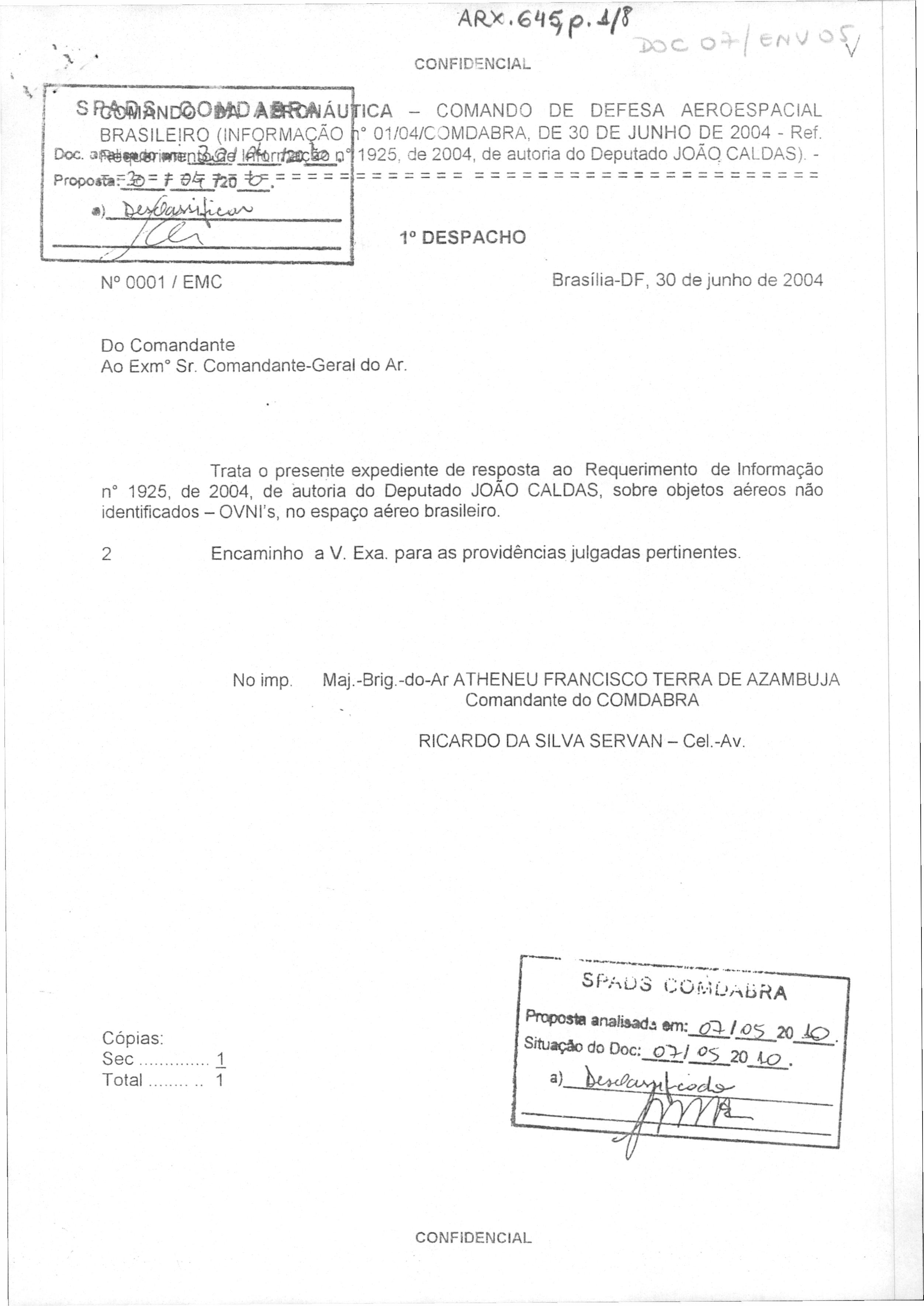
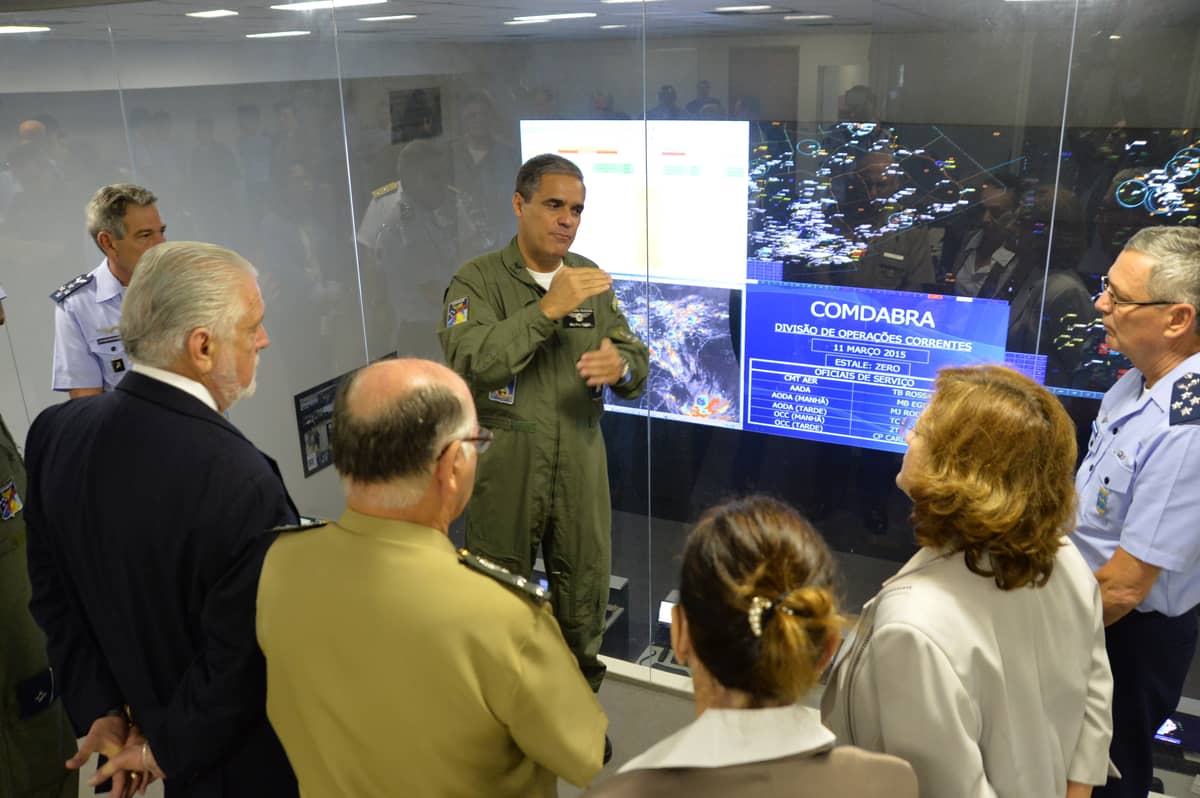
On 30 June 2004 the commander of COMDABRA, Major-Brigadier Atheneu Francisco Terra de Azambuja, answered an information request from Deputy João Caldas. The events of 19 May 1986, he wrote, were the occurrence in Brazilian airspace "that most closely resembles a UFO overflight of Mexico." The file includes statements by the pilots and controllers and press cuttings. Moreira Lima, the letter says, ordered that what had been established be made public, and those involved were told they could describe what they had lived through. At the same time, in a general paragraph on Air Force UFO inquiries:
"a documentação existente, classificada como confidencial / secreto, não apresenta pareceres conclusivos a respeito da existência ou não desse tipo de objeto."
The classified material "does not present conclusive opinions" as to whether such objects exist or not. This does not cancel the 1986 sentence, but it is a later institutional qualification, and it has to be stated.
Brigadier José Carlos Pereira, who commanded COMDABRA from 1999 to 2001, was one of the senior officers who pushed for the files to be opened. In a 2008 interview with Revista UFO he said there was no reason to keep them secret: release "does not expose Brazil to war, does not cause public panic, and does not harm national security." In later remarks after retirement he said the classified documents had been transferred in full to the National Archives, and that "there is no material proof, neither here nor anywhere in the world, unless one counts photographs and films as material proof, which is highly debatable." He did not claim that the night of 1986 had been solved.
In 2013 the Brazilian Commission of Ufologists, CBU, met the Ministry of Defence. G1 reported that April that further documents, including the files of Operation Saucer from 1977 in Pará, would be opened in June. Later sessions in Congress, including a commemorative sitting of the Senate in 2022, returned to the question of openness, but the documented event of 2013 is the meeting at the Defence Ministry. Operation Saucer, which we have already written about here, is a different file: the 1970s, the Amazon, other nights. The connection is institutional, not operational: the same air force, the same archive, and the same argument about what pilots and controllers saw. Another official interceptor-and-radar file, Tehran 1976, has already been published here.
In October 2015 the National Archives released sixteen recordings from the UFO fonds, including controller–pilot traffic from that night (among them BR DFANBSB ARX 0 0 0692 and 0694). I have not re-transcribed them here. They exist, and they are the missing part of the written file.
Conventional explanations tested: Venus, the Moon, and Arcturus
In the days after the press conference, Brazilian scientists and commentators offered a set of explanations. I checked them against the report, and against the sky at those hours.
Venus, or the star Arcturus. One astronomer told the press that the São Paulo case was "clearly a star, probably Arcturus," and that the Rio case was Venus. I computed the position over São José dos Campos. At 23:15 UTC, the first time in the report, Venus was already below the horizon, at an altitude of minus 11.5 degrees. At the first takeoff, 01:34 UTC, it was more than 40 degrees below the horizon. It cannot have been the light the Santa Cruz pilot saw below him and then above him, and it cannot have been the target locked on his airborne radar. Arcturus was above the horizon, in the north, at a reasonable altitude. A star does not produce a radar echo, does not change colour as described, and does not pull away from a supersonic interceptor.
A full moon, and a reflection off the aircraft. The physicist Paulo Marques told the press it "was a night of full moon," that the light had reflected off the airframe, and that the radars had picked up meteors. The full moon was on 23 May 1986, at 20:44 UTC — the day of the press conference, not the night of the events. On the night of 19 May the moon was a waxing gibbous, about 80 percent illuminated, and high in the sky (about 66 degrees at the first report, about 54 degrees at the first takeoff). That is a bright moon, which can confuse a glance. It does not explain an airborne-radar contact at 10 to 12 miles, or five lock-on runs at Anápolis. The claim that "it was a full-moon night" is also inaccurate.
Meteors, or debris from Halley's path. Halley had passed in March 1986, and the explanation appeared at once. A meteor falls. It does not hover, it does not climb from FL 170 to FL 330, and it does not stay on an airborne radar through intercept runs.
Instrument failure, or anomalous radar propagation. The report itself says the ground contacts were sometimes weak and unstable, and that some returns did not appear on every scope at once. That is a possible explanation for some of the ground-radar contacts, especially the thirteen plots behind the second Santa Cruz jet, which vanished when the pilot turned and found nothing. It is harder to apply to the doubled contact, visual and airborne radar, on the first Santa Cruz jet, and to five airborne-radar runs at Anápolis.
Electronic countermeasures, flares, a reconnaissance craft. This was the most common "earthly" hypothesis in 1986: the United States or the Soviet Union testing Brazilian radars. Chaff falls and leaves a familiar pattern. Decoy flares descend. An unmanned aircraft of that period was limited in range and endurance, and would have needed a base or a carrier. According to later coverage, one of the pilots asked for a check on whether a foreign carrier was off the coast; none was found. The Air Force did not adopt this explanation in the report.
Ball lightning or an electrical phenomenon. This too was offered, without a test against the data. Ball lightning does not last for hours across two widely separated regions, and does not behave like an airborne-radar target through repeated runs.
None of these explanations became an official finding. COMDA's opinion is not an identification either. The 2004 letter leaves the question without a "parecer conclusivo." On the 40th anniversary, 19 May 2026, G1 again wrote that the case remains without a conclusive official explanation. That is still the position.
Similar nights, in other files
Tehran, 1976: interceptor pilots again, instrument problems as they closed, and radar.
The light over Tokyo Bay: Haneda tower, an F-94 and a target that left the radar.
Two jets, one light and a radar scope: the Rapid City chase of August 1953.
Guam 1956 F-86D UFO Chase: Air Force Report IR-7-57.
Radar sent Cecconi toward a black target. 82 frames returned to base.
What we think
On the night of 19 May 1986 the controllers confirmed radar contacts, five interceptors were scrambled, one pilot recorded a visual and an airborne-radar lock together, and a second completed five radar runs in to two miles — including against a jet that was already supersonic. The Minister of Aeronautics said there was no explanation. On 2 June the command signed a report concluding that the phenomena were solid and in a certain way reflected intelligence, not necessarily manned. Venus was already below the horizon, and the moon was not full. That is the military record, as it was written and signed.
The pages are scanned. The tapes were deposited in the National Archives.
Frequently asked questions
What was the Official Night of the UFOs in Brazil 1986?
On the night of 19 May 1986 the tower operator at São José dos Campos saw colour-changing lights, and São Paulo approach confirmed radar contacts. The Brazilian Air Force scrambled five interceptors, and the Minister of Aeronautics later said there was no explanation.
How many fighter jets were scrambled?
Five: two from Santa Cruz and three from Anápolis. Later sources identify them as two F-5Es and three Mirage F-103s. The official report itself does not name the aircraft types.
What did the Brazilian Air Force report conclude?
The COMDA report signed on 2 June 1986 stated that the command was of the opinion that the phenomena were solid and in a certain way reflected intelligence, by their capacity to accompany and keep distance from the observers as well as to fly in formation, not necessarily manned.
Did Venus or the Moon explain the sightings?
No. At the time of the first report Venus was already below the horizon, and at the first takeoff it was more than 40 degrees below the horizon. The moon that night was a waxing gibbous, not full, and it does not explain an airborne-radar lock or five intercept runs.
Sources and image credits
Found another source or a detail to correct? Let us know.
