Yacanto 1960: Niotti’s photograph and its archival trail
A dark conical form in a roadside photograph became an enduring Argentine case. The officer’s account sits alongside a quoted examination and questions about successive generations of copies.
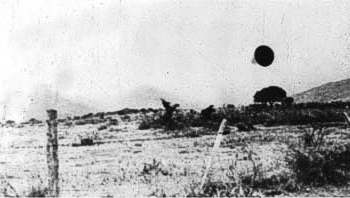
A dark conical form in a roadside photograph became an enduring Argentine case. The officer’s account sits alongside a quoted examination and questions about successive generations of copies.
The sources distinguish records, testimony and explanations.
A stop on the road to Córdoba
On 3 July 1960, Hugo Luis Niotti said he noticed an object beside the road while travelling from Yacanto towards Córdoba. In the account reproduced by CEFORA, he stopped to photograph it before it disappeared into low cloud. Niotti was an Argentine Air Force officer. The image shows a dark conical form alongside the landscape, fence and an animal in the foreground.
What the quoted examination says
CEFORA reproduces an assessment attributed to aviation information-service photographic technicians: processing was described as normal, and the image was said to record an object potentially consistent with Niotti’s account. That is narrower than military confirmation of a spacecraft. The quoted suggestion about the dark base likewise does not constitute a measurement establishing an extraterrestrial source.
The copy belongs to the investigation
In a 2013 review, Vicente-Juan Ballester Olmos describes efforts to locate a suitable copy for analysis. He discusses differences among prints and their provenance, including a misleading stamp on one copy attributed to Project Blue Book. That criticism concerns the chain of copies; it does not establish that every image of the case is fabricated. It shows why an online reproduction cannot automatically be treated as a direct scan of the original negative.
What this reproduction can show
The image here is CEFORA’s limited-resolution reproduction. It allows readers to examine the composition, not to make precise physical measurements. A still photograph also cannot record acceleration: the motion claim comes from the witness account. Yacanto rewards attention because both the image and its archival history can be discussed. Each supports a different kind of question.