


Jerry Cohen’s UFO archive: intelligence aircraft, police officers and military files
An intelligence aircraft crew, a Coast Guard cutter, Ohio police officers and documents from Brazil. Cohen’s website preserved the cases that caught his attention, along with correspondence, images and years of corrections.
Avi Moas, Researcher and Editor-in-Chief · Produced with an AI-assisted newsroom

An old case returned on television
In March 2009, Jerry Cohen watched a television program about physicist James McDonald’s UFO files. One case, an encounter reported by an intelligence aircraft crew in 1957, sounded familiar. Researcher Brad Sparks had written to him about it years earlier, when Cohen was absorbed in other material. Now he returned to the case, added it to his website and told readers why it had moved up his list.
That was how the collection at CohenUFO.org took shape: case pages, preserved articles, photographs, correspondence and accumulating annotations. Cohen connected an aircraft crew’s report with an account from a Coast Guard cutter, a police pursuit and documents obtained after a legal struggle. His selected cases page, updated in April 2010, lets readers follow those choices and see what held his attention.
The lights above his neighbors’ homes
Cohen had an account of his own. In 1967, he recalled, he stepped outside to take out the rubbish before a celebratory dinner with his wife. She had passed a teaching examination and they were preparing to go out. He noticed an object with rotating lights, initially took it for an aircraft, then realized that he could hear almost nothing.
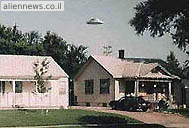
His account describes hovering above two or three neighboring houses, movement resembling a falling leaf and an extremely faint sound. He estimated that the encounter lasted three to five minutes and called his wife outside. Cohen, who described himself as a musician and teacher, emphasized his effort to listen. The couple did not own a camera. The small picture he placed on the page is an illustration, and he explained that the house shown was not his.
In his case index, Cohen linked to this experience as his reason for creating the website. It also helps explain his personal presence throughout the collection. He was looking for accounts that might help him understand his own memory, repeatedly returning to reports involving lights, movement and near silence.
The control tower and the cutter
Two adjacent entries return to November 1957. The first concerns Kirtland Air Force Base, New Mexico, on 4 November. Cohen directed readers to material from Project Blue Book, the US Air Force’s program for examining UFO reports, the later Condon study and McDonald’s analysis. He emphasized that McDonald had located control tower witnesses and strongly disputed the Condon analysis.
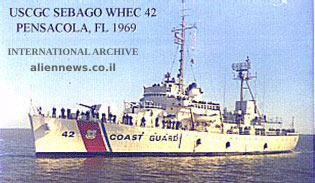
The Coast Guard cutter Sebago appears under the following day’s date. Cohen placed its case beside Kirtland and linked to his response concerning a crew member’s 2003 letter. He also described an unexpected personal connection: according to Cohen, his neighbor had been dating one of the crew members at the time of the sighting.
The timing interested him. After discussing the cases with researcher Jan Aldrich, he wrote that they had occurred only hours apart. The index preserved both the references to the investigators and this later annotation. Its accompanying photograph of Sebago dates to 1969, years after the reported encounter, and shows the vessel on which the witnesses served.
The Portage officers and the investigator who returned to the files
Further down the index is Portage County, Ohio, dated 17 April 1966. Cohen pointed readers to the police officers’ case and a speech McDonald delivered at Kent in 1968. He was particularly interested in how the physicist compared the civilian UFO research organization NICAP’s files, witness interviews and the Air Force’s explanations.
Cohen’s comments are forceful. He objected to dismissing the officers’ identification abilities and asked what they stood to gain from a false story. This is the collection’s editor speaking; the investigations and speech he cited were other people’s work. The distinction recurs across his website. Sometimes he reproduces a researcher’s text, then immediately steps in to explain why he found it persuasive or rejected a proposed explanation.
An aircraft listening for radar signals
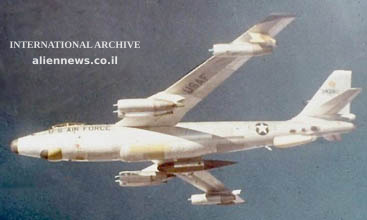
The RB 47 intelligence aircraft case, which Cohen revisited in 2009, illustrates his interest in encounters involving both witnesses and instruments. His page dates the flight to 17 July 1957. Aboard were two pilots, a navigator and three operators of electronic listening equipment. Their equipment received and analyzed radar transmissions without sending a signal towards a target.
According to Cohen’s summary, an operator detected an unusual signal near Gulfport, Mississippi. Suspecting a malfunction, the crew checked another system and antenna. Later, the pilots saw a rapidly approaching light cross their flight path and disappear from view. The equipment operators then detected a signal in the direction where the light had been seen. Cohen also described contact with a ground radar station at Duncanville and the crew’s attempts to change speed and turn towards the object.
He concentrated on the sequence: what the pilots saw, what the operators detected, and when the indications appeared or disappeared on each system. He referred readers to work by McDonald and Sparks and their disagreement with researcher Philip Klass. Cohen explicitly presented his belief that the data indicated an unusually advanced craft as his own assessment.
The newspaper article that kept its corrections
On another page, Cohen preserved an article published in Newsday on 19 January 1979 as a reprint of a Washington Post report. It concerned sightings near bases and missile sites in the northern United States during the autumn of 1975, and documents obtained through freedom of information requests.
One account concerned Wurtsmith Air Force Base, Michigan, on the nights of 30 and 31 October. The newspaper report, drawing on documents, described an unidentified helicopter moving around the base and hovering above weapons storage bunkers. It said that subsequent enquiries had found no known local military, commercial or private helicopter that could account for those appearances. Loring in Maine and Malmstrom in Montana also featured in the article.
After Cohen posted the material, Sparks sent him a series of corrections. Cohen retained the article, numbered its paragraphs and placed the annotations alongside it. Among other points, Sparks explained that the almost 900 pages mentioned in the article were CIA documents, not Air Force and air defense command records. He also corrected the account of which organizations and researchers had done the work to obtain the material. The original coverage and the later effort to correct it survived together.
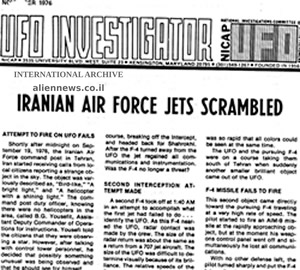
The Tehran aerial encounter also entered this discussion. Cohen wrote that he had kept a NICAP newsletter article since November 1976. It concerned fighter jets scrambled during the night of 19 September and reported failures in their systems as they approached a bright object. He said that later coverage of the released documents renewed his interest in the case. The clipping preserved in the collection shows the newsletter’s masthead and the report about the scrambled jets: the coverage that reached readers just weeks after the event.
The researchers’ visit to the Brazilian Air Force
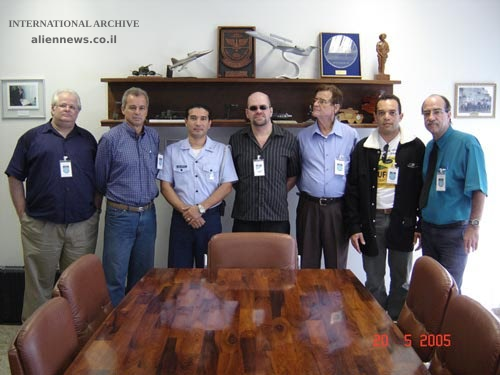
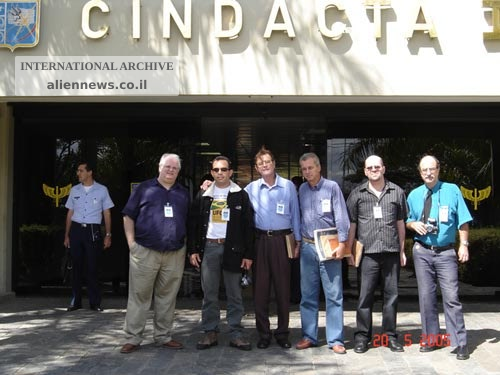
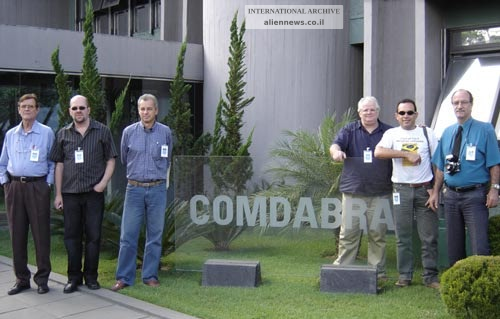
The collection also reached Brazil. Cohen preserved a report by A. J. Gevaerd, editor of the Brazilian UFO Magazine, about a researchers’ visit to Air Force facilities in Brasília on 20 May 2005. Gevaerd was among the visitors. The accompanying photographs show the delegation at the facilities and meetings, while his text describes what they were allowed to examine.
According to Gevaerd, the researchers first visited an integrated air defense and air traffic control center, then the Brazilian Air Defense Command. There they examined three groups of material: a pursuit report from 1954, files from Operation Prato in the Amazon in 1977, and records concerning aerial encounters over Brazil in May 1986. Gevaerd wrote that the 1977 material included more than a hundred photographs.
Alongside his enthusiasm, he recorded an important practical detail. After a certain point in the visit, the researchers were not allowed to film, record, transcribe or copy the material. The text preserved by Cohen is therefore a participant’s account of access to the files and the campaign to open them. The delegation photographs on the page document the visit; they are distinct from the military photographs Gevaerd describes.
Staying with a case after the headline
Cohen also preserved reports by research organizations, including the National Institute for Discovery Science, or NIDS, which investigated accounts of triangular objects. His index points to assessments published in different years and reflects his interest in changes to the explanations researchers proposed.
One account preserved in the institute’s August 2004 report concerns Port Washington, Wisconsin, in 1998. Our separate article follows the witness’s description and presents three views of a reconstruction she created with her husband. We also have a separate article on the O’Hare airport report, another case Cohen repeatedly highlighted in his index.
Across these pages, traces of the work remain visible: a letter that corrected a number, a conversation that prompted a comparison of dates, and a television program that brought Cohen back to a case he had set aside. He let readers see the sources that occupied him, the people who wrote to him and the places where he changed his text.
Found another source or a detail to correct? Let us know.
