


Shklovsky calculated Phobos’s orbit and proposed a hollow moon
In the 1950s, Iosif Shklovsky calculated changes in Phobos’s orbit and proposed that the Martian moon might be hollow or artificial. What led him to the idea, and how did later measurements change the account?
Avi Moas, Researcher and Editor-in-Chief · Produced with an AI-assisted newsroom
Research, hypotheses and ideas at the boundaries of knowledge.
An orbit shrinking too quickly
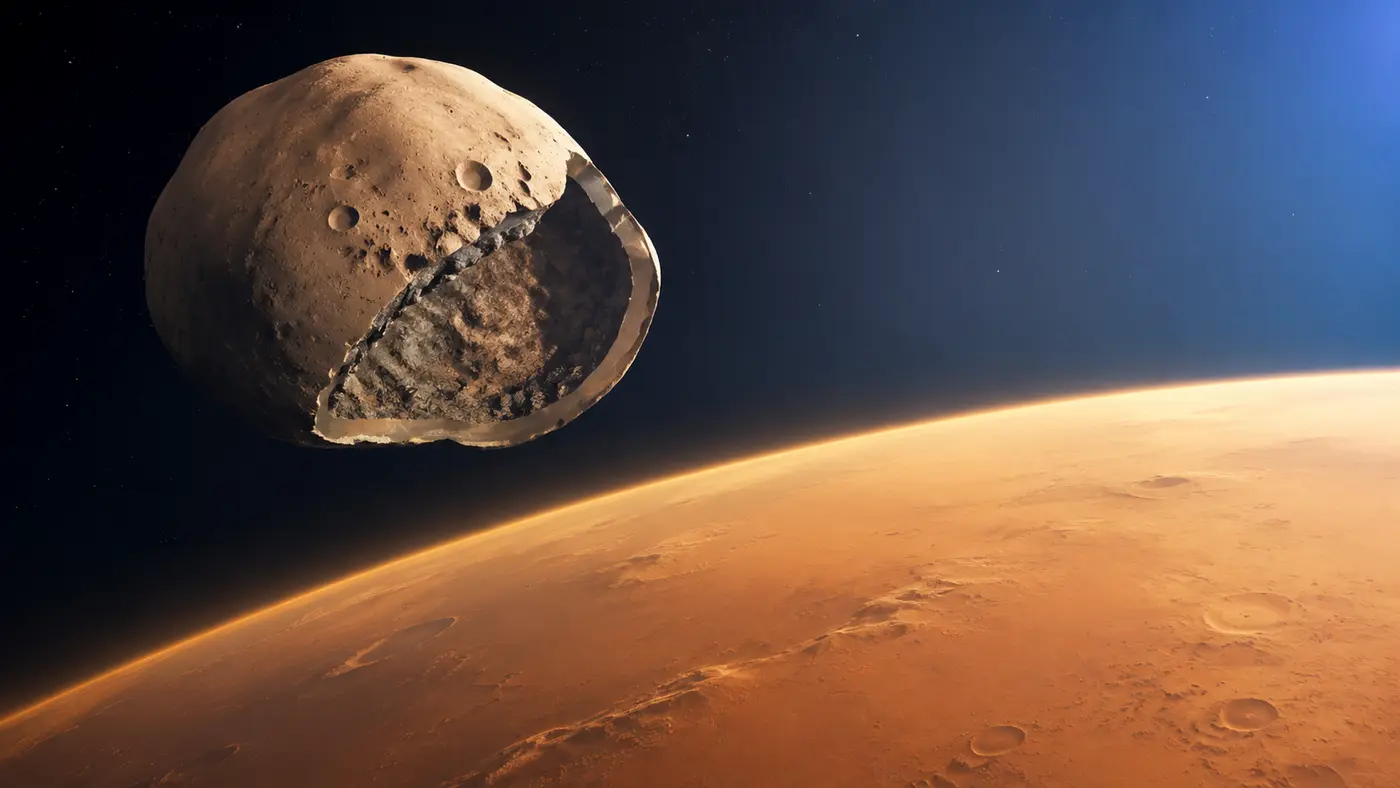
A calculation of the change in Phobos's orbit led Iosif Shklovsky to propose that the Martian moon might be hollow. The hypothesis arose from early orbital data, not from a photograph revealing a cavity inside the moon.
A thin shell around emptiness
Shklovsky proposed an extremely light body resembling a hollow metal shell, perhaps an artificial satellite built by an ancient civilization. In 1960, Fred Singer wrote that if the orbital decay data were correct, a hollow structure was difficult to avoid. He emphasized that the argument depended on the measurements; errors could change the conclusion.
What spacecraft found
Spacecraft revealed a dark body covered in craters and long grooves. Mass and volume measurements indicate low density and substantial porosity, perhaps a quarter to a third of its volume, but not a thin metal shell. Modern data describe a natural body containing voids and fractures, often compared to a rubble pile held together by gravity.
What later measurements changed
Improved measurements changed the explanation for Phobos's density and orbital decay. The moon is gradually approaching Mars and is expected eventually to break apart. Orbital measurements continue to provide information about the voids within its structure.
Shklovsky's proposal followed an apparently rapid orbital decay and an atmospheric-drag calculation in the late 1950s.
Improved orbital and density measurements no longer require a thin artificial shell; modern data indicate a porous natural body.
