


Three nights changed the dust cloud near the Moon
From Namibia, researchers followed polarized light in a dust cloud near the Moon’s orbit and found changes across three nights. What did they measure, and what would be needed to connect these clouds to a separate idea about lifelike matter in plasma?
By Avi Moas ·
Avi Moas, Researcher and Editor-in-Chief · Produced with an AI-assisted newsroom
Ideas and hypotheses, not a verified news report.
Updated:
Returning to the cloud
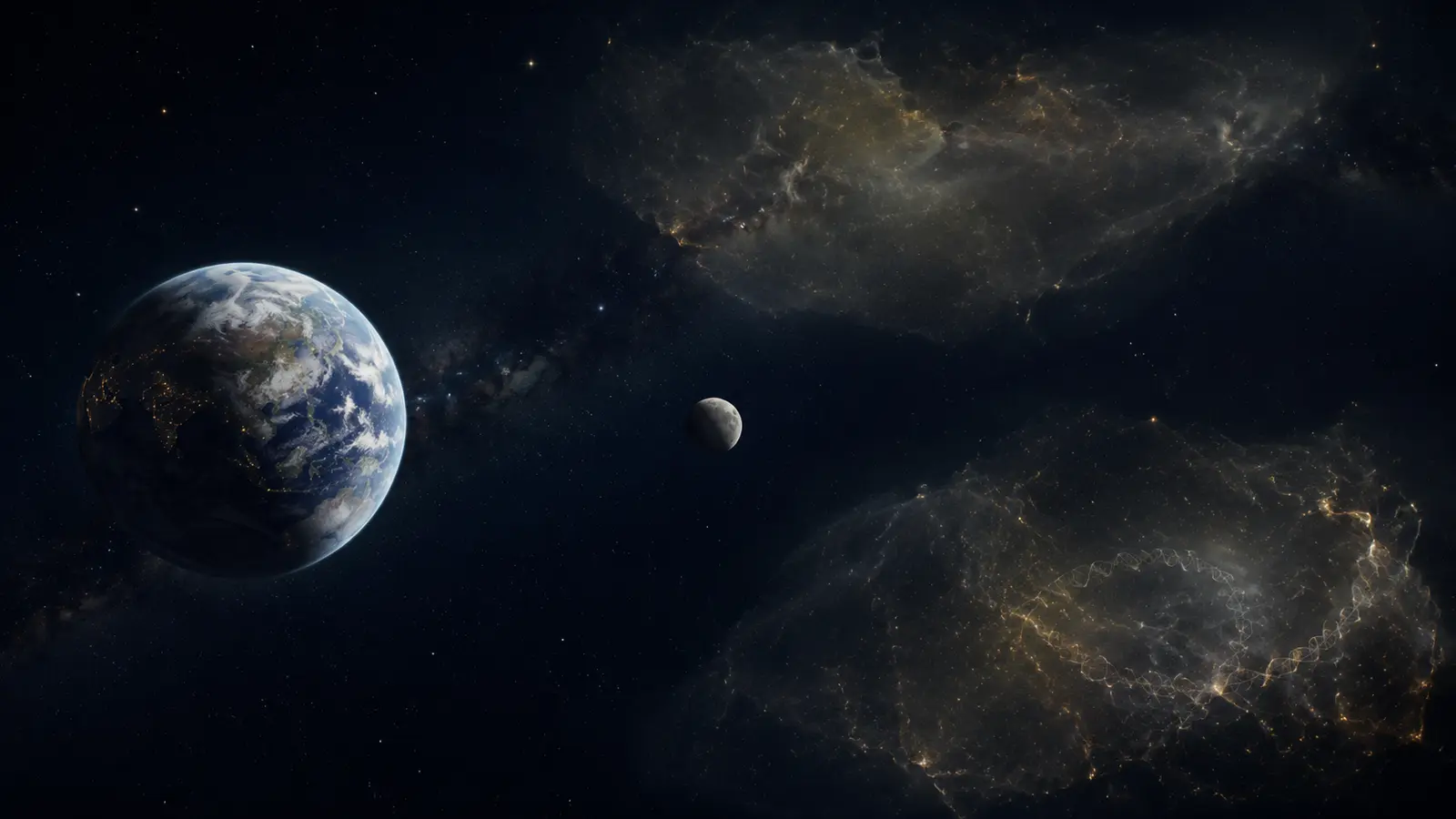
For three consecutive nights in July 2024, researchers in Namibia aimed a polarimetric telescope towards a dust cloud accompanying the Earth and Moon system. Its patterns changed from night to night. The instrument measured scattered light; suggestions about lifelike matter come from a different study.
Published in July 2026, the paper describes three days of change in the cloud near L4. It is a Kordylewski cloud, named after Kazimierz Kordylewski, who reported faint patches in the 1950s and photographed them in 1961. Material spread across a large area of sky while returning very little light is easy to miss.
For decades, some observers found it and others obtained no detection. Japan’s Hiten spacecraft also failed to measure a clear increase in dust in the region in the early 1990s. The disagreement concerns both observing conditions and how long the dust itself remains nearby.
Somewhere to gather
The Earth and Moon system has two Lagrange points, L4 and L5, where a small body can maintain a particular position relative to the larger pair. They form approximately equilateral triangles with Earth and the Moon, about 60 degrees ahead of and behind the Moon along its orbit.
They are stable in a simplified model. In the real system, solar gravity and radiation pressure also act on the particles. Some dust grains remain trapped for a time while others escape. A cloud could persist as its constituent material changes, like a whirlpool retaining its shape while water passes through it.
A single photograph is therefore a limited test. If the structure changes, a negative observation at one time need not contradict a detection at another. Repeated measurements need to use comparable methods and take account of sky conditions.
The orientation of light
Judit Slíz Balogh, András Barta and Gábor Horváth sought another signature beyond brightness. Sunlight scattered by dust can acquire a preferred polarization direction. Filters rotating before a camera allow that orientation to be measured and compared with patterns expected from scattering particles.
The team published a simulation study of L5 cloud stability in 2018. The observational paper appeared online that year and in the astronomy journal’s volume 482 in 2019. Its polarization pattern strengthened the case for dust scattering sunlight.
During summer 2023, the researchers operated a portable telescope at Isabis in Namibia for four weeks. Their 2024 paper described an uneven L5 cloud extending at least 15 by 15 degrees across the sky. The full Moon spans roughly half a degree. The apparent area is large, but its light is faint.
The next campaign measured L4. The 2026 paper presents observations from 5, 6 and 7 July 2024, showing changes in particle concentrations and polarization patterns. These publications involve overlapping researchers, so each paper should not be presented as confirmation by a new independent team.
The spiral belongs to another study
Plasma is a gas in which some atoms have lost electrons. When charged dust grains are also present, electrical forces can organise them into structures. In 2007, Vadim Tsytovich, Gregor Morfill and colleagues examined helical structures in complex plasma and proposed that, under certain conditions, they might display properties resembling living matter.
Their model considered preservation of structural features, formation of copies and competition for available material. The question concerned organization in matter outside familiar biology. The study did not examine Kordylewski clouds.
That is the distance between the two lines of work. A polarimetric telescope measures light scattered by dust. It does not measure grain charge, electron density or the fields required for the model’s organization. The observations supply no evidence that these clouds constitute such a system, or contain life or consciousness. Connecting them is a hypothesis discussed here in the ideas section.
What to bring back from the cloud
A persistent shape is insufficient to define life. Flames grow, crystals repeat structures and whirlpools retain a form. Testing the proposal for lifelike matter would require a mechanism that preserves information, transfers it to copies and allows change and selection over time.
For the clouds near the Moon, measurements of the material come first. As a proposed test, a spacecraft crossing could count grains and measure mass and charge alongside electrons, ions and fields. A polarimetric camera in space could track structure without atmospheric interference.
Those data would allow conditions in the cloud to be compared with the requirements of the plasma paper. For now, three nights already suggest a specific observational target: return to the same region and discover which parts of the pattern recur, and which disappear with the dust.
Editorial clarification ·
On 10 September, the observations ceased to be described as independent confirmations because the publications involve overlapping researchers. On 14 September, the volume dates were clarified using the references in the 2026 paper: the simulation appeared in volume 480 in 2018, and the observation in volume 482 in 2019. Both were available online in 2018.