


SETI Listens at the Anti-Solar Point: 1.9 Million Signals, All From Earth
In the summer of 2023 the Allen Telescope Array, at Hat Creek Radio Observatory in Northern California, was pointed at the place in the sky that sits directly opposite the Sun. The idea is simple, and it comes from game theory: if another civilization can see Earth passing in front of the Sun, that is the natural moment, and the natural direction, in which to transmit. Over three nights the array recorded about 1.9 million radio signals. After filtering, all of them were radio interference from Earth. The search itself did not stop. It now runs two to three nights a week, and covering the full orbit will take about four years.

By Avi Moas
Sources and editorial method
Avi Moas, Researcher and Editor-in-Chief · Produced with an AI-assisted newsroom
Where to listen, and when
A search for someone else's technology in the sky always runs into the same problem. It is not enough to know where to point the telescope. You also have to guess when the other side would transmit, if it transmits at all.
On 3 November 2026, researchers at the SETI Institute published the design of a new survey, and the results of its pilot, in The Astronomical Journal. The lead author is Dr. Sofia Z. Sheikh, a research scientist at the SETI Institute and the Berkeley SETI Research Center. She is joined by Eleanor Hort of the University of New Mexico, and by colleagues at the SETI Institute, Oxford, Berkeley and partner institutions. The Institute's news release went out the same day, under the headline “When Should We Listen for Alien Signals?”
What they are testing is not a particular star. They are following a moving point in the sky: the anti-solar point, the point that lies directly opposite the Sun. At the moment when Earth is at the midpoint of its transit across the Sun, as seen from far away, a possible transmitter would sit, from our point of view, in the direction opposite the Sun.
A meeting point with no prior arrangement
In game theory this is a Schelling point: a choice two sides can make on their own, without talking to each other, because it stands out to both of them. The classic example from the economist Thomas Schelling is two people who have to meet in New York without agreeing on a place or a time, and both go to Grand Central at noon.
Here the geometry of the solar system plays that role. From certain places in the galaxy, an observer could see Earth passing across the face of the Sun. A transit would reveal not only that a planet is here, but that it orbits in the zone where water can be liquid. At the midpoint of that transit, Earth stands between the Sun and the distant observer. From Earth, at that same moment, the observer's direction is the anti-solar point.
The paper does not assume that such a civilization exists, and it does not assume that it would choose this method. It gives the researchers something they can test: a clear place and a clear time to listen. The idea itself has been in the scientific literature for decades. What is new is the observation. According to the team, until this survey the observational coverage of that point was essentially zero.
“The challenge in SETI isn’t simply deciding where to point a telescope,” Sheikh said in the Institute's release. “It’s figuring out where and when another civilization might choose to transmit. The anti-solar point gives us a way to think about that problem from the perspective of a potential sender, rather than just the receiver.”
Three nights, 1.9 million signals
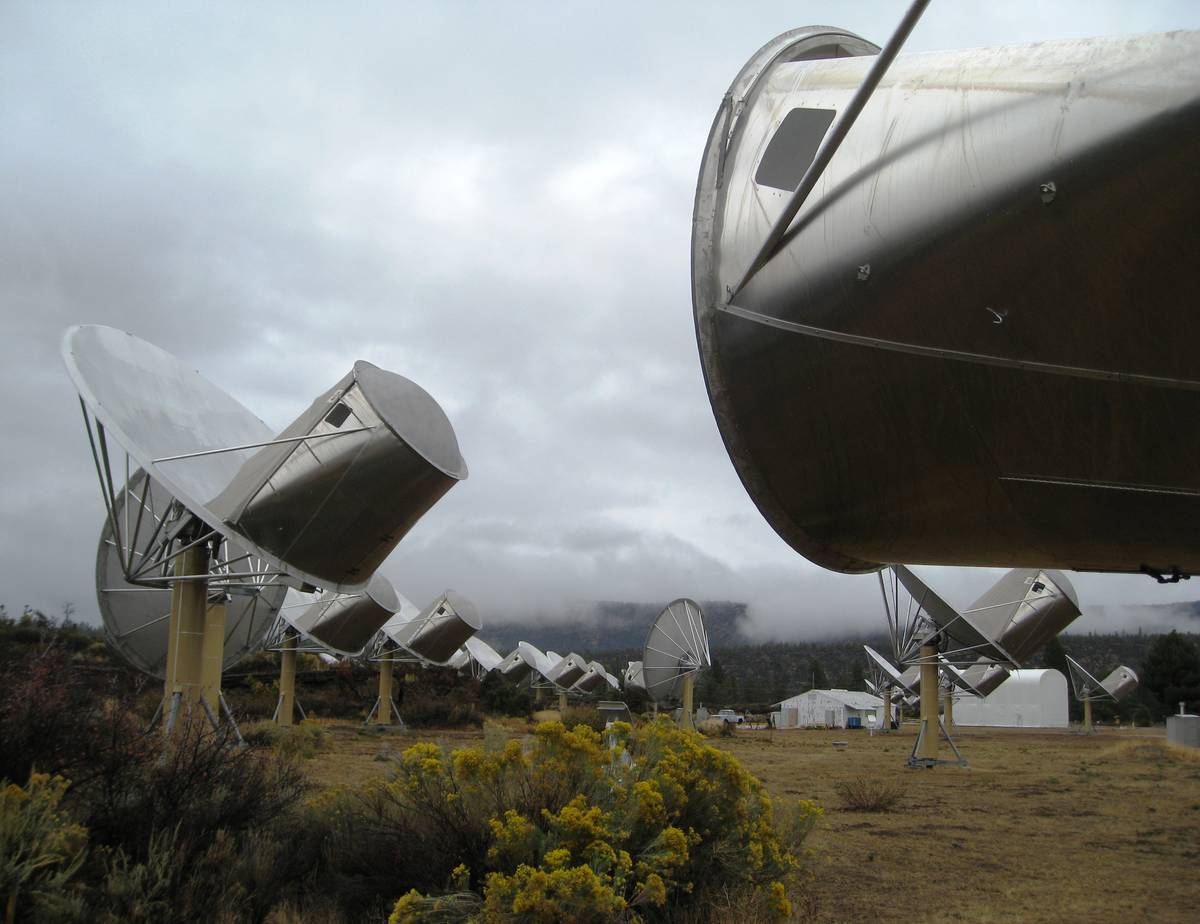
The pilot ran in the summer of 2023, with 20 antennas of the array. Over three nights the team collected about 17 hours of observations, 32 terabytes of data, in the frequency range 1,064 to 2,378 megahertz. The turboSETI software flagged 1.9 million narrowband radio signals, what the paper calls “hits.”
Most were discarded at once: about 1.3 million appeared as exact matches in two directions on the sky at the same time, a sign of local interference rather than a distant source at the point itself. That left about 580,000. From those, the team produced plots of the 500 signals with the lowest scores on each night, 1,500 in all, and inspected them by eye. In a second pass they inspected another 614 signals that cleared an extra beam-ratio threshold.
After that inspection, no signal matched extraterrestrial technology. All of the detections were explained as radio interference from human sources: satellites, communications systems, transmissions from the ground. The paper states it directly: no narrowband technosignatures were found in the right-ascension range 20.266 to 21.312 hours, above a flux-density threshold of 115 to 936 janskys, at these frequencies.
That does not mean the sky is empty. It means that in this patch of sky, on these nights, at these frequencies, and at the sensitivity of the pilot, there was no transmitter there. By the paper's calculation, a transmitter comparable in power to the former Arecibo planetary radar could, under certain assumptions, have been detected at a distance of 44 to 124 light-years. The SETI release cited the upper end: up to about 124 light-years.
The telescope at Hat Creek
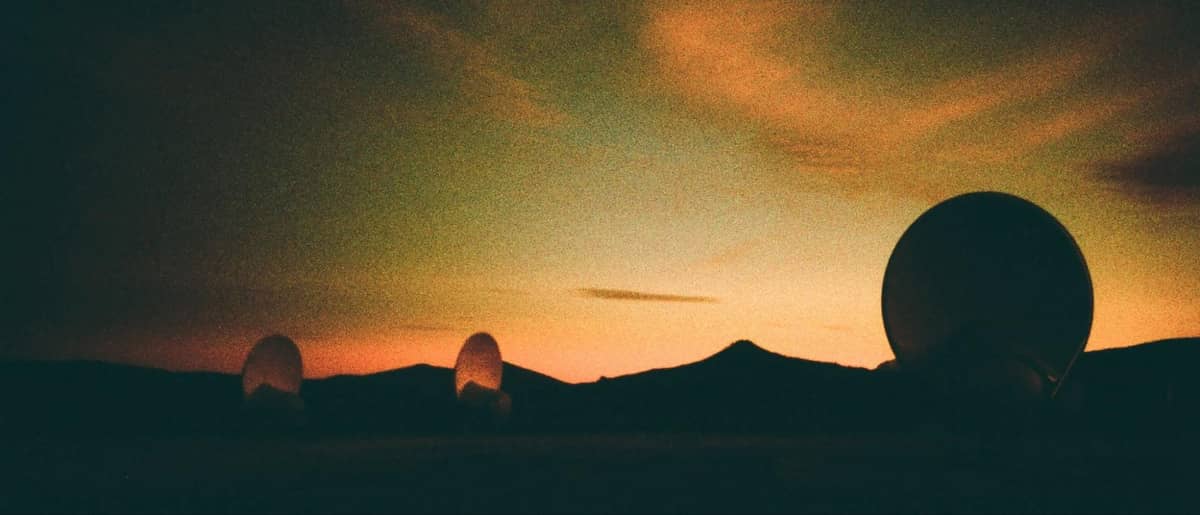
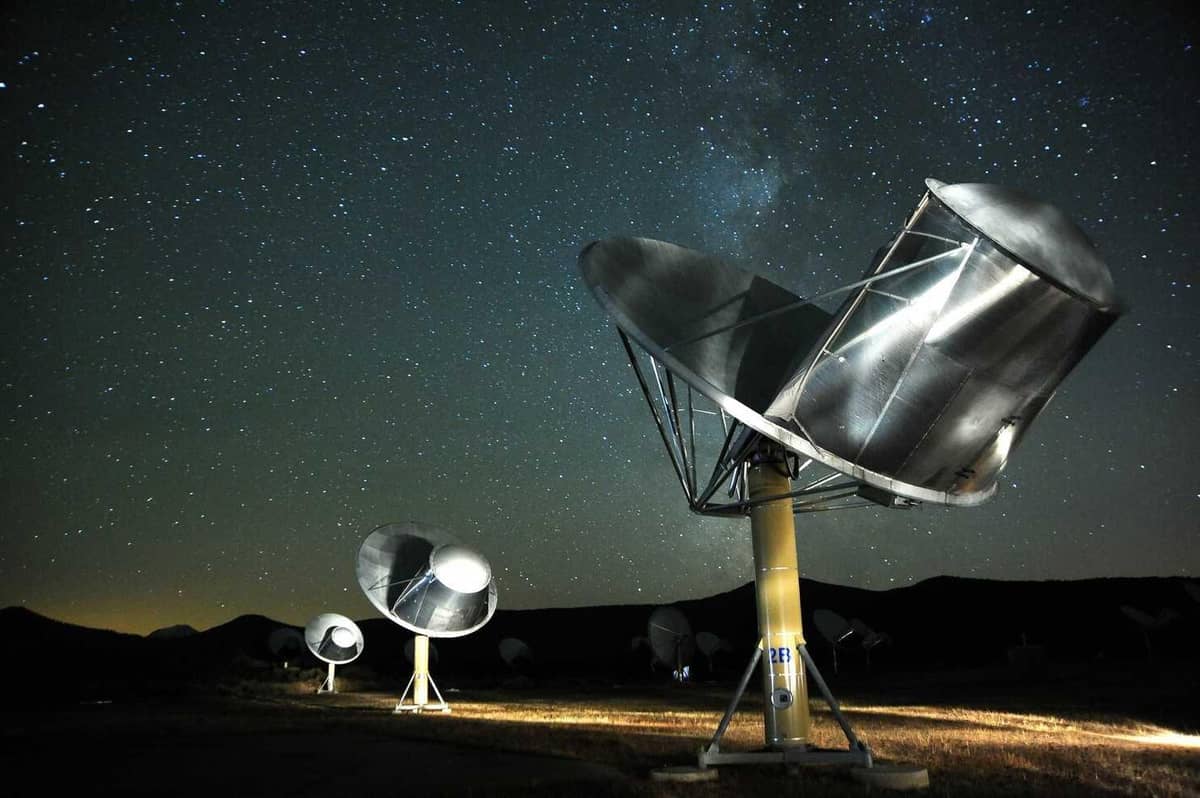
The Allen Telescope Array sits at Hat Creek Radio Observatory in Northern California, about 300 miles north of San Francisco, just north of Lassen Peak. It is operated by the SETI Institute, and it was built from the start to search for radio signals from non-human technology. It has 42 antennas, each 6.1 meters across. They work together, as an array.
The pilot used 20 antennas. In the full survey, 28 of the 42 are now active, with new feeds that cover a wide frequency range. The method is to compare two directions at almost the same time: one beam on the anti-solar point, and a second beam beside it, as a control. A signal that really comes from the point should be stronger, or present only, in the first beam. Interference from the surroundings tends to appear in both.
As Earth goes around the Sun, the anti-solar point moves against the background stars. The work cannot be finished in one night, or in one summer. From the ground at Hat Creek the point is visible only at night, covering about half of the orbit each year. Because of the orbit and the leap day, the parts of the path that can be seen from the observatory shift, and full coverage of the circle takes about four years.
The search continues for four years
The full survey, ATA-ASP, runs at a pace of about two to three nights a week, at higher frequencies than the pilot, 2,356 to 3,700 megahertz. The SETI release says the aim is to cover all the important positions along Earth's orbit over about four years. In the paper published on 3 November the authors wrote that by then they had already taken more than 121 nights of observations beyond the pilot, and that the analysis of the first year of data will appear in a separate paper.
On 5 October 2026 a status paper by Isabel A. Gerrard and Sofia Z. Sheikh was posted to the arXiv. It describes the same survey as the largest observing campaign ever carried out with the Allen Telescope Array. According to that report, by that date about 12 percent of the coordinate targets had been covered, in 126 observing sessions, about 876 hours on the sky and nearly 1.3 petabytes of data. Of the cataloged spectrograms, 25 contained narrowband drifting signals that appeared sky-localized to the beam on the anti-solar point, and the ten corresponding coordinates were scheduled for re-observation.
That is not a detection. It is a follow-up list. The paper does not claim that these are signals from another civilization, and the team itself says that only a repeated observation can test whether they come back, or whether they were a one-time interference.
What has been tested, and what has not
The pilot closed one piece: three nights, one frequency range, a small segment of the orbit. It also changed the larger survey. The lower frequencies were crowded with interference, so the full survey moved to a higher band. A standing filter for problem frequency ranges was added, and the comparison between beams was improved.
The full survey will not cover everything either. It is looking for a narrow signal, drifting in frequency the way a distant technological signal would, and coming from the direction of the anti-solar point. It is sensitive mainly to transmitters that sit in the region from which Earth's transit across the Sun can be seen. It does not check every star, and it does not check every kind of signal. And it depends on the assumption that the other side, if it exists, would choose to coordinate a transmission in this way at all.
What it does offer is a first test, with an instrument built for this work, of an old idea: not only where to look, but when to listen. For now, in those first 17 hours, everything that came through was us.
