Wardenclyffe: what Tesla meant to send without wires, why Morgan stopped, and what Marconi actually took
In 1901 Nikola Tesla began building a Long Island tower intended to connect the world by wireless communication and eventually transmit power. J. P. Morgan financed the start, Guglielmo Marconi crossed the Atlantic with a cheaper radio signal, and Tesla's project became a spectacular skeleton. The record is sharper than the legend of a banker switching off free electricity.
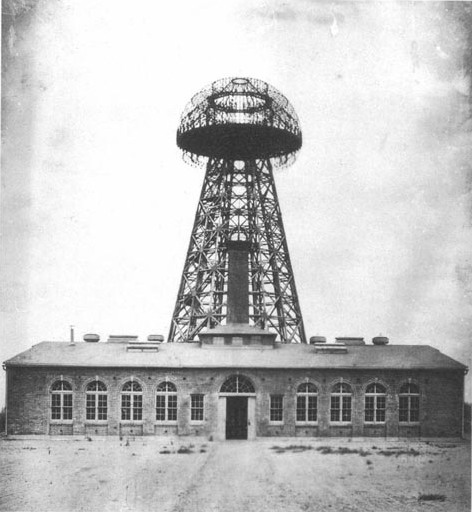
The Tesla Science Center at Wardenclyffe documents Morgan's initial financing, the laboratory and 187-foot tower, and the end of funding in 1903. The tower never became a commercial system and was dismantled in 1917.
No direct document proves that Morgan suppressed a working system because it could not be metered. Wardenclyffe never demonstrated practical global power transmission. Tesla's plans expanded while costs rose and his competitive position weakened.
Radio City before radio had a city
Tesla acquired land at Shoreham in 1901 and hired architect Stanford White to design the laboratory. The tower's immediate purpose was global communication: messages, news, telephony and time signals. Tesla believed electrical oscillations could be coupled to the Earth, using the ground and atmosphere as parts of the transmission system. His ambition expanded to wireless power, a genuine feature of his writings and patents but not a capability demonstrated at the worldwide scale he promised.
Morgan's money and the price problem
Morgan invested about $150,000 in exchange for an interest in patents and the communication venture. The project then grew. Tesla requested more money and increasingly described a system far more ambitious than a competitive messaging service. Morgan declined. The popular version has the banker asking where a meter could be placed if electricity were free. That line does not appear in the known direct correspondence. The surviving record shows an investor losing interest in an expensive, unfinished project with a cloudy business model.
In December 1901 Marconi announced that he had received the letter S in Newfoundland from a transmitter in Cornwall. The demonstration was limited and some details remain debated, but commercially it landed like lightning. Marconi offered transatlantic signalling with a simpler, cheaper system while Tesla was still building. Convincing Morgan that another infusion would create an advantage became much harder. The victorious technology was not necessarily the grandest. It was the one that arrived.
Early radio systems grew from the work of many investigators, including Hertz, Lodge, Tesla, Stone and Marconi. Marconi used components and principles that overlapped earlier patents, and companies fought over priority for decades. In 1943 the U.S. Supreme Court invalidated parts of a Marconi patent based on prior work by Lodge, Tesla and Stone. The decision did not proclaim Tesla the sole inventor of radio or return a stolen crown after his death. It defined the legal limits of one patent.
The tower rose about 57 metres above a substantial laboratory, with a shaft and underground works that remain subjects of study. Equipment was installed and experiments were conducted, but the global system did not enter service. Debt, Tesla's deteriorating finances and the First World War closed the remaining paths. The tower was scrapped in 1917. The laboratory survived and is the last remaining building from one of Tesla's working sites.
Wardenclyffe can be cast as capital conspiring against free energy, but the available material also fits a simpler and less comforting explanation: a brilliant engineer tried to solve several enormous problems in one platform, underestimated cost and was overtaken in communications. That does not make Tesla a fraud. It makes him an innovator whose vision ran faster than engineering, finance and the market.
Wardenclyffe was not a finished miracle machine strangled at the final moment, and it was not merely a failure. It was an architectural and physical experiment built at the scale of belief. Marconi took commercial primacy, not the contents of Tesla's mind; Morgan withdrew his money, not the laws of nature. The interesting question is which parts of Tesla's wireless-power vision were a century early and which could never work as he hoped.