The moon that seemed too light: Shklovsky's hollow Phobos
An early orbital calculation led Iosif Shklovsky to argue that Mars's inner moon would need to be hollow, perhaps even artificial, to show the reported acceleration.
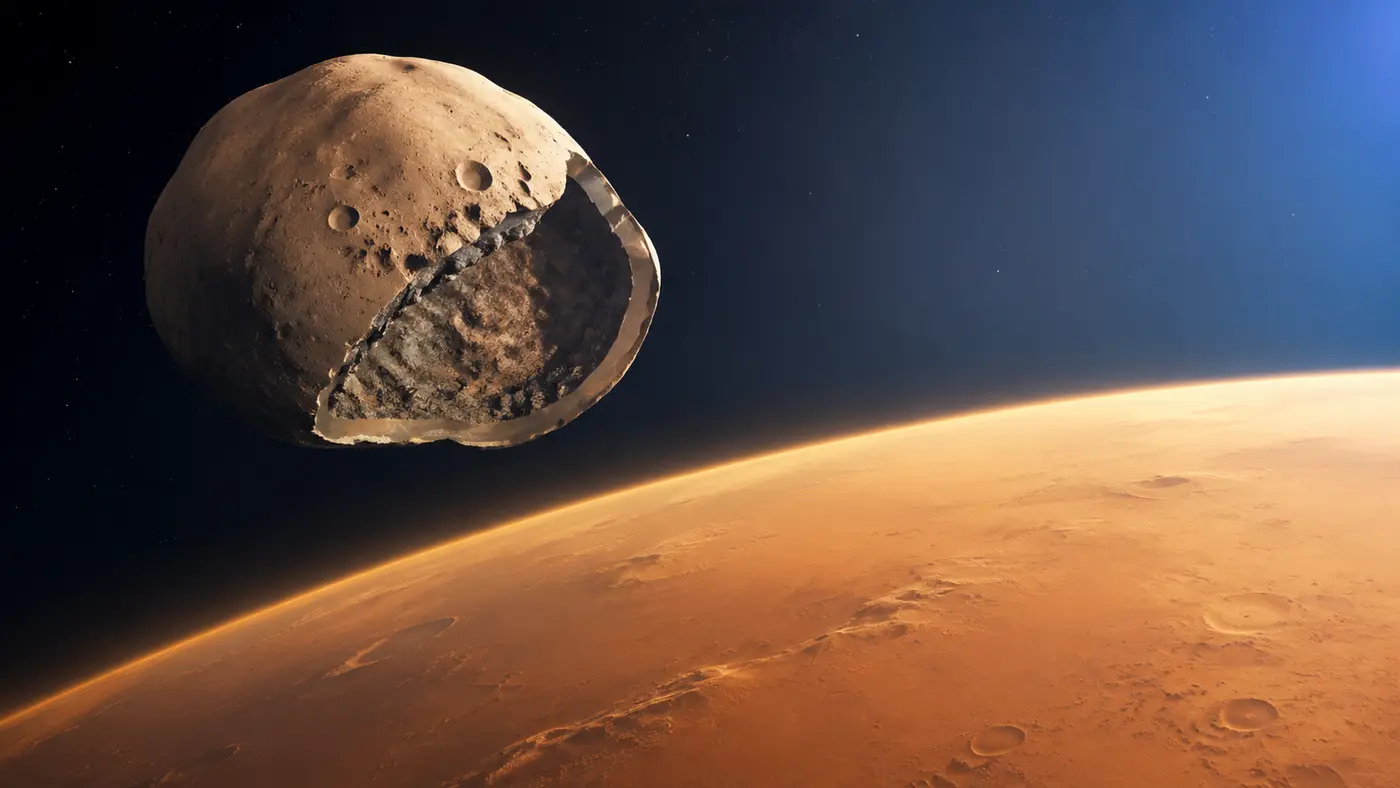
Shklovsky's proposal followed an apparently rapid orbital decay and an atmospheric-drag calculation in the late 1950s.
Improved orbital and density measurements no longer require a thin artificial shell; modern data indicate a porous natural body.
An orbit shrinking too quickly
Phobos circles Mars in under eight hours and slowly spirals inward. Early estimates made the acceleration appear difficult to explain with atmospheric drag.
A thin shell around emptiness
To obtain enough drag with so little gas, Shklovsky inferred an extraordinarily low mass and raised the possibility of a hollow artificial satellite.
Images reveal a dark, cratered, grooved moon. Mass and volume indicate substantial porosity, perhaps a rubble-rich interior, but not a thin metal shell.
The story shows how a bold inference can follow a measured anomaly and then change when the measurement improves. Phobos remains genuinely unusual without requiring an artificial origin.