The sky carved in stone: Anthony Peratt's plasma columns
Los Alamos plasma physicist Anthony Peratt identified striking parallels between ancient petroglyphs and the shapes produced by powerful electrical instabilities. His proposal is more substantial than a collection of lookalike pictures, yet it still lacks the shared dating and archaeological agreement needed to turn resemblance into history.
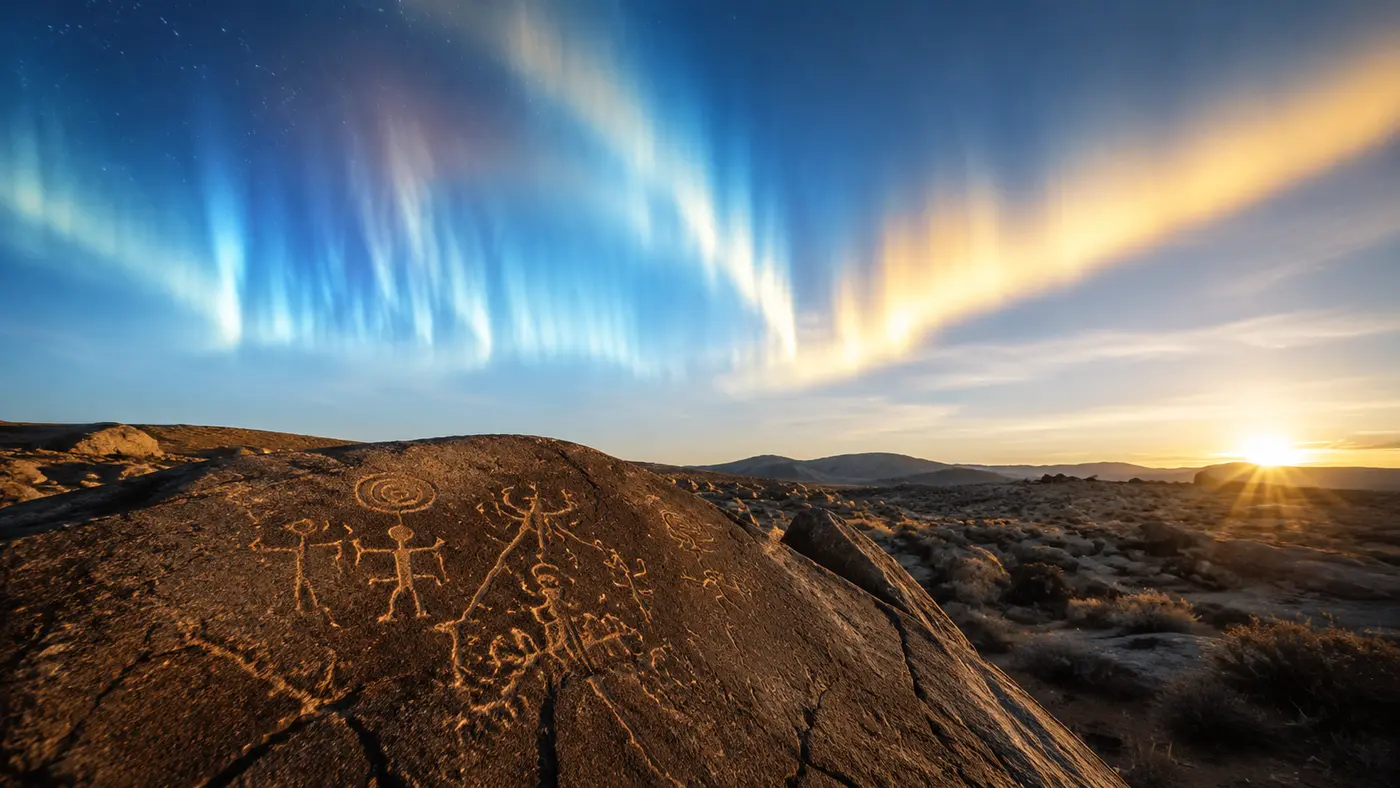
Peratt published two peer reviewed comparison studies in IEEE Transactions on Plasma Science and attempted to compare form, site orientation and viewing geometry.
Shape similarity alone cannot establish the age, meaning or common origin of carvings made by different cultures. A single global plasma event has not been independently demonstrated.
Shapes from the laboratory
Powerful electrical currents can pinch plasma into a narrow column. During its evolution the discharge may form stacked rings, hourglasses, branching arms and figures that look unexpectedly human. Peratt noticed that several of these laboratory morphologies resemble recurring forms cut into rock, including raised arms, concentric circles and ladderlike structures. He asked whether some marks normally read as ritual symbols could instead record an extraordinary sky.
A survey across continents
Peratt and collaborators collected and classified thousands of petroglyph examples from many countries. The papers compared recurring forms with successive plasma configurations and, in a second stage, considered the direction from which selected sites would have viewed a proposed luminous structure near Earth's magnetic axis. That move matters because orientation is testable in a way that visual resemblance alone is not.
In the proposed scenario, extreme solar activity drives immense currents through the magnetosphere. Observers would not see a single flash. They might see a slowly developing column, rings piled above one another and arcs resembling the limbs of a gigantic figure. Severe geomagnetic storms can push auroral light far beyond ordinary polar latitudes, although the scale required by this reconstruction remains exceptional.
The work attempted to connect three things: laboratory morphology, the geography of rock art and the direction of observation. The archaeological record, however, is uneven. Neighbouring carvings may belong to different centuries, the face of a rock does not necessarily preserve the artist's viewing direction and sites can be altered over long periods. Those uncertainties weaken any claim that distant cultures recorded one event.
People in unrelated societies can carve similar bodies, circles and ladders because the forms are simple, useful and visually memorable. They may represent ceremony, ancestry, territory, counting or ordinary human figures. To favour plasma, researchers would need consistent dates, a concentration within one period and directional results that survive independent selection of sites. That complete package has not yet appeared.
The proposal remains valuable because it treats ancient images as possible observations and tries to expose the idea to measurement. If even a fraction recorded unusual aurorae, petroglyphs could preserve information from an era without instruments. That possibility deserves collaboration between plasma physicists, archaeologists and specialists in the cultures that produced the art.
Peratt presented a detailed physical hypothesis, not proof that a global electrical catastrophe was witnessed by ancient humanity. The formal similarities are intriguing and the orientation study raises the story above a viral collage. Yet without common dating and broad archaeological replication, the responsible verdict is open but unconfirmed. The sky may have been carved into stone, but the stone does not yet give us one date, one intensity or one interpretation that excludes earthly meaning.