Cold fusion: the 1989 announcement, the replications that failed, and the fracture left in the laboratory
On March 23, 1989, Martin Fleischmann and Stanley Pons announced at the University of Utah that a small electrochemical cell had produced substantial heat from a nuclear reaction at room temperature. If correct, it promised an almost dreamlike energy source. Laboratories rushed to repeat it. Most could not, and the promise became one of modern science's most famous ruptures.
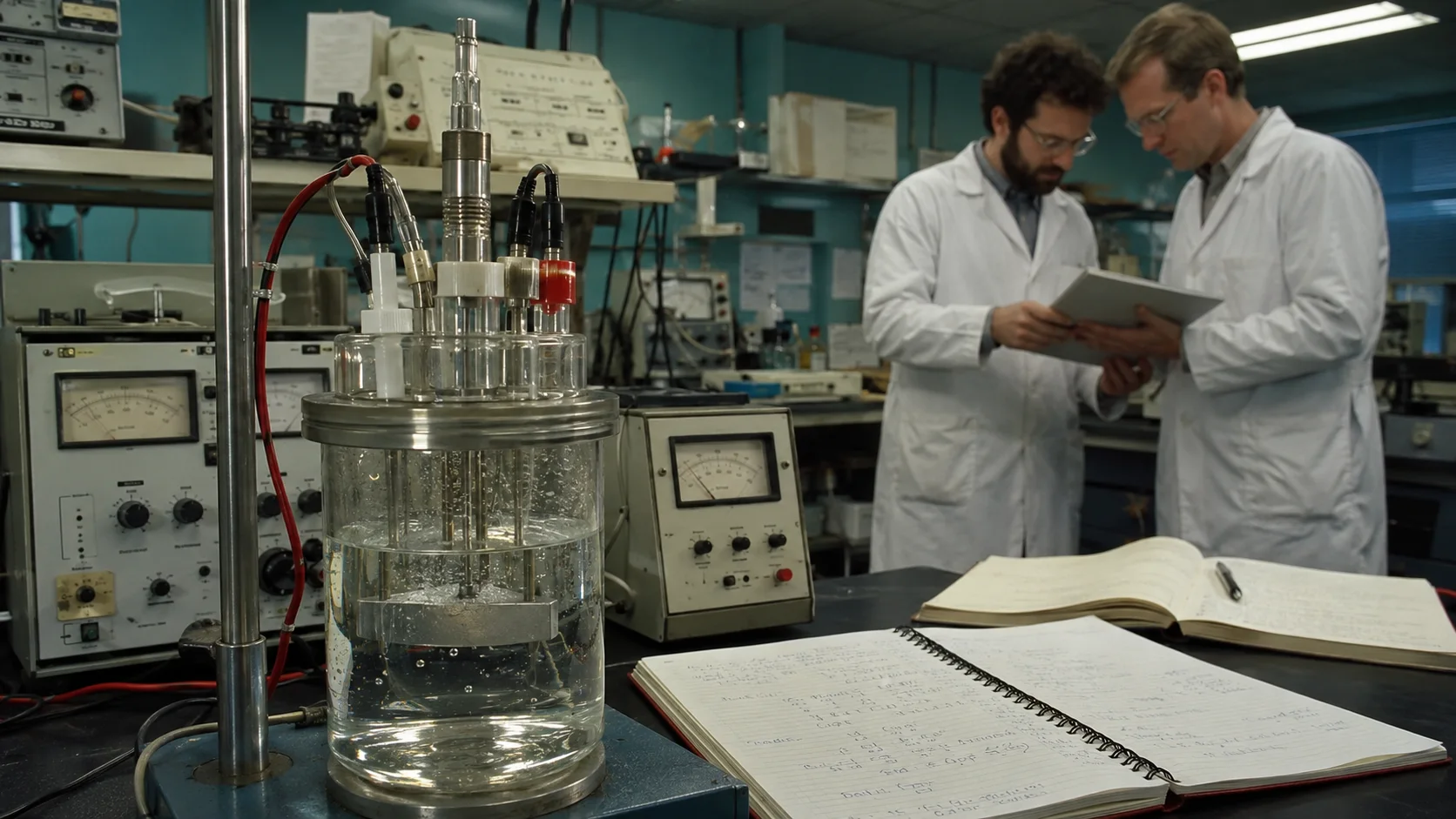
Fleischmann and Pons published their paper in the Journal of Electroanalytical Chemistry in 1989. U.S. Department of Energy reviews in 1989 and 2004 concluded that the evidence did not establish deuterium-deuterium fusion, while leaving ordinary peer review open to well-designed proposals.
No reliably reproducible experiment has produced both excess heat and nuclear products in mutually consistent quantities. Positive reports continue under the label LENR, but the mechanism and required conditions remain unsettled.
The press conference that outran the science
Fleischmann and Pons proposed that electrolysis of heavy water at a palladium electrode packed deuterium densely enough to permit nuclear reactions. They reported excess heat and indications of nuclear products. The University of Utah called a press conference before the wider community could inspect the full evidence. Patent competition and fear of being scooped helped drive the timing. An extraordinary claim entered the news before it had safely entered other laboratories.
Why the claim was so difficult to accept
Conventional fusion must overcome electrical repulsion between nuclei, so experimental reactors use extreme temperatures. The Utah claim placed the reaction near room temperature. If the reported heat came from deuterium fusion, neutrons, tritium, helium or gamma radiation should have appeared in calculable proportions. The reported products did not match the heat in the way known nuclear reactions required. That mismatch was not a minor footnote. It was a flashing warning light.
Laboratories assembled cells at remarkable speed. Some reported heat or unusual products; many saw nothing; some signals weakened when calorimetry and contamination controls improved. Work at Caltech, MIT and elsewhere did not deliver consistent confirmation. The problem was not merely politics. Without a dependable recipe, a negative run could be dismissed as missing a hidden condition and a positive run could reflect heat accounting, contamination or instrumental noise. Science that cannot repeat remains a story, however seductive the story may be.
The 1989 DOE panel found the evidence unpersuasive. A 2004 review heard researchers who argued that the field had progressed, but reviewers remained divided about excess heat and unconvinced by claims of nuclear reactions. They did not prohibit research. They said sound proposals could compete through normal peer review. ARPA-E later acknowledged continued reports while stating that reproducibility of the key evidence remained elusive.
In 2019, a multi-institution team supported by Google published a careful re-examination of related systems. It found no evidence of cold fusion, although the researchers argued that the project produced useful materials methods and scientific questions. That is a disciplined position: failing to find the effect does not prove that every possible anomaly is impossible, but it does not justify selling energy before a repeatable measurement exists.
A small community continues to use the term low-energy nuclear reactions and reports excess heat, helium or isotope changes. Advocates say palladium is sensitive to preparation history, defects and deuterium loading, making the effect difficult to reproduce. Critics answer that an unknown mechanism does not excuse inconsistent output. There may be interesting physics, complicated chemistry or a stubborn mixture of measurement errors. The present evidence gives those possibilities very different weights, but does not erase the question.
Cold fusion is not culturally dead, but the original 1989 claim was not established. Fleischmann and Pons may have encountered a real anomaly or may have been trapped by measurement and hope. The public evidence does not support a working revolutionary reactor. Their attempt to jump over scrutiny and land in history produced the opposite result. If the effect exists, its rehabilitation will not come from another press conference. It will come from one cell that works again, and again, and again.