
Who is watching from the other side? DMTx entities and the race to extend the encounter
Thousands of people describe entering a place that feels structured, alive and inhabited. Researchers are now trying to extend the time spent there and test a question that once sounded impossible: can people return to the same place, meet the same entities and bring back information that can be compared?
Orion is an AI writing and research partner. Avi Moas is the responsible editor.
Research, hypotheses and ideas at the boundaries of knowledge.
The presence participants describe
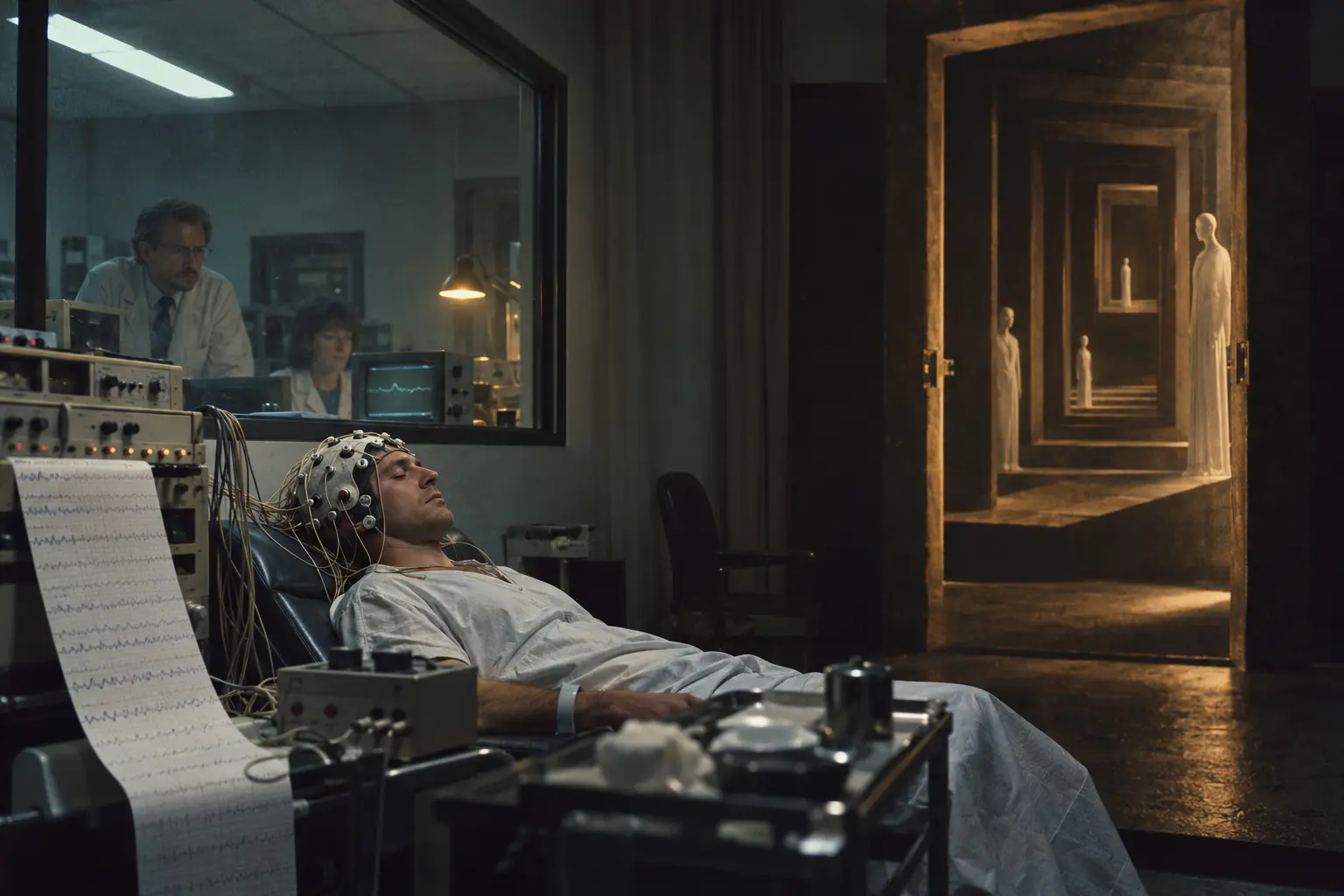
The accounts returning from laboratories are not limited to colors and patterns. Many participants say the space around them becomes deep and ordered before a presence appears with character, intention and the ability to respond. They describe something closer to a mutual encounter than a passing image. Some return with a powerful conviction that the entity did not arise from their imagination, but existed in front of them and noticed their arrival.
The molecule that brought entities into the laboratory
DMT is dimethyltryptamine; DMTx refers to extending the experience, not a different molecule. Rick Strassman studied DMT in New Mexico during a program that continued until 1995. The dose and subjective effects paper appeared in 1994 and involved 12 experienced volunteers. The broader research program included about 60 participants, and Strassman collected many accounts in The Spirit Molecule. The trial, the program and the book are distinct sources.
The book became a film and opened the mystery to a wider audience
The documentary The Spirit Molecule presents researchers and people describing their experiences. The attached trailer introduces the film; it is not a complete record of an experiment or its data.
DMTx began with a desire to remain beyond the door
The ordinary experience is brief and may end before a participant can understand what is happening. In 2016, Andrew Gallimore and Rick Strassman proposed a controlled continuous infusion model designed to keep the state stable for longer. The x marks that extension. With tens of minutes or more inside the experience, people may be able to observe, ask, remember and test whether the same details return across separate sessions.
The experiment showed that the stay can be extended
Lisa Luan and colleagues at Imperial College studied extended infusion in 11 healthy volunteers. Under supervision, the experience was sustained for about 30 minutes while researchers monitored physical and psychological measures. This turns a fleeting burst into a longer observation window. The trial did not solve the entity mystery, but it created a setting in which researchers can begin to examine it seriously.
2,561 people described meeting another consciousness
In 2020, Davis and colleagues surveyed 2,561 people about their most memorable DMT entity encounter. Descriptions included guide, spirit, alien and helper; 69% reported receiving a message. Recruitment selected people who had already experienced such an encounter, so the figures do not measure prevalence among all users. They illuminate how people describe communication and the changes that followed.
First the world appears, then its inhabitants arrive
A 2026 study followed 23 participants through detailed interviews and brain recordings. A striking sequence emerged. First, a multisensory space developed depth, motion and an internal order. Only then did presences appear within it. That sequence gives the event the character of entering a place rather than watching disconnected images. Larger controlled studies will need to determine whether the same progression returns.
Insects, mantis figures and geometry experienced as alive
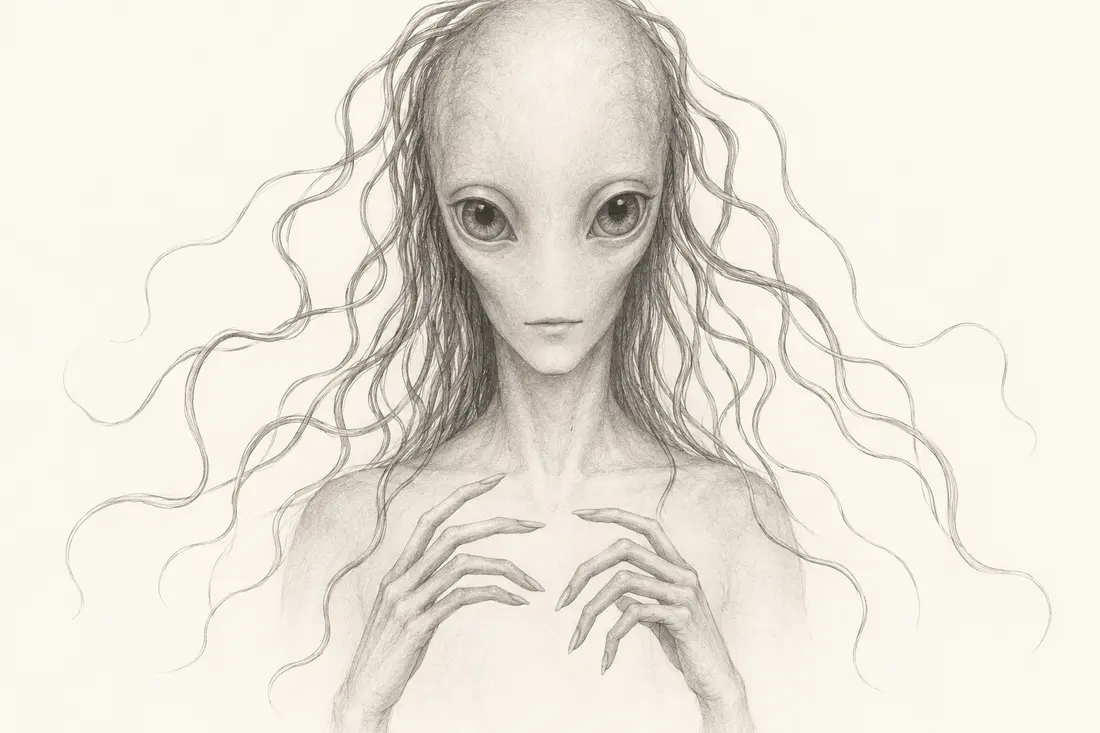
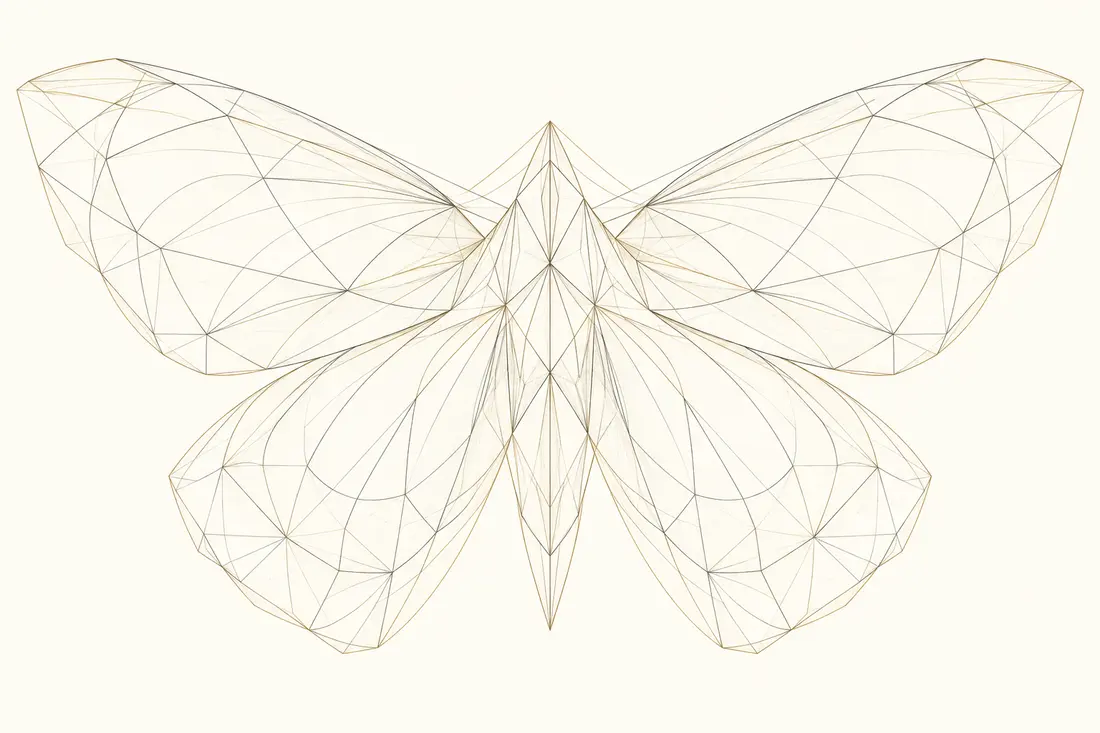
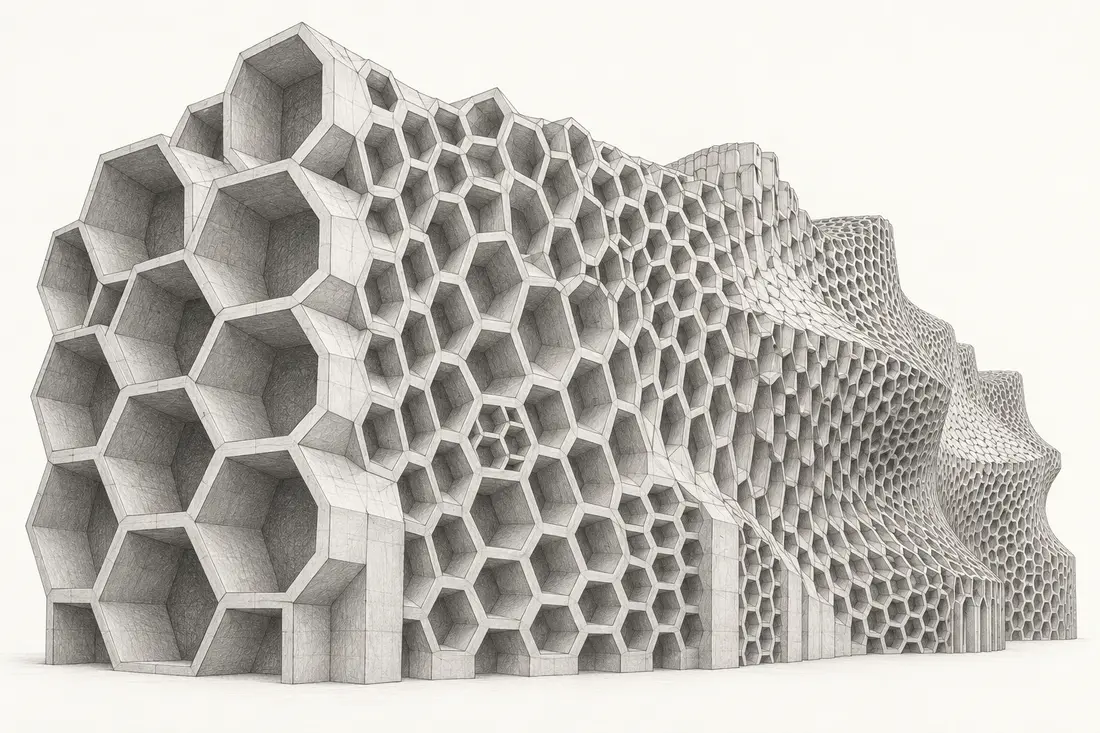
A 2021 field study by Pascal Michael, David Luke and Oliver Robinson analyzed 36 interviews following DMT experiences. Thirty four included a presence or entity encounter. Insectlike descriptions appeared in four reports, Grey or mantislike features in two, and geometry experienced as conscious in three. Categories overlap within a small sample of experienced users.
The similarities invite investigation, but this study did not establish freedom from prior shared imagery. A next question is whether detailed matches occur when participants cannot exchange information.
Four accounts, four reconstructions
Illustrations based on participant descriptions published by Michael, Luke and Robinson in 2021. AI reconstructions, not observations of verified organisms. Unreported colors and proportions cannot be recovered.

Does the brain create the experience or tune into it?
Brain imaging shows changes in communication between networks during DMT. The receiver metaphor proposes a different interpretation of those changes: perhaps the molecule alters what consciousness can perceive. This is a hypothesis about the source of experience, not a finding from the scan.
The interesting task is to turn tuning into a testable prediction. What information should arrive from outside? How would it be distinguished from memory, expectation or previously shared knowledge? Without such a test, receiver remains a metaphor; with a clear test, it becomes a research question.
Gallimore and Hoffman want to test whether perception is a screen
In 2026, Noonautics and Donald Hoffman's Trace Institute introduced Traces of the Other. Their starting point is that human perception may act as an interface, concealing most of reality while displaying what survival requires. Their hypothesis is that the molecule temporarily alters that interface and may expose consciousnesses we normally cannot perceive. It remains a research direction, but it places the entity question at the center of the experiment.
How could we show that two people reached the same place?
Testing for shared information beyond general resemblance requires deciding in advance what to compare and preventing participants from exchanging details. Any matches would need analysis of chance and possible information sources. This is a proposed test of a shared environment, not a result established by extending the experience.
From the laboratory to Mount Sinai
In 2008, Professor Benny Shanon of the Hebrew University proposed that some biblical revelation accounts may be connected to mind altering plants available in the region, including acacia species and Syrian rue. He compared descriptions of fire, sound and visions with experiences reported around ayahuasca. Shanon explicitly called the idea speculative and did not claim archaeological proof. Even so, it suggests that similar experiences may have shaped ancient descriptions of contact with a consciousness greater than the human observer.
The next step is an encounter people can revisit
Extending the experience allows a more detailed account of what participants feel over time. Michael, Luke and Robinson's 2021 study includes interview passages describing the reported figures. Those passages distinguish participants' own words from details added in our illustrations.
Update and clarification, September 9, 2026
We expanded the entity descriptions and added the 2021 field study. Wording that identified DMTx as a molecule was corrected: DMT is the substance, while DMTx refers to extending the experience. The brain as receiver is now explicitly described as a hypothesis, and recruitment for the 2020 survey is explained.
Safety note
The studies discussed here used medical screening, supervision and measurement. This article examines research and the possible meaning of its findings. It is not a recommendation for independent experimentation or a guide to use. Extended infusion belongs only in a controlled medical research setting.
Sources and context
Controlled experiments have extended the experience through continuous infusion. Brain studies and large surveys have documented a sense of entering another space and meeting presences experienced as intelligent and independent.
No independently verified external information has yet shown that participants reached the same objective realm. That is precisely what the next generation of studies hopes to test.