Duxi 1994: the night that left a broken forest
Broken trunks, an unusual roar and reports of lights produced the “airborne strange vehicle” story. Chinese reporting and CCTV’s investigation reveal both the damage and the debate over its cause.
Broken trunks, an unusual roar and reports of lights produced the “airborne strange vehicle” story. Chinese reporting and CCTV’s investigation reveal both the damage and the debate over its cause.
The sources distinguish records, testimony and explanations.
A night at the end of 1994
Reports place the event around the end of November and start of December 1994 at Duxi forest farm, north of Guiyang. China News dates it to the early hours of 1 December; CCTV’s transcript also uses 30 November. Despite that discrepancy, accounts describe a loud roar, lights and damage to trees and a nearby railway facility. The sources presented here do not supply a photograph of a vehicle causing it.
The trees left behind
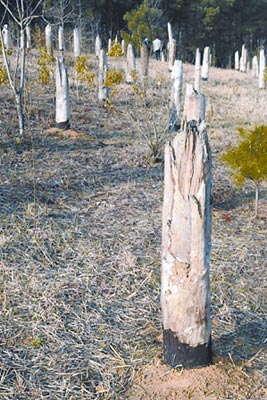
Our image appeared in a 2009 report and shows broken pine trunks attributed to the incident. That report describes bands of damage interspersed with surviving trees. Neither the photograph’s date nor its photographer is specified. It is therefore presented as a site photograph in later reporting, not a frame of the impact or proof of a particular mechanism.
Weather enters the investigation
CCTV’s 2005 programme examined tornadoes and local wind phenomena. Experts explained how a brief, small-scale event could escape a fixed observation station, and how damage at tree height need not leave uniform disturbance at ground level. Interviewees also debated breakage direction and damage to structures. Those explanations belong beside the testimony, rather than being omitted to preserve the mystery.
Damage and cause are different findings
Duxi is a visual record of aftermath. Photographs can show what broke; identifying the cause requires a damage map, weather records and dated observations. The local nickname provides a powerful image, not an engineering record of a vehicle crossing the forest. The interesting task is tracing how an explanation is built from the surviving material, and which details each proposal can account for.