Five hours of red lights and the watch that jumped 25 minutes
Two FBI interview summaries describe an unusual night in the western United States. Two witnesses reported groups of red lights, some apparently very close to the ground, moving through a mountainous area beneath heavy cloud. After the observation, one witness found that his mechanical watch was 25 minutes ahead of both phones, the vehicle clock and the second witness's digital watch.
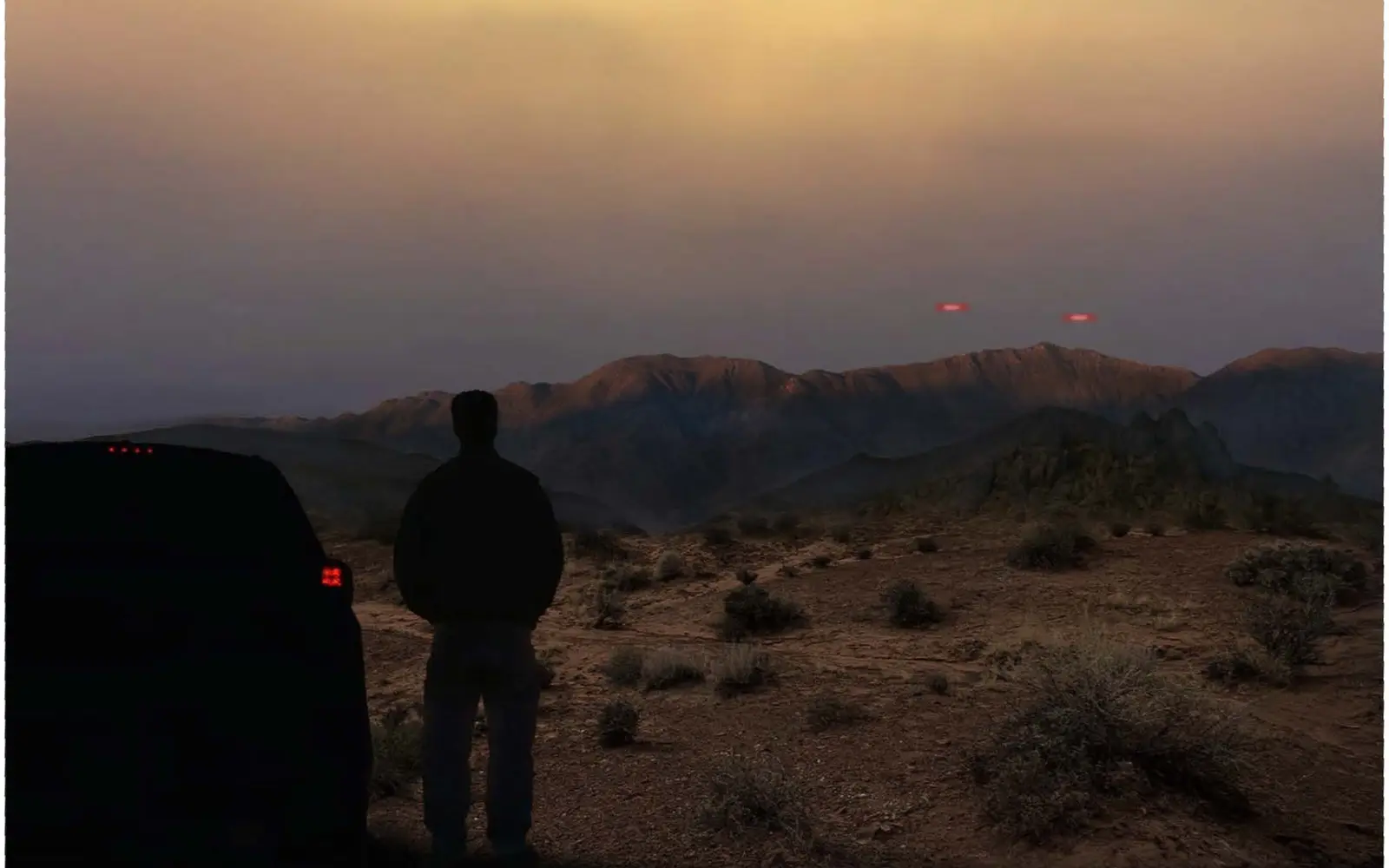
FBI UAP D037 and FBI UAP D040 are separate FD 302 interview summaries for the two people present. They were released on August 7, 2026 in the fifth PURSUE collection, together with four FBI digital renderings based on the witnesses' descriptions.
The witnesses' names, the precise location and the complete incident date are redacted. No original sensor files, position logs, event photographs, professional inspection of the watch or environmental measurements were released.
Two interviews, not a verdict
The files are government records, but their function matters. An FD 302 is an FBI agent's summary of an interview. It preserves what a person reported and how the interview was recorded; it does not certify that every event occurred exactly as described. Here, agents prepared a separate summary for each witness. Names, occupations and much of the operational context are redacted, yet both accounts describe the same night drive, the same families of lights and the same unusual difference between the mechanical watch and every digital time source nearby.
The first light above the ridge
According to one summary, the pair entered a mountainous area for reconnaissance during the evening, waited for heavy rain to ease and then drove about 25 miles along a remote route. Around 10:00 pm they noticed a red light near the crest of a range to the west. It first appeared to be on the mountain, then began moving east. The witness placed it between the roughly 5,000 foot ridge and a cloud base near 7,000 feet. About fifteen minutes later, six to ten more lights appeared above them, joined a common movement and travelled east and southeast. One dropped an estimated 1,000 feet rapidly before disappearing.
To the naked eye and at first glance through night optical devices, the objects looked like single red points. Under closer observation, the witnesses described each cluster as three smaller lights arranged in a triangle or diamond. The three lights in each cluster moved together and never separated. Cloud cover was heavy enough to hide the stars. One witness reported more than 25 years of experience with night vision equipment, which helps explain why the records distinguish carefully between unaided vision, night optics and an unsuccessful attempt to acquire the lights with thermal equipment.
More lights appeared later to the east. One interview places two of them roughly 200 to 300 metres from the vehicle and says they were visible only through night vision. The other describes a light approaching and stopping at an estimated 400 metres, with a second light apparently only six feet above the ground. A third descended into a dry wash about 100 metres behind the observers. Terrain blocked a direct view of its source, but they said its glow moved through the wash. The pair changed position and tried to reacquire the targets without success. They reported no engine sound, exhaust or physiological effect.
Near the end of the observation, one witness checked an automatic mechanical watch he had owned for about five years. It was 25 minutes ahead of his phone, the vehicle clock, his companion's phone and the companion's digital watch. He said the watch had never differed by more than 60 to 90 seconds and had shown the correct time when checked around 10:00 pm. He deliberately left it unchanged for another 24 hours. It continued to run at a normal rate but remained 25 minutes fast. The second witness told the agent that the discrepancy was shown to him at the scene and that every digital source agreed.
The files contain no inspection by a watchmaker, so the public record cannot determine whether shock, magnetism, crown movement or a brief mechanical fault changed the display. Visibility was also difficult. Rain, low cloud, darkness, estimated distances and optical magnification can alter judgments of height and motion. Aircraft lights, drones, flares or ground activity would need to be compared with flight and location records. At the same time, the reported duration, coordinated movement, very low apparent altitude, lack of sound and failure to see the lights thermally leave questions the released material does not answer.
This is a valuable case not because the FBI declared a nonhuman event, but because the archive joins two separately recorded accounts, a long sequence and a physical detail that could have been tested. The watch is also the investigation's largest missed opportunity. Immediate measurement of magnetism, power reserve, movement and timekeeping history might have turned an odd memory into data. What remains is an official record of a highly unusual night, two accounts that align on the central events and one watch that left the area carrying 25 minutes found nowhere else.