


Three tools for documents, sensitive data and AI answer checks
Docling, Presidio and Promptfoo address layers that are easy to overlook when building an AI system. This selection is based on official documentation, without installation or testing.
Avi Moas, Researcher and Editor-in-Chief · Produced with an AI-assisted newsroom

Before replacing the model
An AI system can fail even when its model is capable. A table may be read in the wrong order, personal information may travel with a document, or a prompt change may improve one answer while damaging another. This week's three projects address those surrounding layers.
This is a documentation review of official repositories, without installation or execution. Selection reflects a defined role rather than GitHub popularity. The tools mainly suit developers, or people working with one, rather than readers expecting three ready made websites that immediately deliver finished work.
Docling: give documents a readable structure
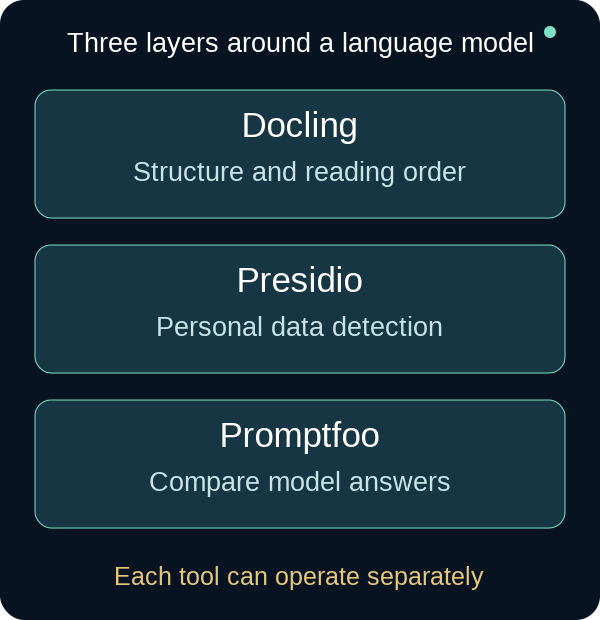
Docling turns documents into representations that other processing tools can use. Its documentation describes multiple formats, page layout and table processing, with exports including Markdown and structured data. It could suit a research collection whose documents look clear to people but reach a model in a confusing order.
Imagine a page with two columns and a table underneath. Copying its text may join sentences that were not adjacent in the original. A document parser attempts to preserve the reading structure. Comparing representative results with the original remains necessary, particularly for tables and low quality scans.
The project code uses the MIT license. Its documentation specifies Python 3.10 or later and describes local execution. Model weights and additional components can carry their own requirements and terms. The code has no license fee, but computing, storage or external services connected to it can still cost money.
Presidio: identify details that should not travel
Presidio provides components for finding and obscuring personal information in text and other media. Its official repository has moved to the Data Privacy Stack organization. The framework combines predefined recognisers with customisation, including rules for the information a particular application handles.
It could help a team preparing documents for processing reduce the transfer of identifying details. The maintainers explicitly warn that automated detection cannot guarantee finding all sensitive information. Language, entity types and configuration require attention; general text support does not establish suitable coverage for every Hebrew document.
Its code is MIT licensed, with Python and container deployment options. Operation and selected models require resources and configuration. Fictitious examples without real personal details are a sensible starting point for specifying requirements before deciding how the tool belongs in a system.

Promptfoo: see what changed in the answers
Promptfoo supports evaluating language model applications and comparing results. Instead of trusting one attractive answer, developers can define cases and expectations, then examine the effect of changing a prompt or model.
It suits teams maintaining behavior over time. An assistant required to return a particular data structure should continue doing so after a wording change. One check can examine structure, while content quality requires a separate criterion. Scores depend on what was measured and are not a universal certificate of model quality.
The core project is also MIT licensed. Documentation describes a command line tool and connections to model providers. External services may require credentials and incur charges under their own terms, while receiving the test content. Local evaluation software does not imply that every connected provider operates on the same machine.
Choose the missing layer
These tools need not be combined. Start with document parsing when extraction is the problem. Define evaluation cases when answers change unpredictably. Map data and transfer boundaries when sensitive material enters a workflow. A useful project solves a specific problem without introducing an entire unnecessary system.
Before selecting a version, examine updates and open issues relevant to the intended role. Open source makes inspection and modification possible, while local maintenance and adaptation remain part of the work.
This selection is based on official documentation for Docling, Presidio and Promptfoo, without installation or hands-on execution.
No performance benchmark or test on real files was performed. Language coverage, model choices and connected services require separate validation.
