


The assistant supplied a citation. What does the source actually say?
A citation starts the check. Connecting each claim to the passage that supports it makes research easier to verify without collecting an unnecessary pile of links.
Avi Moas, Researcher and Editor-in-Chief · Produced with an AI-assisted newsroom
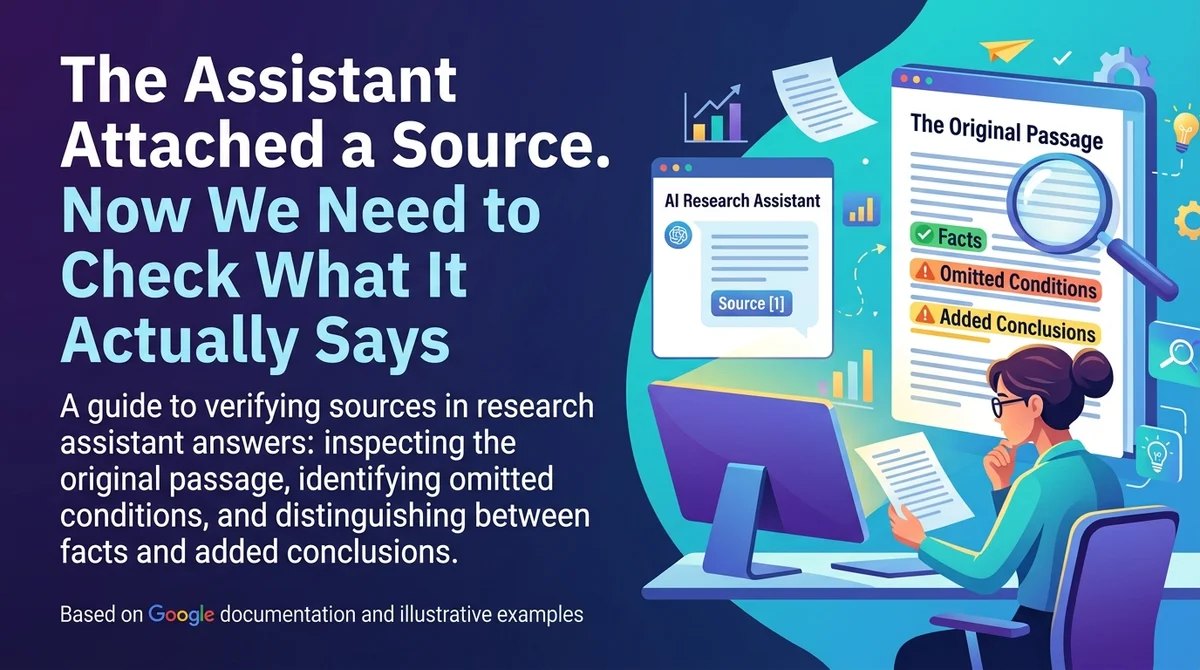
The little number after the sentence
A polished answer followed by a numbered source looks ready to use. It is tempting to copy it into a presentation or draft and move on. Yet the reference identifies where to check a statement; it does not establish that the document supports every part of that statement.
Google's documentation for Gemini Notebook explains how to select sources for a conversation and move from citations to relevant passages. These features can create a short route from a claim to its evidence. This guide draws on documentation and illustrative examples, rather than a hands on experiment or an accuracy ranking.
The aim is to reduce the distance between writing and verification. With a long answer and a general reading list, readers must guess which source supports which detail. When each claim points to a passage, they can open it, examine the context and return to their work.
Ask for the missing information too
Instead of requesting a broad summary, ask for three findings on a specific subject, each with its document, supporting passage and information the passage does not provide. This is an editorial suggestion, not a tested prompt with guaranteed results. Its purpose is to make missing evidence visible.
Imagine uploading a municipal transport report. An assistant says a new route reduced congestion. The document may show that congestion fell during the same period without attributing the change to that route. The figure could be correct while the causal explanation remains unsupported.
Split the sentence into smaller questions. What was measured? In which area and months? Did the authors identify the route as the cause? These concrete checks are more useful than asking the model, in general terms, to make sure it is not mistaken.
If a source has changed since it was added to a notebook, retain its version date too. An accurate reference to an old document can still produce an answer that no longer fits current circumstances.
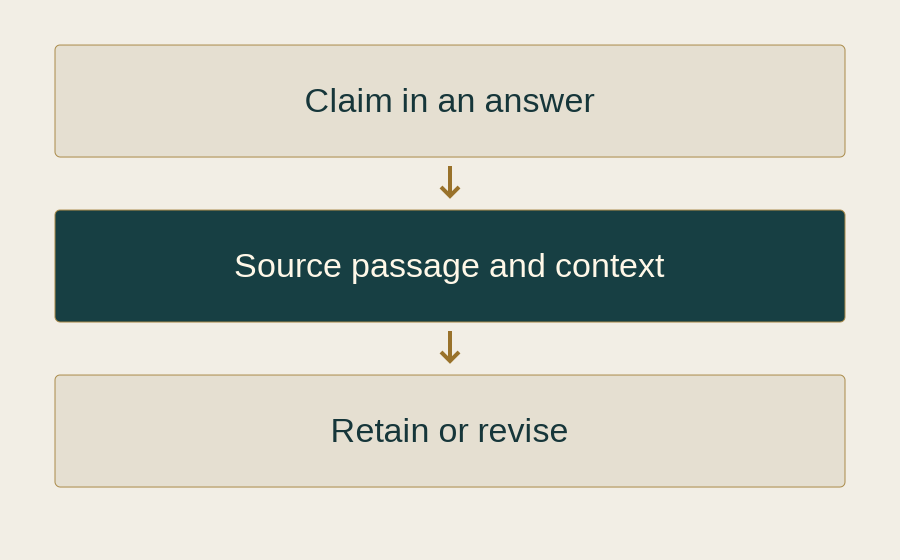
Read the surrounding paragraph
After following a reference, read the sentences immediately before and after the highlighted passage. A possibility qualifier, an excluded participant group or a narrow definition of success may change its meaning. A table footnote might explain that a number applies to one scenario only.
For another example, product documentation may say a feature is available on selected plans. A summary describing it as universally available preserves the feature's name while losing the condition. The entire answer need not be discarded. The condition needs to be restored where it affects the decision.
There is also a difference between the source an assistant consulted and the document containing the original evidence. A news article may cite a study, while a presentation quotes a report. When a key detail drives the conclusion, follow that chain to the document supporting it. Another link is useful when it shortens that route.
Keep the claim with its evidence
Google describes saving responses as notes with their citations. A useful working principle is to retain a short source passage and its location alongside a draft claim. Later edits can then be checked against the basis for the original wording, rather than against memory.
Source selection also requires attention to the mode being used. Alongside conversations involving selected documents, the documentation describes advanced options that may use additional tools. Do not assume every conversation mode is automatically confined to uploaded files. Where source boundaries matter, check the mode and specify the intended scope.
Before circulating a document, concentrate on the statements carrying its main weight: a prominent number, quotation, causal explanation or recommendation. Match each to its source and context. Finding one unsupported sentence during editing is preferable to discovering later that an impressive looking citation led somewhere else entirely.
