Walter Russell's spiral vision of the universe
Walter Russell imagined matter, light and motion as rhythmic expressions of a single underlying process. His sweeping cosmology was not accepted as established physics, but its visual language influenced artists, alternative thinkers and later conversations about consciousness.
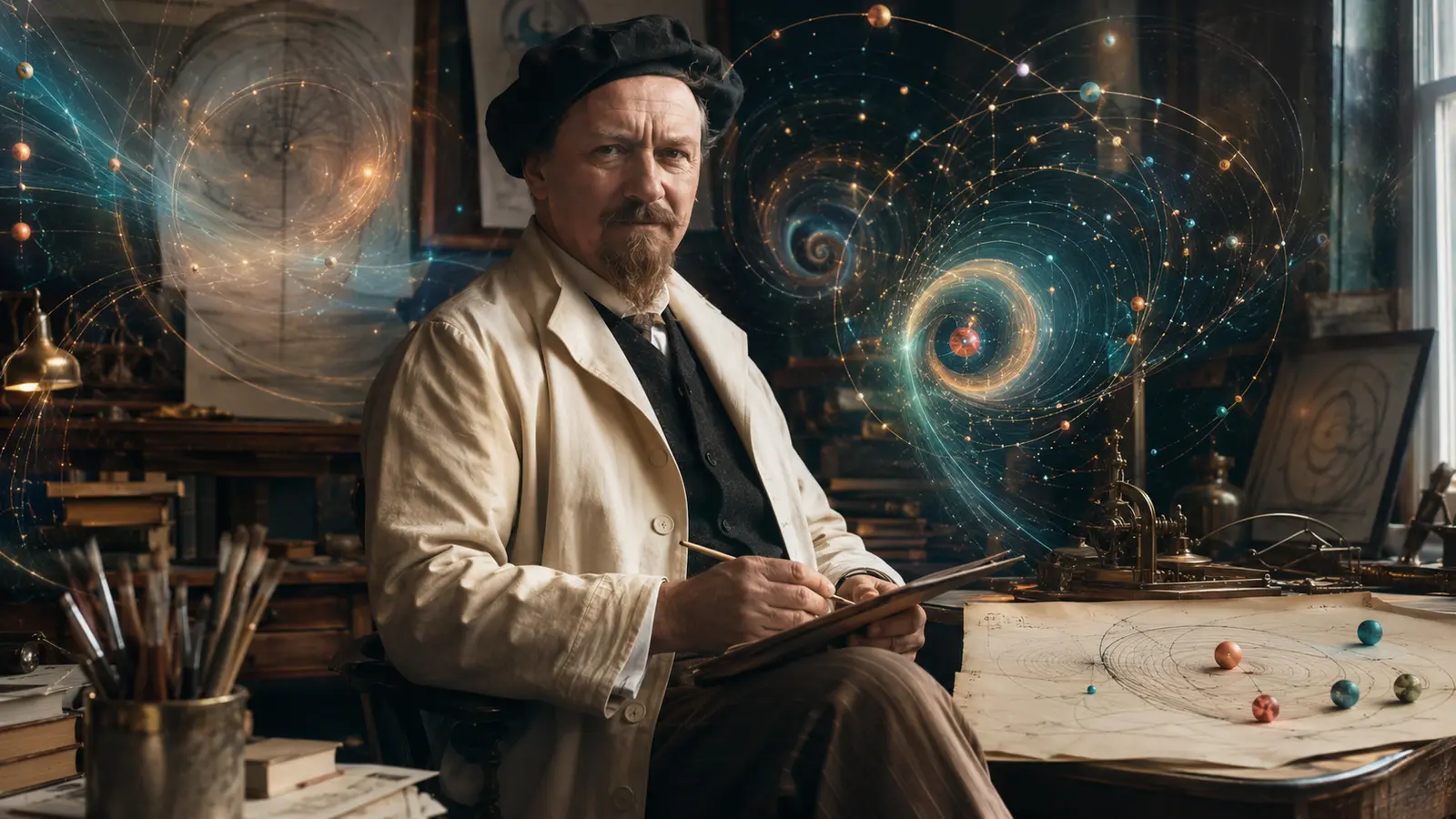
Walter Russell's spiral vision
Russell published an extensive cosmological system in books, diagrams and lectures, presenting the universe as rhythmic, polar and continuously transforming.
His physical claims were not developed into a predictive, independently validated scientific theory comparable with modern physics.
A universe made of rhythm
Russell described creation as alternating concentration and expansion rather than a collection of permanently separate objects. Spirals, waves and paired opposites were his basic visual grammar.
Where the originality lies
His strength was synthesis. He connected light, geometry, music, consciousness and cosmology in a coherent visual system that could be grasped intuitively, even when its scientific claims were disputed.
Russell treated inspired insight as a route to knowledge. That approach makes his work culturally fascinating, but scientific acceptance still requires equations, testable predictions and reproducible evidence.
The Universal One, The Secret of Light and his later diagrams continue to attract readers looking for models that place consciousness and pattern at the centre of nature.