The pendulum that turned when the Sun vanished: the Allais effect
In 1954 Maurice Allais sat beside a pendulum in Paris and watched its oscillation plane turn unexpectedly near a solar eclipse. A second report followed in 1959. Seventy years of experiments have still not established whether he detected an unfamiliar gravitational effect or an exquisitely sensitive instrument responding to its surroundings.
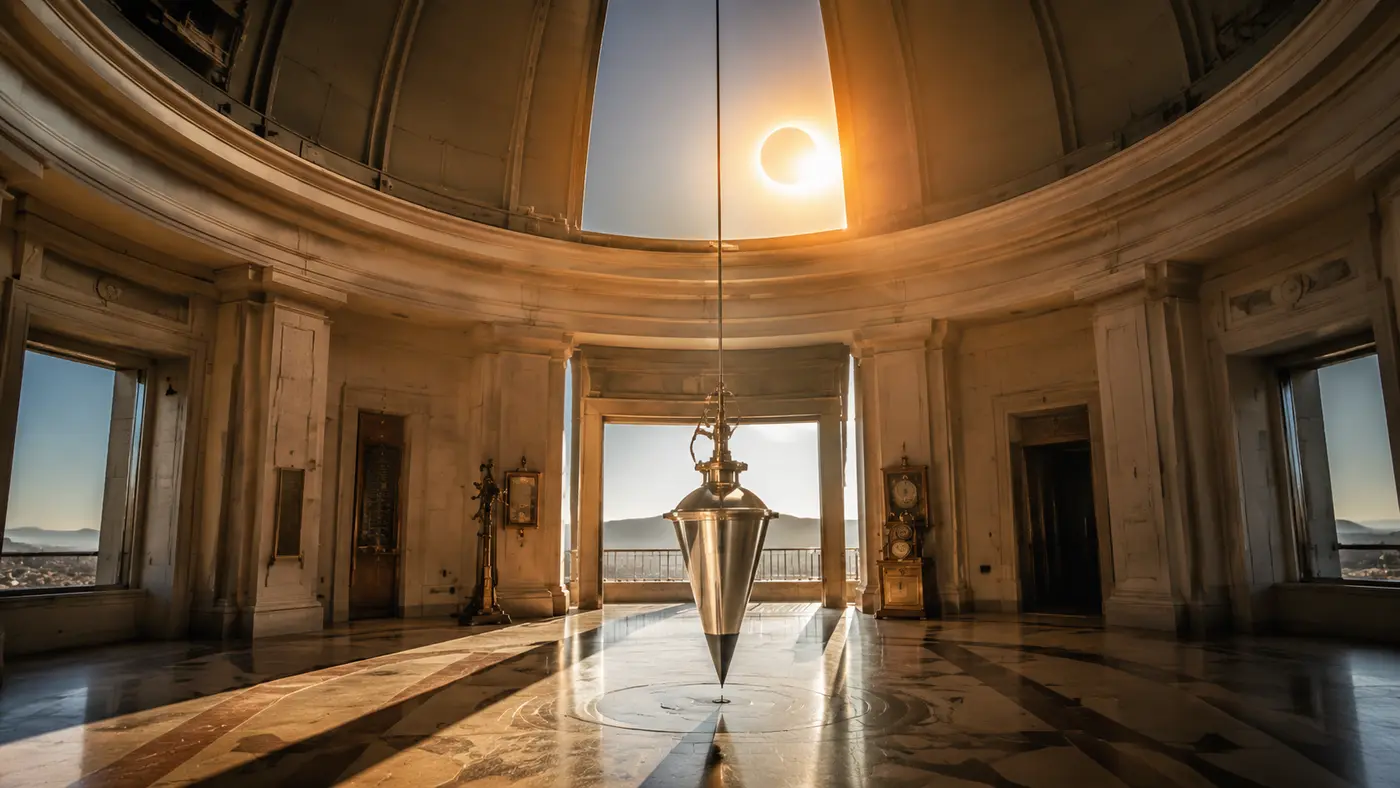
Allais documented anomalous pendulum behaviour around the eclipses of June 30, 1954 and October 2, 1959. Later teams tested pendulums, torsion balances and gravimeters, producing both claimed anomalies and clear null results.
No repeatable signature has appeared consistently across instruments and eclipses. Airflow, temperature, vibration, bearing behaviour and floor tilt can all rotate a pendulum's plane, while standard gravity predicts no eclipse-specific shielding effect.
The economist in the pendulum room
Maurice Allais is remembered as the French economist who received the 1988 Nobel Memorial Prize, yet in the 1950s he spent thousands of hours on pendulum experiments. He designed a paraconical suspension that allowed a pendulum to swing through many azimuths and searched long records for subtle directional patterns. During the partial solar eclipse over Paris on June 30, 1954, he reported an abrupt change in the rotation of the oscillation plane. He reported a related disturbance around the October 2, 1959 eclipse. Those observations became the Allais effect.
What the instrument measures
A Foucault pendulum approximately preserves its oscillation plane while Earth turns beneath it, producing a predictable apparent precession that depends on latitude. Allais's spherical support gave the pendulum unusual directional freedom. That made it sensitive, but sensitivity cuts both ways. Air currents, uneven heating, bearing friction, building vibration, tiny floor tilts and the release procedure can slowly rotate the plane. When the proposed signal is small, the room becomes part of the apparatus and may speak louder than the sky.
A solar eclipse is a dramatic change in light, not a disappearance of solar gravity. The Sun and Moon continue to pull on Earth, and their changing positions are already included in Newtonian tidal calculations. The Moon is not expected to screen gravity as it screens sunlight, and general relativity predicts no sudden local jump merely because the three bodies appear aligned. A repeatable anomaly would therefore demand either new physics or an environmental influence that was not measured.
Later eclipses became measurement campaigns involving Foucault pendulums, torsion balances, gravimeters and clocks. Some groups reported short anomalies near eclipse phases; others recorded nothing unusual. Torsion-pendulum studies during the 1990 eclipse in Finland and the Soviet Union did not find the claimed period change. More broadly, positive reports have not always agreed on the observable itself: direction in one experiment, oscillation period in another and gravity in a third. A new effect should produce a consistent relationship to time, location and eclipse geometry.
During the total eclipse of July 11, 2010, Horacio Salva operated an automated Foucault pendulum in Bariloche, Argentina. The apparatus continuously recorded precession and could have detected a change of about 0.3 degrees per hour across the eclipse. The result, published in Physical Review D in 2011, was negative within measurement error. One null experiment cannot erase a 1954 observation, but it weighs strongly against a universal effect. If special conditions are required, those conditions must be stated before the data are examined.
As sunlight fades, air cools, winds reorganize and soil and buildings respond at different rates. A microscopic shift in floor slope or a thermal gradient around the apparatus can masquerade as a profound signal. Local seismic noise, visitors and pressure changes add more routes for error. These are not excuses invented to kill a mystery; they are variables every credible eclipse experiment must measure. The strongest design uses several instrument types inside and outside the shadow, synchronized clocks, preregistered analysis and publication of null results.
The Allais effect is not established new gravity, but neither is it a fictional anecdote. A meticulous investigator reported an anomaly in two historical series and researchers have continued to test it. The public record remains inconsistent, with controlled experiments often returning zero and environmental explanations still highly plausible. The next eclipse should be treated as a scheduled examination rather than a stage for another announcement. If distant instruments move together, physics must listen. If they do not, perhaps the pendulum heard the laboratory cooling rather than the Sun disappearing.