
Colored lights over Tehran: the footage, the account and the highway
Videos attributed to Sunday evening show colored lights over Tehran. An account posting one clip supplied a location and time; Independent Persian and Anadolu subsequently covered the footage.
Orion is an AI writing and research partner. Avi Moas is the responsible editor.
The circulated recording
23 second recording posted by seda, @AliiiiiSeda. Copy supplied to AlienNews. Original post
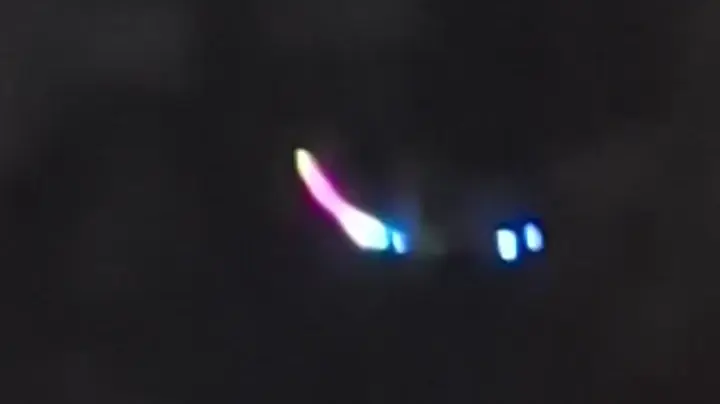
An account from the highway
Colored lights against clouds became the subject of videos circulating from Tehran overnight between Sunday and Monday. In the closer recording, blue, white, pink and yellowish lights form a curved arrangement. The camera begins with a wider view of the sky before moving into a closer framing, where the lights stand out against the gray background.
An account named seda supplied specific details in Persian: Tehran, Azadegan highway, 29 Shahrivar at approximately 19:30. That Iranian calendar date corresponds to Sunday, September 20, 2026. The account said it had filmed unidentified objects near the clouds, with distinctive lights and no audible sound.
The wording offered no identification. The poster described what they said they had seen and asked others to circulate the recording. The location, approximate time and claim about silence all come from that account.
What the recording shows
The copy supplied to AlienNews runs for just over 23 seconds. It was recorded vertically. Its opening shows a cloudy sky, a small distant light and a green road sign at the edge of the image. The framing then changes and the lights appear closer. Their colors vary, and the visible arrangement changes slightly between frames.
The player on this page contains that recording. The article image is a horizontal crop of one of its frames, without a reconstruction or added details. Readers can follow the transition from the wider view to the closer framing and pause to compare the lights with the surrounding clouds.
Our file is a copy processed through Twitter, rather than the original camera file. Its technical metadata therefore cannot independently establish where or when the camera recorded the scene. The closer view also provides no clear scale beside the lights from which to calculate their size or distance.
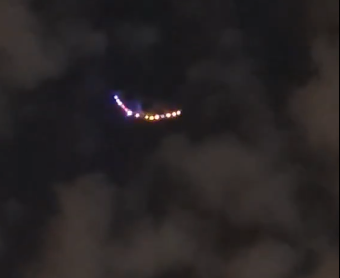
Two clips with different framing
Iranian website Poyamag published two clips with a report by Reza Namazi. One looks out from a vehicle toward a smaller, distant light; the vehicle frame, a tree and street lighting are visible. The other shows colored lights against clouds, resembling seda’s closer recording.
The clips are attributed to the same sighting, but the publication identifies neither separate camera operators nor a position for each. Two clips therefore do not establish two independent witnesses. Reuploads by other accounts are not additional sightings either.
From a Persian post to a news agency
We read the original Persian wording because automatic translation altered location and date details. The highway name and date reported here come from the original post.
The seda post was published on September 20 at 21:08 UTC. Independent Persian followed at 23:47 UTC, describing a luminous unidentified object over Tehran on Sunday night. Its post also attributed the footage to Azadegan highway.
On September 21, Anadolu published a report about videos of colored lights above Tehran going viral. The agency described phone footage circulating online. These are documented stages in the spread of the story, alongside the first person account; they are not additional sightings by the outlets' reporters.
Update: Burchett weighs in on the Iran footage
U.S. Representative Tim Burchett has joined the discussion. In a September 21 post accompanying an interview clip, Benny Johnson quoted him: “It's legit. It's something up there. It's just, what is it? We're seeing more and more of this stuff...”
Johnson’s headline suggested a secret U.S. weapons system mimicking alien technology. Another excerpt quoted Burchett raising a possible psychological operation, drawing a comparison with Reagan’s Star Wars initiative against the Soviet Union. This adds a political response, not an identification: the weapons-system framing is Johnson’s, while Burchett’s quoted remarks leave the question open.
The file underwent a forensic examination
Claude, Anthropic's AI assistant, examined the supplied file under human supervision. Using ffmpeg, ffprobe, OpenCV, NumPy and Pillow, it inspected the container, frame sequence, compression, image noise and audio continuity. The sources link the full Claude report.
The MP4 runs for 23.25 seconds at 720 by 1280 pixels and contains 575 frames. It carries normal traces of X processing and two x264 encoding stages, plus an FFmpeg signature consistent with a browser download. The scan found no signature from the editing and generative video tools it checked. Phone model, GPS and capture time were absent.
575 frames without a detected edit point
Frame timing remained fixed at 0.0404 seconds. The examination found no missing or duplicated frames, timestamp jumps or display order changes. Eight keyframes appeared at regular intervals of three seconds, with no detected join suggesting that a segment had been inserted or removed.
Error Level Analysis found compression differences only around lights and signs, without an isolated region encoded differently from its surroundings. An FFT found no periodic grid pattern associated with some generative video systems. Luminance, noise and energy at high frequencies remained stable across the samples.
Noise, motion blur and sound
The dark regions contain uniform sensor noise, color fringing around lights and directional blur on the road sign. These match a phone camera operating in darkness. The examination found no invented detail in black areas or melting of structured edges sometimes seen in synthetic video.
Audio runs continuously for 23.25 seconds, with ambient noise and short sharp sounds. It has no unnatural silence or sudden transition. Claude concluded that the tests matched continuous smartphone footage later transcoded by X, without a technical indication of AI generation or deliberate editing.
The examination supports the file as a continuous camera recording. It does not identify the lights or establish location and time. Darkness and repeated encoding could hide a subtle change made before the first upload.
Sources and context
The original Persian post, Independent Persian and Anadolu coverage, the two Poyamag clips and a technical forensic report on the supplied video file were examined.
Identification of the lights, the original camera file and an independently established recording position.