


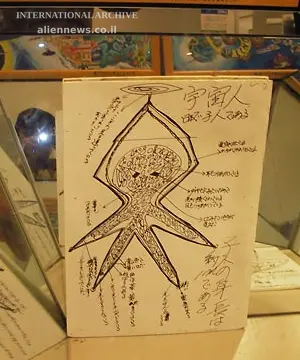
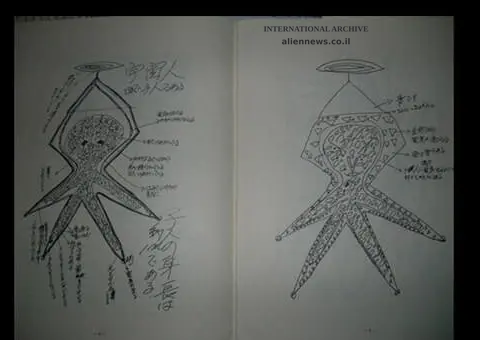
A knock came at three in the morning. This is the being Fujiwara drew
Yoshihiro Fujiwara said knocking and barking drew him outside, where a short figure stood near an orange craft. The story later expanded into space journeys and telepathy. The drawings survive, but the event rests on his testimony alone.
Avi Moas, Researcher and Editor-in-Chief · Produced with an AI-assisted newsroom

How Fujiwara drew the being and the craft
The drawings document the testimony. They are not photographs of the being or craft.
The knock that woke him
At about three in the morning on 6 April 1974, Yoshihiro Fujiwara, a 28-year-old farmer in Nikoro near Kitami, said knocking at the door and barking dogs woke him. Outside, he reported a figure about one meter tall. He described a dark wet looking body, a large head, bright eyes and four arm like limbs. This is one witness's description, not a photograph of the being.
An orange craft above the field
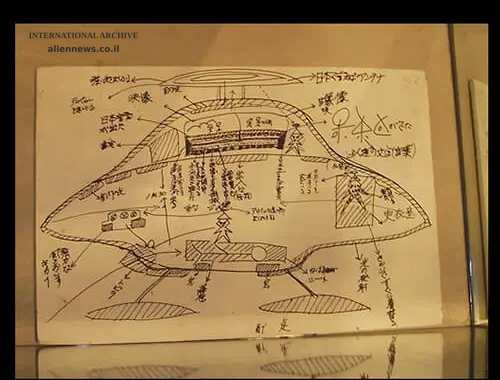
Fujiwara said an orange craft about 8 meters wide and 1.5 meters high hovered nearby. When he tried to flee, he reported hot air rising beneath him and being pulled inside. He said he jumped out after it landed and found himself about 3 kilometers from home. No ground measurement or second witness confirms the distance or the craft's motion.
The drawings carry the visual record
A display at the Iino UFO museum preserves a drawing attributed to Fujiwara. It shows a broad headed figure with long limbs and Japanese annotations. Another drawing depicts the craft and its parts. These are witness drawings. They show what Fujiwara wanted to describe, not a photographed scene outside his home.
The story expanded within days
Later versions say Fujiwara felt heat in his ears and trembling fingers that evening, then claimed to bend a spoon and receive telepathic messages. On 8 April, the story says, he traveled with two friends to a meeting place and entered the craft again. The friends are not described as witnesses to the journey itself. A further trip was attributed to him on 13 April. These are later layers of testimony, not verified findings.
The earliest issue still needs examination
The Japanese source displaying the museum drawing points to an article by Kinichi Arai in a special July 1974 issue of a UFO journal. A complete copy matters because it could show which details were present three months after the event and which emerged later. Without it, the account's development cannot be dated with confidence.
No official response closes the case
No public police, air force or local authority record has been located that determines what happened at Nikoro. Later claims about devices in Fujiwara's ears and unusual abilities are not accompanied by a complete medical report or controlled test. The file remains a detailed personal account with drawings, but without sufficient independent support.
What can be said now
Fujiwara reported an unusual encounter and produced detailed drawings that became part of Japanese UFO culture. The drawings do not prove an abduction or space journey. The case is strongest as a traceable story and visual testimony. It is weakest where independent records from the night should be.
The three nights do not carry equal weight
The first event contains the knock, figure and craft he said he saw nearby. Later encounters enter a story already involving telepathic messages and journeys. Combining everything into one encounter gives later details the status of the first report. A clear timeline shows how the claim expanded within a week and what evidence each stage would require.
A museum preserves testimony, not the event
Displaying the drawing at the Iino museum gives the public a clear source for the surviving image. It does not make the museum a witness. Its role is preservation: keeping the drawing, annotations and attribution to Fujiwara. Historical work begins with that object and moves backward to the 1974 issue and any local records that can still be located.
Documented. Fujiwara's name, date, encounter narrative and attributed drawings appeared in Japanese publications. A museum display photograph preserves one drawing.
Under review. No encounter photograph, second witness to the initial event, complete police or medical report, or physical material with a chain of custody is available. A special Japanese issue from July 1974 is cited by later sources but has not been examined here in full.
Found another source or a detail to correct? Let us know.


