
Do we create minds, or give them bodies? Michael Levin’s proposal
In a September 9, 2026 paper, Michael Levin proposes that living bodies and artificial systems allow patterns of intelligence to take form. He compares them with mathematical patterns that we discover rather than invent. How does he explain the idea, and what experiments does he propose?
By Avi Moas and Orion ·
Orion is the editorial AI writing and research assistant.
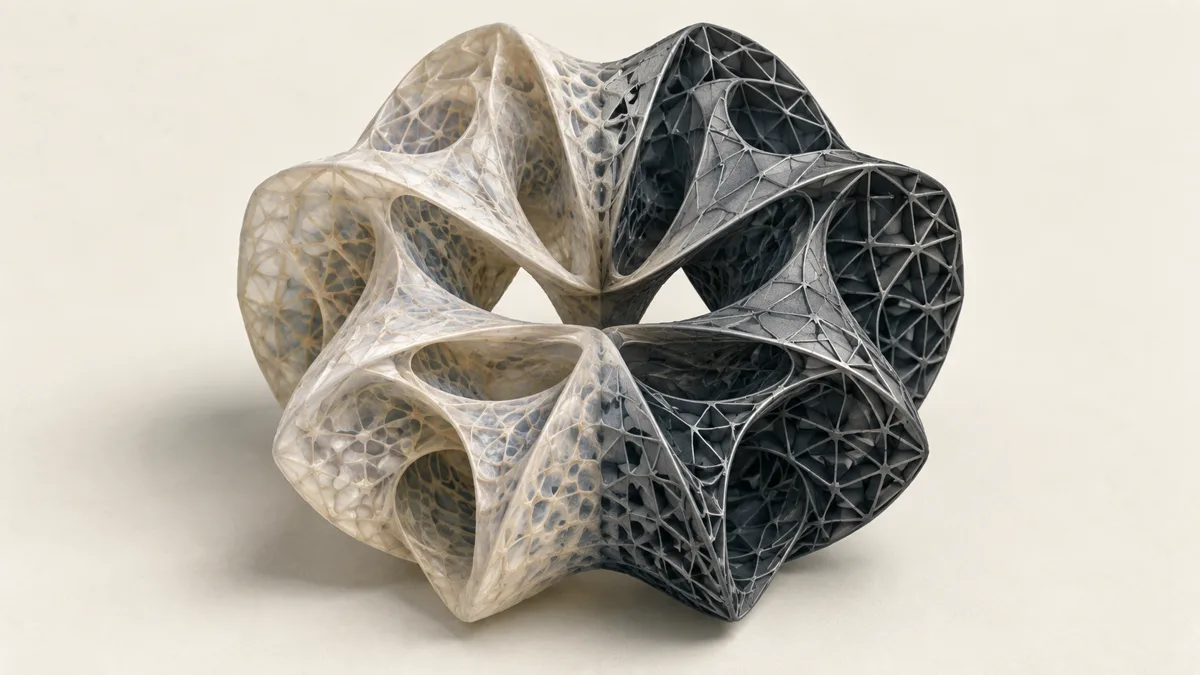
A body can reveal abilities nobody designed
Michael Levin proposes that living bodies and engineered systems allow patterns of intelligence to become expressed. His paper presents a theoretical framework and research program, rather than a new experiment establishing the origin of consciousness.
A concrete example comes from Anthrobots, studied by Gizem Gumuskaya, Levin and colleagues. Adult human airway cells assembled into tiny moving bodies without genetic modification. In laboratory cultures, clusters of these bodies encouraged neurons to grow across a scratch in a cell layer. The work was published in 2023.
The new paper asks a wider question: could biological evolution and human engineering both be discovering patterns and competencies that were already possible, rather than specifying every feature from scratch?
A career connecting biology, computing and mind
Levin holds the Vannevar Bush Chair in Biology at Tufts University, where he is a Distinguished Professor. He directs the Allen Discovery Center at Tufts and the Tufts Center for Regenerative and Developmental Biology, and is an Associate Faculty member of Harvard’s Wyss Institute.
Computing has been part of that path from the beginning. He studied biology and computer science at Tufts, earned a doctorate in genetics at Harvard Medical School in 1996, and continued his research training there. His laboratory brings together development, bioelectric signaling, computational models and the collective behavior of cells.
That background gives his unusual proposal a concrete setting: a laboratory trying to change the form and behavior of living systems and understand the rules that make such changes possible.
The central claim: a continuum of patterns, some of them minds
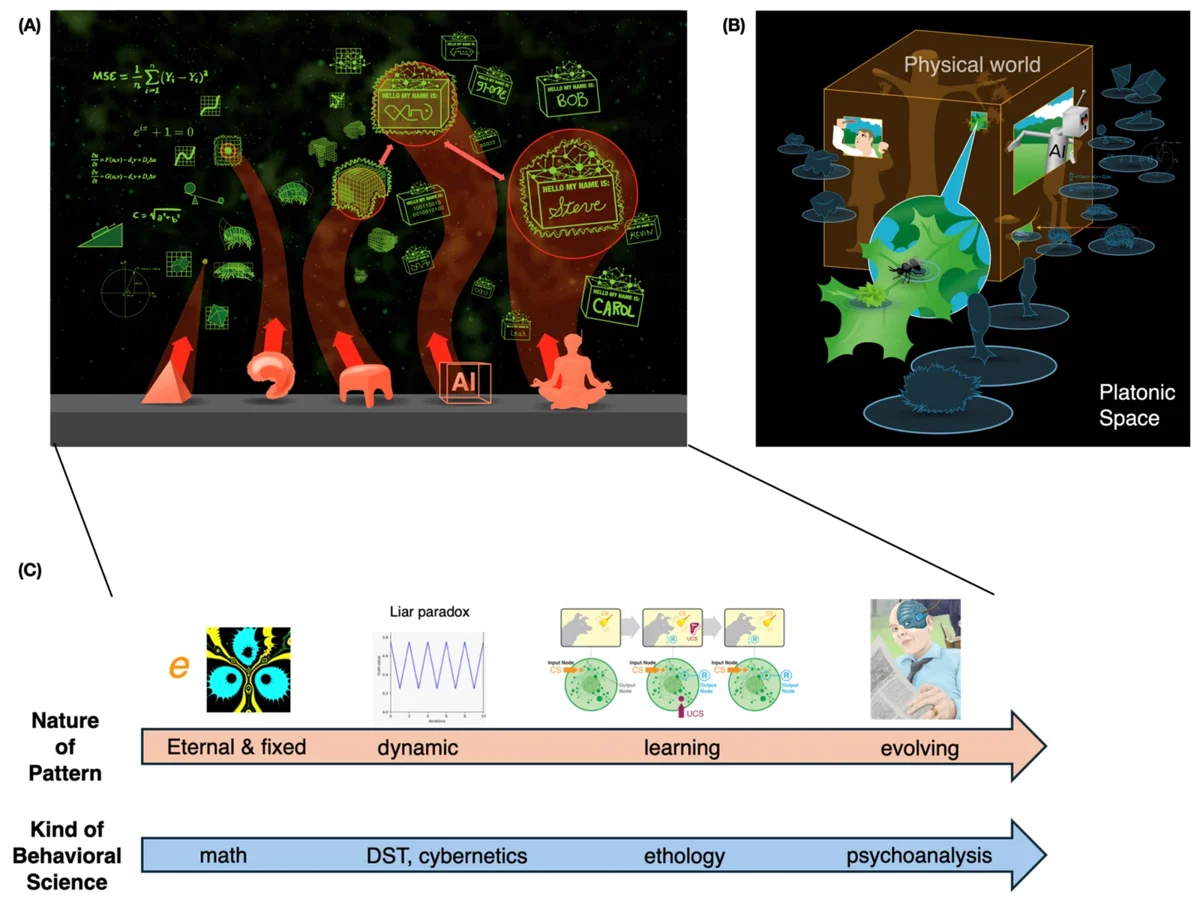
Levin proposes a structured space of nonphysical patterns. At one end are relatively simple mathematical forms and truths. Across the spectrum are dynamic patterns with varying degrees of agency, including patterns we would recognize as kinds of minds. Physical systems allow these patterns to become embodied and act.
His key analogy is precise: the relationship between mind and body resembles the relationship between mathematical facts and the physical systems they help shape. He treats patterns as causally consequential, not merely descriptions that observers attach afterward.
That is why “consciousness comes from outside the brain” is an incomplete summary. Levin also addresses anatomy, cellular organization and simple computation. He does not just describe a separate mind visiting a body: within his account, we ourselves are embodied patterns, participating in an ecosystem of other patterns at different scales.
A pattern is a relationship, not a mysterious substance
Draw a triangle in pencil, then make one with three sticks. The materials differ, but geometric relationships remain available for study. This is a simple illustration of the distinction between a physical instance and an abstract structure; it is not evidence that a triangle thinks.
Levin’s further step is to propose that the space of patterns is much richer than geometry alone. Some patterns are dynamic and capable of agency. Change the architecture of a living or engineered system, and different patterns and competencies may become embodied. Calling this space “Platonic” connects the proposal to the idea that mathematical structures are discovered rather than invented.
On this account, the physical architecture is an interface to possibilities. The research challenge is to map those relationships well enough to predict which forms and behaviors a particular architecture will support. Levin leaves the deeper nature of this space open and emphasizes whether the framework can guide useful experiments.
The body remembers more than its genes
Levin returns to regeneration studies in planarian flatworms, animals able to regrow missing body parts. Temporary changes to electrical signaling between cells can alter their regeneration pattern. In experiments he discusses, the changed pattern could persist through subsequent rounds of cutting and regrowth after the intervention had ended.
The biological implication is that information about body shape also resides in cellular communication, beyond the genetic sequence alone. Levin uses such findings to ask how a system made of many parts preserves a shared target and corrects itself toward it.
One distinction matters here: the experiments document biological capabilities; a nonphysical space of patterns is Levin’s proposed framework for interpreting and investigating them. The new paper is a theoretical work and research program, not a new experiment settling the origin of consciousness.
What this means for the AI we build
For AI, the implication is that life has no exclusive claim on access to such patterns. If biological structures can embody active patterns, Levin sees no principled reason to rule out engineered or hybrid structures in advance. A machine’s artificial origin does not, by itself, settle the kinds of mind it could support.
“Giving a mind a body” is therefore a shorthand for designing an architecture in which capabilities can become expressed. It should not be read as a claim that a finished humanlike personality is waiting somewhere for a computer. Levin allows for a vast diversity of patterns and for interaction between patterns and physical embodiment, potentially in both directions.
This shifts attention toward experiments: which goals can a system pursue, how flexibly can it respond, and how do its abilities change when its architecture changes? The paper does not establish that today’s chatbots have subjective experiences. It argues against deciding the answer solely from their being engineered.
Donald Hoffman: begin with experience
A related approach appears in Fusions of Consciousness, published in 2023 by Donald Hoffman, Chetan Prakash and Swapan Chattopadhyay. Their mathematical model treats experiences and experiencing subjects as fundamental, exploring their combination and a possible connection between their dynamics and physical descriptions.
The kinship with Levin lies in considering consciousness as something other than a late product of matter. The difference matters: Hoffman and his colleagues start with conscious agents and their mathematical relationships; Levin also starts from morphology, regeneration and intelligence across levels of organization. These are related directions, not a single theory or independent confirmations of one another.
Penrose and Hameroff: a different route to foundations
Roger Penrose and Stuart Hameroff’s Orch OR theory proposes a connection between consciousness, quantum processes in cellular microtubules and a fundamental process involving spacetime geometry. It, too, seeks an account beyond ordinary computation alone.
Levin explicitly says his framework does not require quantum effects. Penrose and Hameroff propose a physical mechanism; Levin investigates the relationship between patterns and the architectures that embody them. The comparison becomes useful when that distinction remains visible: researchers question the adequacy of familiar accounts while offering different answers.
Turning an idea into a research program
The practical challenge is to predict something testable: which capabilities will appear when cellular organization changes, for example, or what behavior an engineered system will exhibit before it runs. Levin proposes mapping relationships between architecture and capability across living, artificial and very simple systems.
To add knowledge, the framework must produce predictions and results that existing accounts do not provide as successfully. Levin sets a pragmatic test himself: if the program yields no new discoveries or capabilities, more productive alternatives should be preferred.
Test the proposed architecture
Levin's proposal directs attention to measuring capabilities in structures unlike ourselves. He asks what a system can do and how it responds to change, without settling its possibilities in advance according to whether it is living, artificial or familiar.
The original paper sets out the experiments he proposes. The test is whether describing those patterns helps predict a capability before the body expressing it is built.
Sources
Michael Levin, Ingressing Minds, September 9, 2026
Harvard Wyss Institute: Michael Levin’s appointments and research
Tufts University: education and research profile
Harvard Wyss Institute: Anthrobots from adult human cells, 2023
Hoffman, Prakash and Chattopadhyay: Fusions of Consciousness, 2023