

The next cut revealed the surprise
In a study published in 2017, some planarian fragments treated in Michael Levin’s laboratory grew two heads. Further cuts after treatment had ended could bring back the altered form, including in worms that had initially looked normal.
The researchers had briefly disrupted communication channels between cells using octanol. About a quarter of the fragments initially grew two heads. Later rounds of regeneration changed the question. This was no longer simply about producing an unusual animal. Something in apparently normal tissue had retained the possibility of building a different body.
A book waiting in a secondhand shop
Levin's route into this work connected biology with computing. In a Wyss Institute interview, he recalled finding Robert Becker's The Body Electric in a Vancouver secondhand bookshop in 1986. It introduced him to older research on electrical activity in tissues that he had not encountered in his textbooks.
Cells outside the nervous system also maintain voltage differences across their membranes. Ion channels and connections between cells help those signals participate in tissue coordination. Levin asks how groups of cells build, repair and stop. Here, anatomical memory means retaining a target form, rather than remembering an experience as a person does.
Give the cells a different body
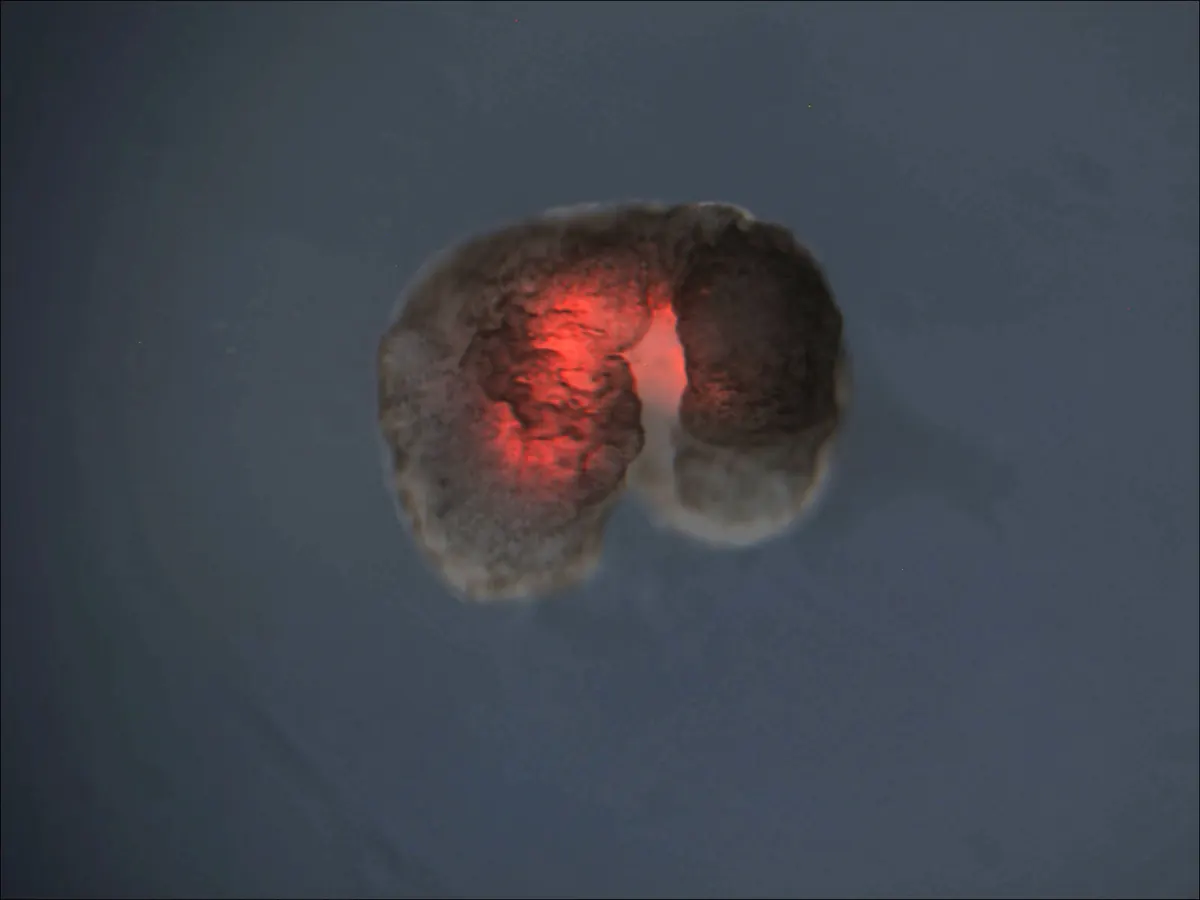
In 2020, researchers at Vermont and Tufts introduced xenobots assembled from embryonic frog cells. An algorithm explored shapes in simulation, and researchers built living versions using skin and heart muscle cells. The red region in the lead photograph marks muscle tissue.
Cells from a frog were participating in a structure that was not a frog. Contracting tissue enabled movement, and the team investigated repair after damage. Proposed uses such as carrying substances inside the body were future possibilities. The achievement already on the bench was more modest and more tangible: living material functioning in a new arrangement.
In 2026, nerve cells joined the experiment
On March 16, 2026, Tufts reported neurobots. Levin and Haleh Fotowat's team incorporated neural precursor cells into structures made from frog cells. Branching networks developed, with calcium imaging indicating neural activity. Bodies containing neurons acquired different shapes and movement patterns from those without them.
The experiment asks what a nervous network does in a body that has not inherited the developmental programme of a complete animal. Electrical activity alone does not establish an inner experience. It does provide something to image and measure: cells forming new connections within a body capable of movement.
The experiments behind Levin’s model
Using these signals for tissue repair requires understanding when they act, which cells respond and how growth can be confined to the intended place. The worm experiments examine changes in body shape; they are not a treatment tested in humans.
The linked 2017 Tufts publication describes the repeated cuts. The detail still requiring explanation is what persisted in the tissue after treatment had ended, allowing it to grow two heads again.
Hear the researcher
Michael Levin at TED: The electrical blueprints that orchestrate life. In English.