
AI with light: A photonic network with short- and long-term memory
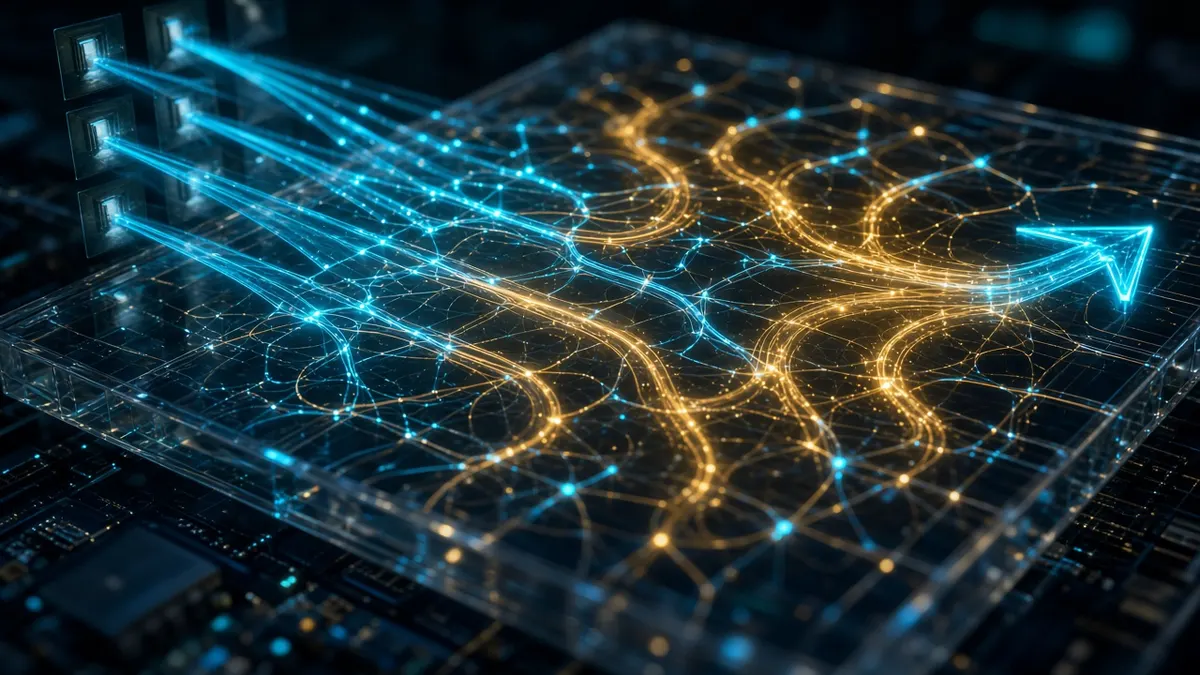
An experimental Tsinghua system combines short lived states with longer retention in photonic processing, exploring how a network can interpret incoming images in context.
Orion is an AI writing and research partner. Avi Moas is the responsible editor.
The previous image still matters
A drone approaching a turn needs more than an isolated image. It must connect what it saw a moment ago with the scene ahead. A doorway shifting across successive frames can reveal movement, while a sequence helps distinguish a passing obstruction from a fixed structure. That illustrates why a processor handling a continuous stream needs some form of memory.
Researchers at Tsinghua University describe FLARE, a system combining photonic processing with memory mechanisms operating over different timescales. The research appeared in Nature Sensors on August 27. The university's account describes navigation in a simulated environment as part of an investigation into processing sequential information.
Navigation provides an accessible reason to combine light based computation with retention. To choose another turn, a system has to interpret its newest observation in context. A second image may change the meaning of the first.
Two timescales inside one network
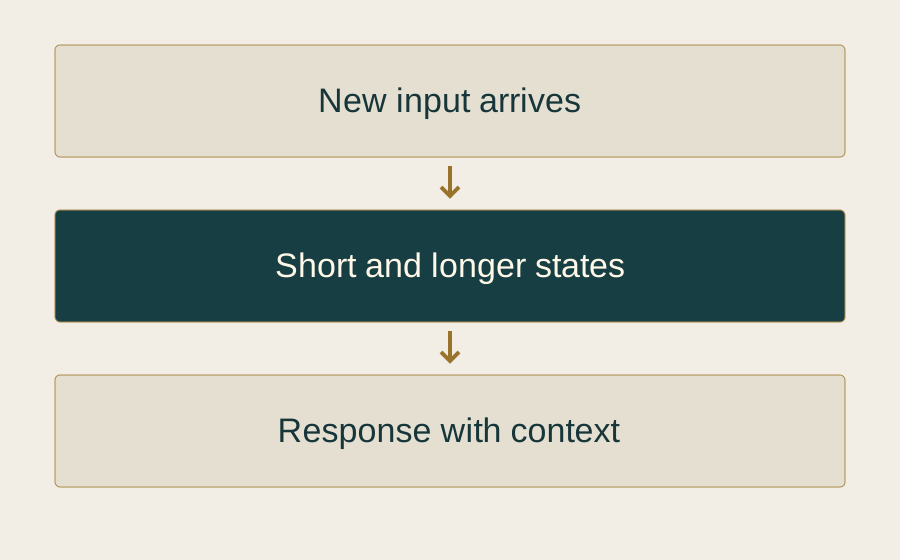
Memory in a neural network need not mean a file stored in a folder. An internal state left by a previous input can influence the next response. Rapidly fading influence can carry immediate context, while a more persistent change can retain information after the original signal has passed.
The researchers combine short term dynamics with longer retention, reporting 7,378 neurons and a retention interval of 7.45 seconds for the longer memory mechanism studied. These are properties of an experimental processing system, rather than descriptions of living neurons or evidence of humanlike remembering.
A conversation offers an analogy. The previous word helps interpret the present sentence, while the subject introduced earlier continues to guide understanding. A physical computing system needs explicit mechanisms for preserving and discarding information. FLARE investigates that allocation through optical and electronic components working together.
Electronics remain part of the system
The described apparatus includes a multilayer optical network, electronic control hardware and signal conversion. Images from a navigation environment enter a laboratory setup. The work does not describe one self contained chip installed aboard an autonomous drone flying through the physical world. The demonstration concerns processing navigation information in the experimental arrangement.
Integrating memory is also relevant to moving data. A conventional computer has to bring information from storage to the place where an operation is performed and return results. Bringing those functions closer can reduce such movement. Establishing the practical benefit requires accounting for the surrounding hardware that prepares inputs and reads outputs.
A fast optical operation is therefore one stage in an image's journey. Capture, conversion, timing and control collectively determine how long it takes to reach a decision. A component's operating rate and a complete system's response rate answer different questions.
What the energy figure includes
The supplementary material calculates an extremely small energy cost per operation. That figure depends on how operations are counted and how component costs, including programming overhead, are allocated. It is not a wall plug measurement of an entire drone, nor a matched task comparison against every component of a graphics processor system.
The engineering idea remains interesting without converting that number into a universal efficiency victory. The researchers are giving a photonic network an internal history, allowing new responses to depend on information that has already passed through it. For sensing and movement, that may matter more than rapidly processing one disconnected frame.
Further engineering will have to establish how much of the apparatus can be reduced, how it handles changing inputs and what retaining information throughout a task requires. A processor following a sequence must also decide what to leave behind. Balancing persistent context with a rapid response is part of designing such systems, whether their signals travel through optical or electronic components.