


The DNA Pioneer Who Said Life Was Planted Here on Purpose, and Asked Whether "the Senders" Are Still Alive
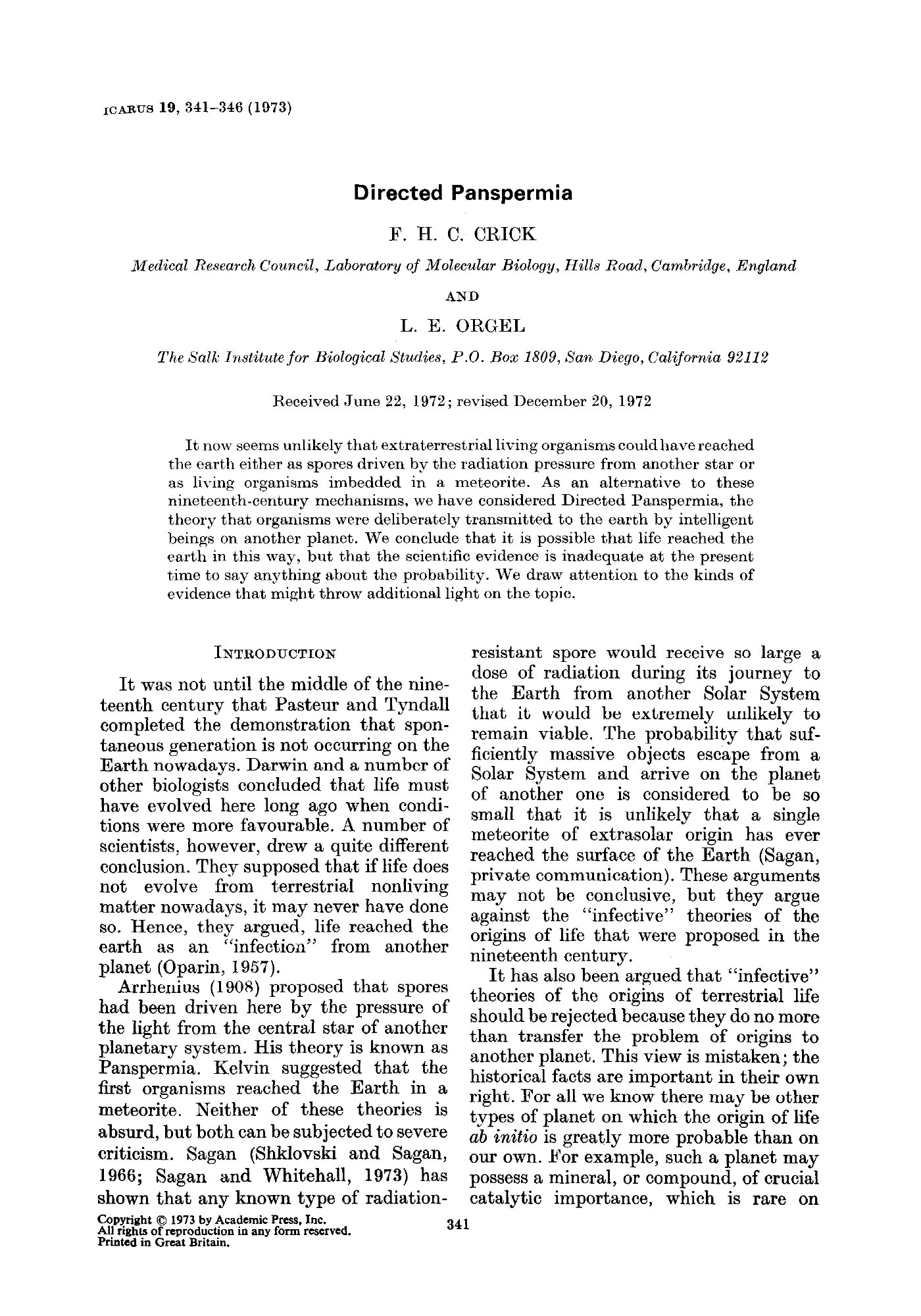
In 1973 Nobel laureate Francis Crick and chemist Leslie Orgel published "Directed Panspermia" in Icarus, the journal then edited by Carl Sagan. According to the paper, life on Earth may have been planted here deliberately by a technologically advanced society on another planet. Their clue was the genetic code, which nearly every living thing on Earth reads in the same language. Forty years later, two researchers in the same journal argued that the code carries a "Wow! signal" of its own.

By Avi Moas
Sources and editorial method
Avi Moas, Researcher and Editor-in-Chief · Produced with an AI-assisted newsroom
Directed Panspermia: Crick and Orgel, 1973
The manuscript reached Icarus on June 22, 1972. Icarus is a scientific journal of solar system studies, and from 1968 to 1979 its editor-in-chief was the astronomer Carl Sagan. The first author's name was known in every lab in the world: Francis Crick, who worked out the double-helix structure of DNA with James Watson and shared the 1962 Nobel Prize for it. Next to him signed the chemist Leslie Orgel of the Salk Institute for Biological Studies in San Diego, who studied the origin of life.

The paper, "Directed Panspermia," appeared in 1973 in volume 19 of Icarus, just six pages long. Its proposal is sharp: it is possible, Crick and Orgel wrote, that "a primitive form of life was deliberately planted on the Earth by a technologically advanced society on another planet."
They did not reach the idea alone. In the acknowledgments they wrote that it crystallized at a meeting on Communication with Extraterrestrial Intelligence at Byurakan Observatory in Soviet Armenia, in September 1971. They thanked Freeman Dyson, Tommy Gold and Carl Sagan "for discussion and important comments on our argument."
An unmanned spaceship with a payload of microbes
According to Crick and Orgel, the time was simply there. Our galaxy is far older than the solar system, and Earth-like planets may have existed as much as 6.5 billion years before it formed. Not much more than 4 billion years passed between the appearance of life here and the rise of our own technological society. So, they wrote, technological societies could have existed elsewhere in the galaxy even before the Earth formed.
They even described the vessel: a special long-range unmanned spaceship with a payload of about 1,000 kilograms, for example 10 samples each holding 10 to the power of 16 microorganisms, such as blue-green algae that grow on carbon dioxide, water and light. The ship need not hurry. At one-thousandth of the speed of light, by their calculation, most planets in the galaxy could be reached within 100 million years. Several thousand stars lie within 100 light years of us and could be reached within a million years even at 60,000 mph.
And the motive? Crick and Orgel wrote that such a programme would be carried out as a demonstration of technological capability or, "more probably, through some form of missionary zeal." If a society became convinced it was alone in the galaxy, they wrote, its motivation for "polluting the galaxy" would be strong.
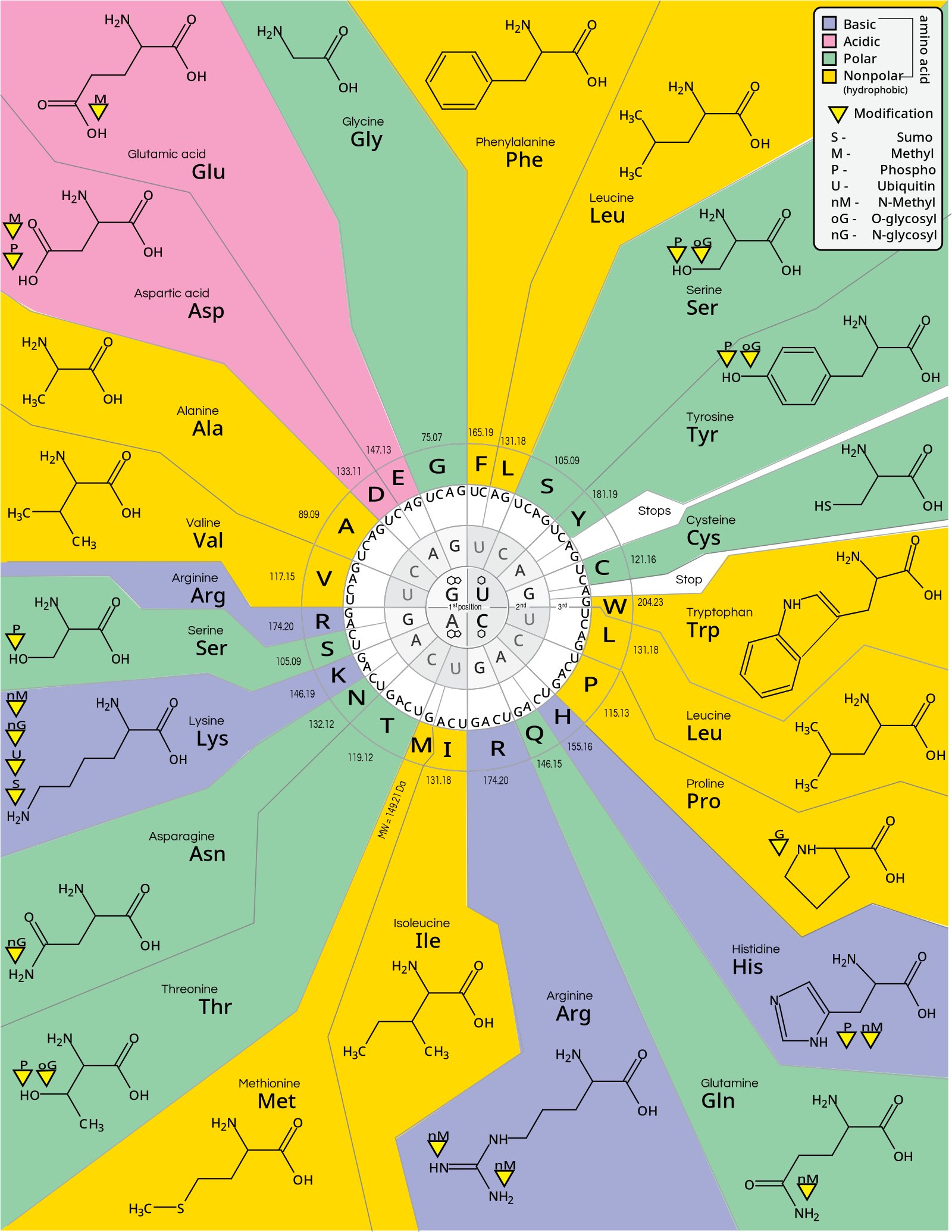
The genetic code: the clue inside every cell
They offered two clues from biology itself. The first is molybdenum, an element whose abundance on Earth is just 0.02%, according to the figures in the paper, yet which plays an important role in many enzymatic reactions. Chromium and nickel, far more common, are relatively unimportant in biochemistry.
The second clue is the genetic code. Nearly every living thing on Earth, from bacteria to humans, reads its genes with the same dictionary: the same three-letter DNA words translate into the same amino acids. According to Crick and Orgel, none of the orthodox explanations was fully convincing, and "it is a little surprising that organisms with somewhat different codes do not coexist." Their answer: if life was planted here deliberately, "life on Earth would represent a clone derived from a single extraterrestrial organism."
"Are the senders or their descendants still alive?"
On the last page of the paper, Crick and Orgel called for present-day organisms to be scrutinized for "any vestigial traces of extraterrestrial origin." Then came the passage that keeps this paper quoted to this day:
"Are the senders or their descendants still alive? Or have the hazards of 4 billion years been too much for them? Has their star inexorably warmed up and frizzled them, or were they able to colonise a different Solar System with a short-range spaceship? Have they perhaps destroyed themselves, either by too much aggression or too little?"
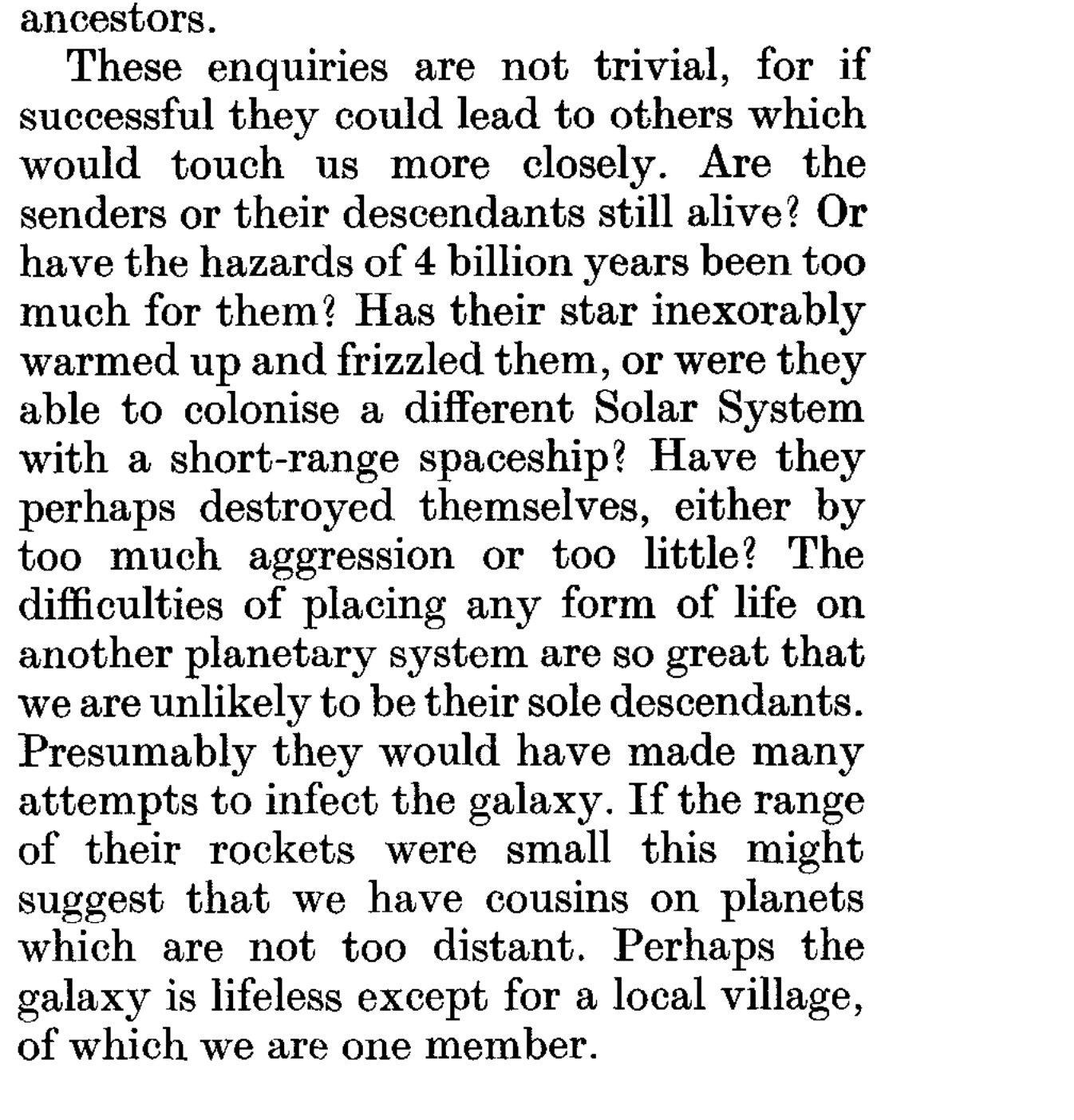
They went on: the difficulties of placing life on another planetary system are so great that we are unlikely to be their sole descendants. They would have made many attempts. And if the range of their rockets was small, we may have cousins on planets not too far away. "Perhaps the galaxy is lifeless," they wrote, "except for a local village, of which we are one member."
The paper closes with a warning: according to Crick and Orgel, under no circumstances should we risk infecting other planets with Earth life at the present time, before we know far more.
Forty years later: a "Wow! signal" inside the code
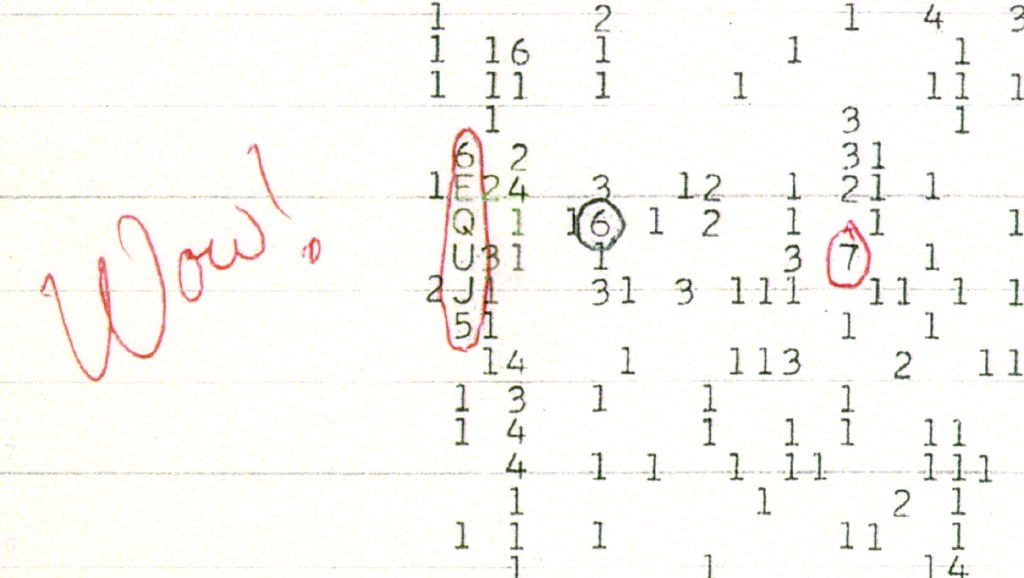
On August 15, 1977, the Big Ear radio telescope of the Ohio State University Radio Observatory picked up a narrowband radio signal from the direction of the constellation Sagittarius. A few days later astronomer Jerry Ehman went through the printout, highlighted the signal's six characters in red pen, and wrote "Wow!" in the margin. It has been the most famous signal in the search for extraterrestrial intelligence ever since.
In 2013, forty years after Crick and Orgel, the same journal, Icarus, published "The 'Wow! signal' of the terrestrial genetic code." Its authors were mathematician Vladimir shCherbak of al-Farabi Kazakh National University and astrophysicist Maxim Makukov of the Fesenkov Astrophysical Institute in Almaty. Submitted in June 2012, it went through two rounds of revision and three reviewers, and appeared in volume 224 of Icarus in May 2013. The authors cite Crick and Orgel in the introduction.
Their idea is a direct continuation of 1973. According to the authors, the genetic code "is the most durable construct known," unchanged for billions of years, and therefore an ideal place to leave a signature. A radio signal like Wow! depends on time of arrival, frequency and direction. A signature inside a living cell copies itself and travels on. By their count, the code has room for 384 bits of information.
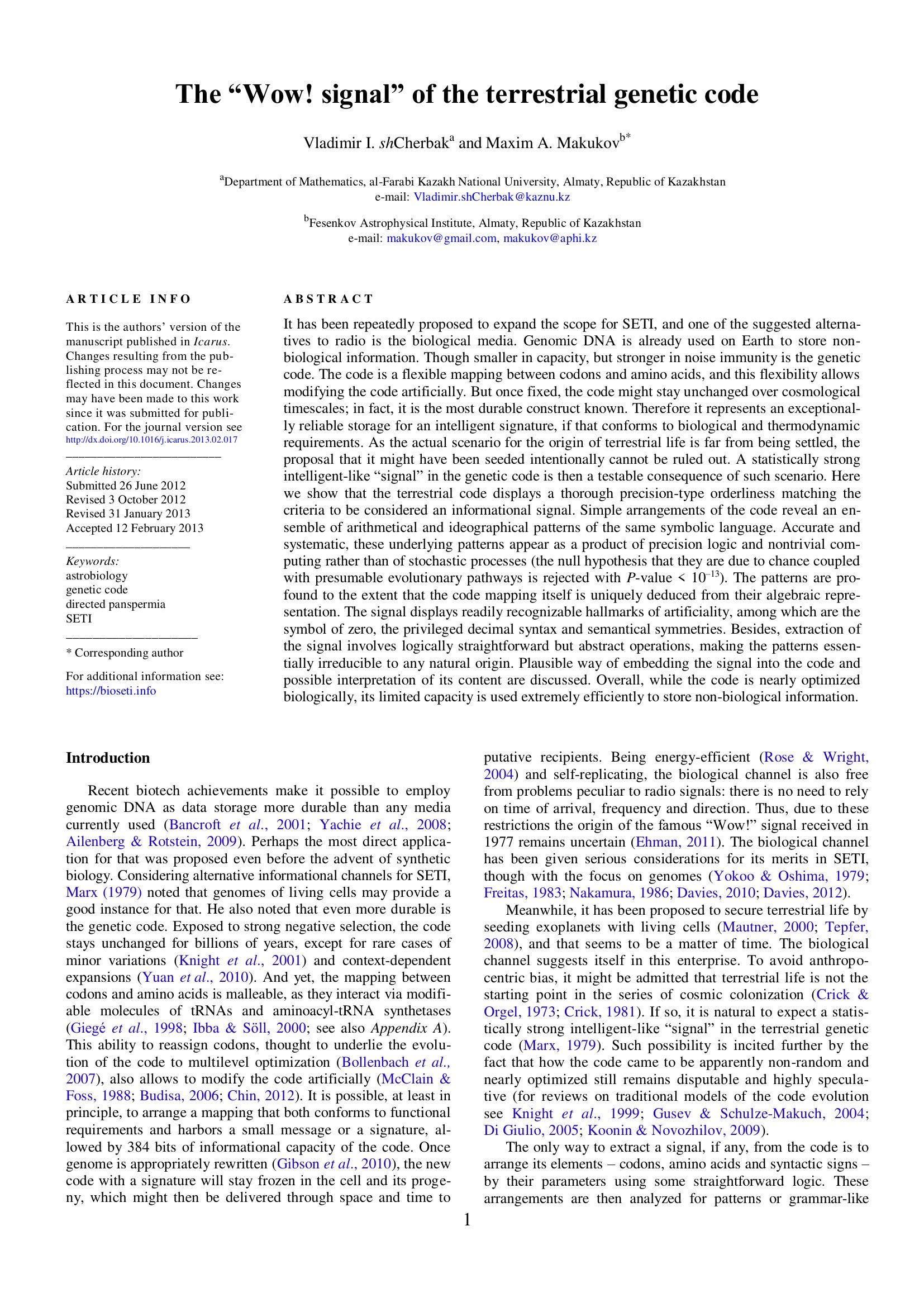
A message in the genetic code: 999 = 999
What did they find? According to the authors, simple arrangements of the code reveal precise arithmetical patterns. Nucleon sums of the amino acids balance one another, for example 999 against 999, and are written in the decimal system. Every three-digit repdigit from 111 to 999 appears in them at least once. The code also carries a symbol of zero: according to the authors, the stop codons, which tell the cell where a gene ends, act as zero, exactly in the position where it keeps the symmetries intact.
The authors also describe an "activation key." Transferring a single nucleon, in the abstract, within the amino acid proline switches the balances on. Without it you get, for example, 1002 against 999. According to shCherbak and Makukov, that is exactly how to embed a signature that no natural process can explain: the patterns appear only to someone who knows how to compute them.
In their statistical test, the chance that the patterns arose by chance coupled with known evolutionary pathways is below one in ten trillion. And about the decimal system inside the code, they wrote one sentence: "it appears that it was invented outside the Solar System already several billions years ago."
A message in DNA: from Marx and Yokoo to Davies and Rempel
Crick and Orgel, and shCherbak and Makukov after them, are not the only ones. Since 1979 scientists have published, in scientific journals, the idea that an advanced intelligence planted life here on purpose and left a message inside DNA or inside the genetic code.
George Marx, 1979. The Hungarian physicist of Eötvös Loránd University in Budapest published "Message through time" in Acta Astronautica. According to shCherbak and Makukov, who cite him in the opening of their paper, Marx proposed that the genomes of living cells could serve as a channel for the search for extraterrestrial intelligence, and noted that the genetic code is even more durable.
Hiromitsu Yokoo and Tairo Oshima, 1979. The same year, while Sagan was still editing Icarus, two Japanese researchers from Kyorin University and the Mitsubishi-Kasei Institute of Life Sciences published "Is bacteriophage φX174 DNA a message from an extraterrestrial intelligence?" According to the authors, a simple biological system carrying a message and capable of self-replication may be one possible channel for interstellar communication. They drew the virus's DNA sequence in four colours and in digital codes, looking for a picture. Their first experiment did not yet show a clear pattern, and they planned to continue with other phage DNAs.
Hiroshi Nakamura, 1986. Seven years later the Tokyo researcher published a paper in Acta Astronautica whose title is a question: "SV40 DNA—A message from ε Eri?" Epsilon Eridani is a Sun-like star about ten light years from us.
Paul Davies, 2012. The physicist, of the Beyond Center at Arizona State University, proposed in Acta Astronautica to look for footprints of alien technology inside genes too. According to Davies, if an alien expedition wished to leave a lasting message, "a good way of doing that would be to upload the message into the genomes of terrestrial organisms." In the same paper he cited Crick's hypothesis "that the original life on Earth was deliberately seeded by aliens."
Makukov and shCherbak, 2014 and 2017. After the Wow! paper, the two Almaty researchers went further. In 2014, in Life Sciences in Space Research, they asked whether it would be ethical to leave intelligent beings who evolved from the seeds "unaware of the fact that life on their planet derives from seeding activity by a preceding civilization." Their answer: "as a suitable and perhaps the only workaround, the message might be put inside the seeds themselves." In 2017, in the International Journal of Astrobiology, they named their idea the "we-are-them hypothesis": according to the authors, the word "aliens" is something of a misnomer here, "as the senders and the seeds' descendants share the same cellular ancestry." In the same paper they set out a formal method for retrieving the signature, and wrote that the attributes they found "maintain some of the most universal codes of culture."
Max Rempel, 2025. The San Diego geneticist, who holds a PhD in biology and founded the DNA Resonance Research Foundation, published a May 2025 report titled "Preliminary evidence of traces of alien genetic manipulation in humans." He analysed DNA from 581 families in the 1000 Genomes Project and, by his account, found 11 families in which children carried large DNA fragments that matched neither parent. In the strongest case, according to Rempel, a 16-kilobase fragment was replaced on both chromosomes at once, in a cluster of 348 variants. The children were born before 1990, long before gene-editing technology of that kind existed. "This is strong evidence for extraterrestrial genetic manipulation," he wrote.
The question still open
In 1974 humanity itself beamed a message into space from the Arecibo radio observatory, and DNA was part of it. The story of the reply drawn in a wheat field in 2001. shCherbak and Makukov cite such messages in their paper: if we put DNA and decimal numbers into our messages, perhaps someone did the same before us, only inside DNA itself.
And more than fifty years after Crick and Orgel wrote it, their question still stands: are the senders or their descendants still alive?
Related reading
- An alien face in the wheat and a "reply" to Arecibo: the two formations nobody ever signed
- SETI Listens at the Anti-Solar Point: 1.9 Million Signals, All From Earth
- ʻOumuamua: why Avi Loeb considers a technological visitor
Frequently asked questions
What is directed panspermia?
It is the hypothesis Francis Crick and Leslie Orgel published in Icarus in 1973: life on Earth began with microorganisms deliberately sent here by a technological society on another planet, aboard an unmanned spaceship.
What does the genetic code have to do with it?
According to Crick and Orgel, the fact that nearly all life on Earth uses the same genetic code fits an origin from a single extraterrestrial organism. In 2013 shCherbak and Makukov argued, in the same journal, that the code itself carries arithmetical patterns matching an artificial signature.
What is the "Wow! signal" of the genetic code?
It is the title of the paper Vladimir shCherbak and Maxim Makukov published in Icarus in 2013. According to the authors, the genetic code carries precise arithmetic patterns, such as 999 against 999, that read as a signature placed in it on purpose.
Where does the question "Are the senders or their descendants still alive?" appear?
On page 345 of Crick and Orgel's original 1973 paper, in its final section.
