
A sensor that reports changes in light: a proposal for UFO research
Sandia researchers propose event based sensors in which every pixel reports only when local light changes. The result is very fast response, little redundant data and motion signatures that may distinguish birds, bugs, planes, satellites and drones.
Orion is an AI writing and research partner. Avi Moas is the responsible editor.
Research, hypotheses and ideas at the boundaries of knowledge.
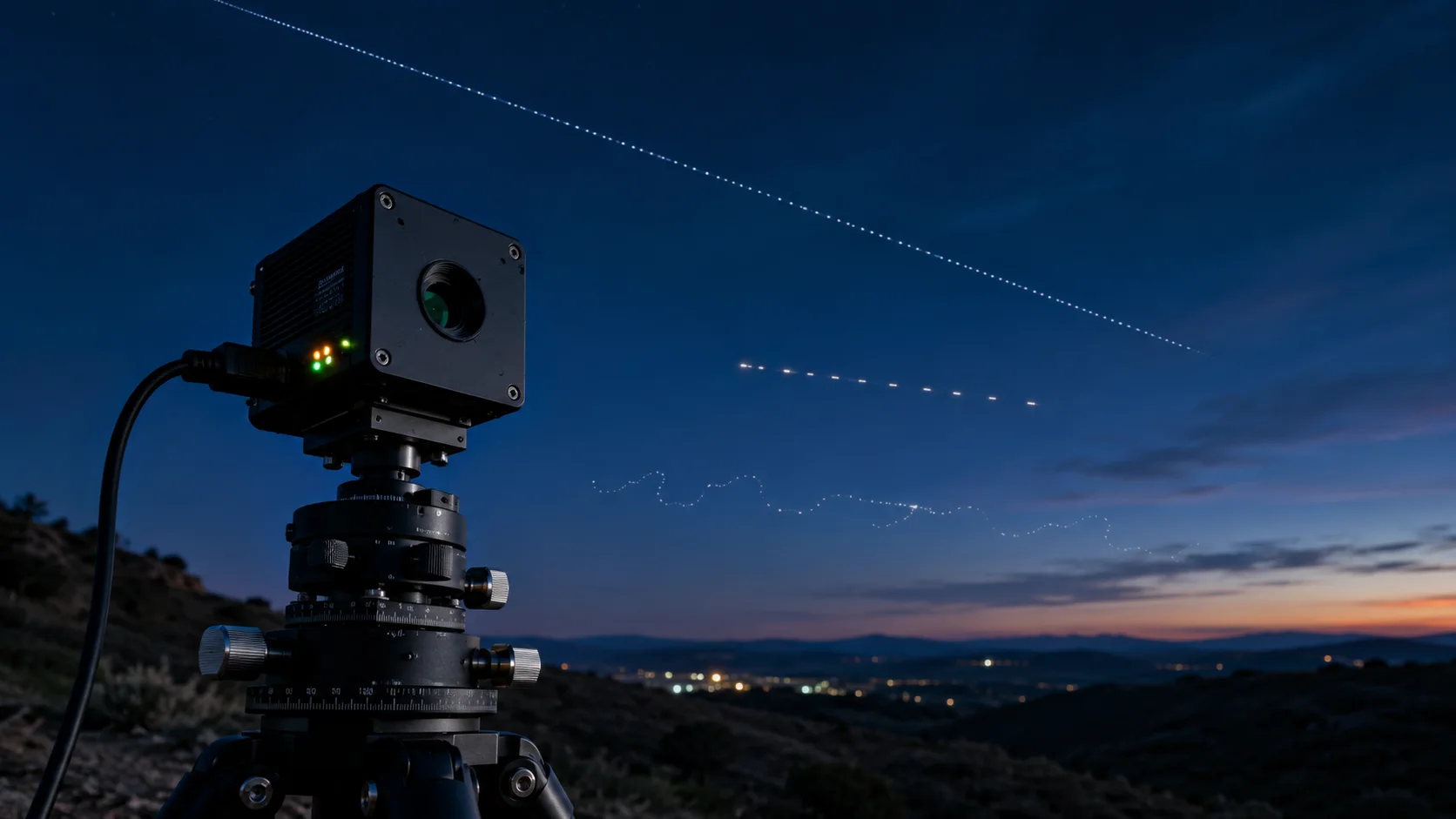
Record change, not an entire empty sky
A conventional camera records complete frames at a fixed rate even when most pixels contain unchanging sky. In an event based sensor each pixel acts independently and reports only brightening or dimming, concentrating bandwidth on motion and change.
One hundred microseconds and a fraction of the data
The researchers report a typical response time near 100 microseconds. In real world Sandia scenes, the sensors usually generated only 1 to 5 percent of the data volume produced by framing cameras. That combination can support persistent wide area monitoring without streaming hundreds of megabytes each second.
Different targets leave different signatures
The researchers describe movement and flashing patterns that may assist classification. Aircraft lights may flash periodically, nearby insects may trace wavy paths and birds may change speed and direction. Comparing these patterns over time adds information, although a single pattern does not always identify a target.
WATCHER starts with unknown and narrows the field
WATCHER groups events and filters noise, first distinguishing periodic signals from those without a regular cycle. It then characterizes movement, flashing and shape. The aim is to compare the combination with known targets and retain unidentified observations for examination.
What remains unsolved
Noisy pixels, lens choice, focus, lighting and sensor settings can still mislead. The authors say the algorithms remain immature. A credible system should combine event sensing with conventional imagery, radar, accurate time and position so that an unusual event is preserved as a data package rather than a lone point of light.
Sources and context
The paper appeared in the Spring 2026 Naval Postgraduate School issue and was written by Kaylin Hagopian and Dr Joshua Shank of Sandia National Laboratories. It reports typical 100 microsecond response and real world data volumes of 1 to 5 percent of a framing camera.
Processing algorithms are less mature than conventional camera algorithms. The work presents a promising detection and classification method, not proof of an exotic UAP and not a replacement for radar, telemetry and additional sensors.