Nuremberg 1561: the sky that became a broadsheet
Spheres, crosses and elongated forms above a sixteenth-century city. Hans Glaser’s broadsheet preserves both a reported celestial spectacle and the language used to give it meaning.
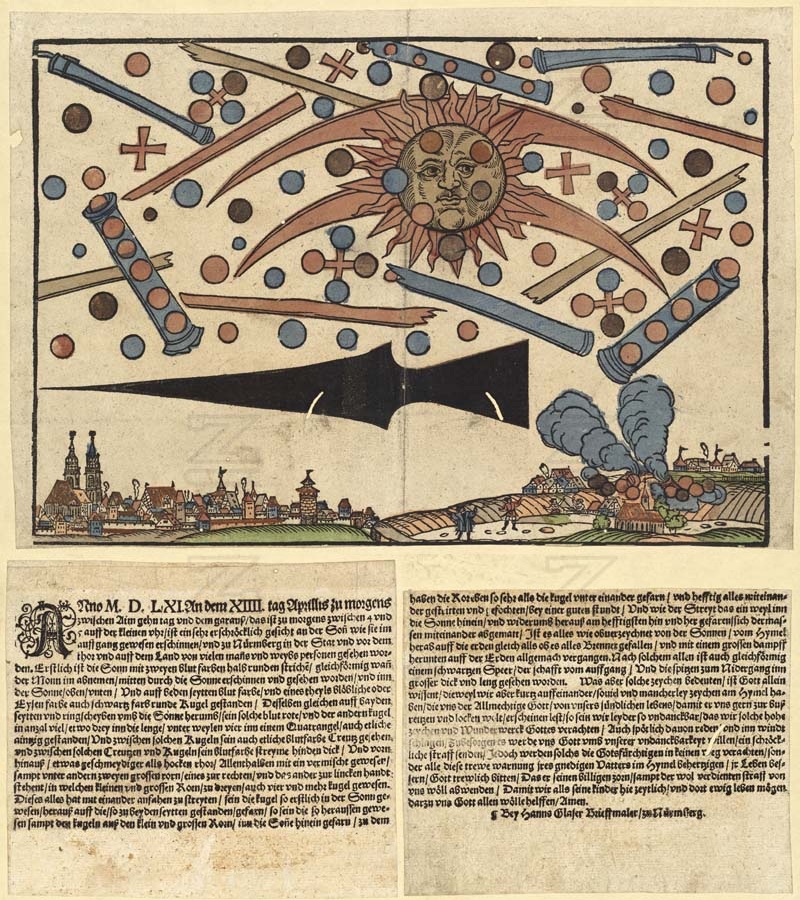
Spheres, crosses and elongated forms above a sixteenth-century city. Hans Glaser’s broadsheet preserves both a reported celestial spectacle and the language used to give it meaning.
This article distinguishes the source material, participants’ accounts and later interpretations.
The morning of 14 April
The broadsheet describes an unusual appearance above Nuremberg on the morning of 14 April 1561. Its image contains coloured circles, crosses, long forms and a dark spear-like shape. A recognizable city sits beneath them, with printed text explaining the spectacle below. Picture and words were designed to be read together.
The surviving document
Hans Glaser produced the broadsheet; a copy survives in the Zentralbibliothek Zürich’s Wickiana collection. This is a historical print, not a modern UFO illustration. Its wording, colour, arrangement and emphasis can therefore be examined as part of what a contemporary reader encountered.
Why the battle looks familiar
Modern viewers readily see an aerial battle. The print also belongs to a tradition of interpreting extraordinary skies as religious and public signs. The Swiss National Museum places it alongside the Basel leaflet and other celestial images. That context does not erase the report; it helps explain the language through which it was presented.
Keeping the page intact
The broadsheet is presented with its text and margins because cropping out the words removes part of the source. It establishes that this report was published in the sixteenth century. It cannot supply measurements of trajectory, altitude or speed. A spacecraft reading is a later interpretation of a remarkable document, not a property measured from a photograph.