


Nancy Williams’s account of a weapon bringing down UFOs over Brookhaven
An alleged UFO interception leads to Nancy Williams, a novel and a particle beam that really flew in space. Following the sources and original diagrams.
Avi Moas, Researcher and Editor-in-Chief · Produced with an AI-assisted newsroom

A book before a letter
Nancy Williams was not standing beside the weapon when it fired. She was working with somebody else’s account, turning it into a novel. In a letter published by Project Camelot on 4 May 2008, she returned to a precise date: 22 November 1992. Four UFOs had passed over Brookhaven on Long Island, she wrote. A secret beam destroyed the largest and brought down one of the smaller craft.
Even within that account, the weapon had a striking name: a quark-gluon plasma beam. Williams attributed the incident to J. B. Michaels, whose story she adapted with his agreement into A Matter of Destiny. The surviving source here is her letter, written years after the alleged event. It came without a firing log, a photograph from the location or identified testimony from someone inside the laboratory at the time.
Following the surviving diagram
Another beam appears in the public record with a launch date, an engineering team and measurements. On 13 July 1989, the Los Alamos BEAR accelerator was launched and operated in space. Three years before the incident Williams described, researchers were testing a neutral hydrogen beam beyond the atmosphere as part of the American Strategic Defense Initiative.
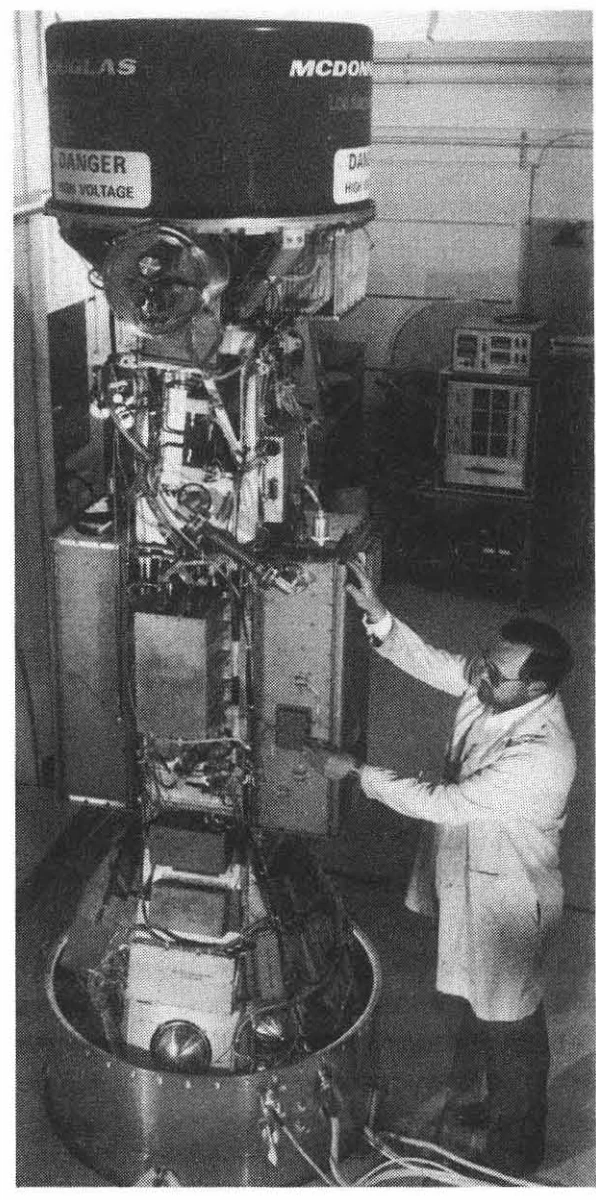
The diagram reproduced in this article belongs to that experiment. Its components follow the particles from their source through the accelerator towards the exit. It is neither a plan of a Brookhaven installation nor a drawing supplied with the interception story.
The accelerator came back
The flight tested whether an accelerator could operate in space, how its beam propagated and how electrical charging affected the payload. Producing a beam was only part of the task. The team compared its behavior with ground measurements and monitored the hardware through launch.
Their 1990 paper includes a schematic, a photograph of the flight assembly and an onboard image of the beam. The recovered apparatus was operated again in the laboratory. The team reconnected a loose wire; on July 26 the accelerator again reached its preflight performance. The military connection is explicit, but the reported mission was to operate an accelerator and study its beam, not to strike an aircraft.
Inside Brookhaven’s actual research
“Plasma” alone cannot join these accounts. A neutral hydrogen beam contains atoms. Quark-gluon plasma is a state in which the constituents of protons and neutrons are no longer confined within those particles in the usual way. At CERN, heavy-ion collisions create a tiny, intensely hot region which expands and cools back into ordinary particles.
Brookhaven itself announced a result from RHIC in April 2005: material created in gold-nucleus collisions behaved like a strongly flowing liquid rather than the gas researchers had expected. That was a measurement of matter’s properties. These publications do not describe a system carrying that material as a controlled beam from an accelerator to a target in the sky.
Getting a prototype into service
A laser, a microwave system and a particle beam are not different names for one machine. Their mechanisms determine how energy is produced, directed and delivered at a distance. Comparing a reported weapon with a documented experiment therefore starts with the technology, rather than the shared phrase in the headline.
An April 2023 Government Accountability Office report described roughly a billion dollars in annual US defense spending on directed-energy weapons. Lasers had brought down drones in demonstrations; microwave systems were being developed against threats including swarms. The report also followed the difficult handover from prototype teams to operational programs. Its updated recommendation record says two Air Force actions were closed after steps reported in October 2025. That is progress in separately documented programs, not evidence for the Brookhaven interception.
Back to the person who supplied the account
The White Sands allegation discussed in our Skywatcher feature also concerns attempts to engage UFOs. That resemblance helps explain why such accounts become associated. It does not supply a shared witness, a common document or identification of the same weapon. The sources examined do not connect Ross Coulthart’s reporting with Michaels or Williams.
For Brookhaven, the next useful trail is closer to the author than to a particle-physics diagram: the person who supplied her story and any record from the day on which he placed it. Williams wrote the novel. Michaels supplied its story, and his account is the link to follow back.
The BEAR paper documents a hydrogen beam experiment in space in 1989.
The examined sources do not independently document a UFO interception at Brookhaven.
Found another source or a detail to correct? Let us know.
