The echoes of 1928: a star map pointing to Epsilon Boötis
In 1928 radio experimenters recorded pulses returning after delays of several seconds. Decades later Duncan Lunan plotted those intervals and believed one sequence formed a map of Boötes as it appeared roughly thirteen thousand years ago. The radio phenomenon was real. The alleged interstellar map remains an interpretation.
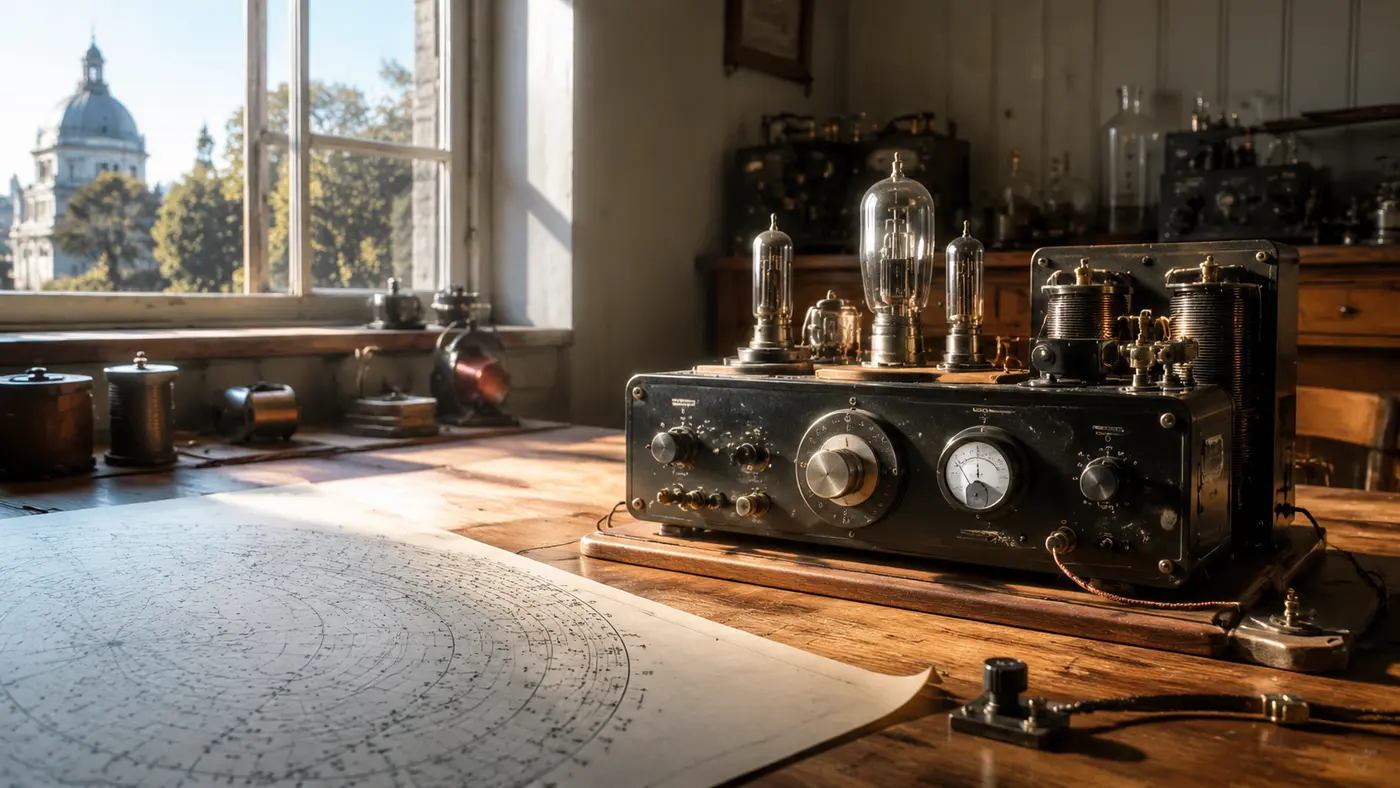
Long delayed echoes were recorded by Jørgen Hals and investigated by Carl Størmer and Balthasar van der Pol. The published delay sequences gave later researchers genuine data to examine.
The apparent map depends on choices of axes, rotation and point matching. No modern independent sequence has reproduced the same picture and no transmitting probe has been identified.
A signal returning too late
Radio pulses were heard again after changing delays far longer than an ordinary local reflection. Some copies returned seconds after transmission, and the intervals appeared irregular. These events entered the literature as long delayed echoes. Their existence was not invented by a later UFO writer, although the phrase covers observations that may arise through more than one physical mechanism.
When numbers became a sky
Lunan placed echo order on one axis and delay on the other. After rotating and reorienting a sequence, he saw a resemblance to the constellation Boötes. The placement of Arcturus appeared to fit the sky roughly twelve thousand six hundred years ago, while Epsilon Boötis became the proposed source. A set of timing measurements had become a picture carrying an address and an epoch.
Ronald Bracewell proposed that an advanced civilisation might leave an automated probe inside another planetary system. It could listen quietly, repeat a newly detected signal to attract attention and then begin a structured exchange. A star map would make an elegant opening because geometry can identify origin and time without a shared spoken language. Lunan joined this prior concept to the old echo sequence.
Long delays do not point to one agreed cause. Radio energy can travel through complicated magnetospheric paths, interact with plasma structures or return through more than one propagation mode. Equipment, accidental retransmission and reception effects also require examination. A delay that looked impossible under a simple ionospheric reflection does not automatically become artificial. The local radio system and near Earth environment must be eliminated before a visitor is invited into the explanation.
A deliberate code should do something that random structure cannot. It might repeat, preserve a grammar, predict an unselected detail or appear in synchronised recordings at separate receivers. Lunan's picture required plotting choices and interpretation of a small collection of points. No independent modern observation has returned the same map. The more transformations required before an image appears, the greater the risk that the analyst supplied the connection.
The story joins a genuine radio puzzle to a bold decoding. It is a useful lesson in how readily the human eye finds a meaningful form after data are rearranged. Lunan himself revisited elements of his interpretation over time. That intellectual honesty matters, but revision cannot substitute for a fresh transmission carrying the same structure.
The 1928 echoes deserve a place in radio history. The Epsilon Boötis map should be presented as an imaginative hypothesis, not as a decoded alien message. That distinction does not drain the case of wonder. It gives the mystery a fair test. If a Bracewell probe is waiting in the Solar System, it must eventually do what the ionosphere and graph paper cannot: repeat a controlled code and reveal precise information that was not placed into the plot by its interpreter.