The forbidden crystals: Dan Shechtman and the battle over what could not exist
On April 8, 1982, Dan Shechtman examined an electron-diffraction pattern from an aluminium-manganese alloy and saw fivefold symmetry that classical crystallography did not permit. The response was not applause. It was doubt, resistance and sometimes ridicule. Three decades later he received the Nobel Prize in Chemistry for discovering quasicrystals.
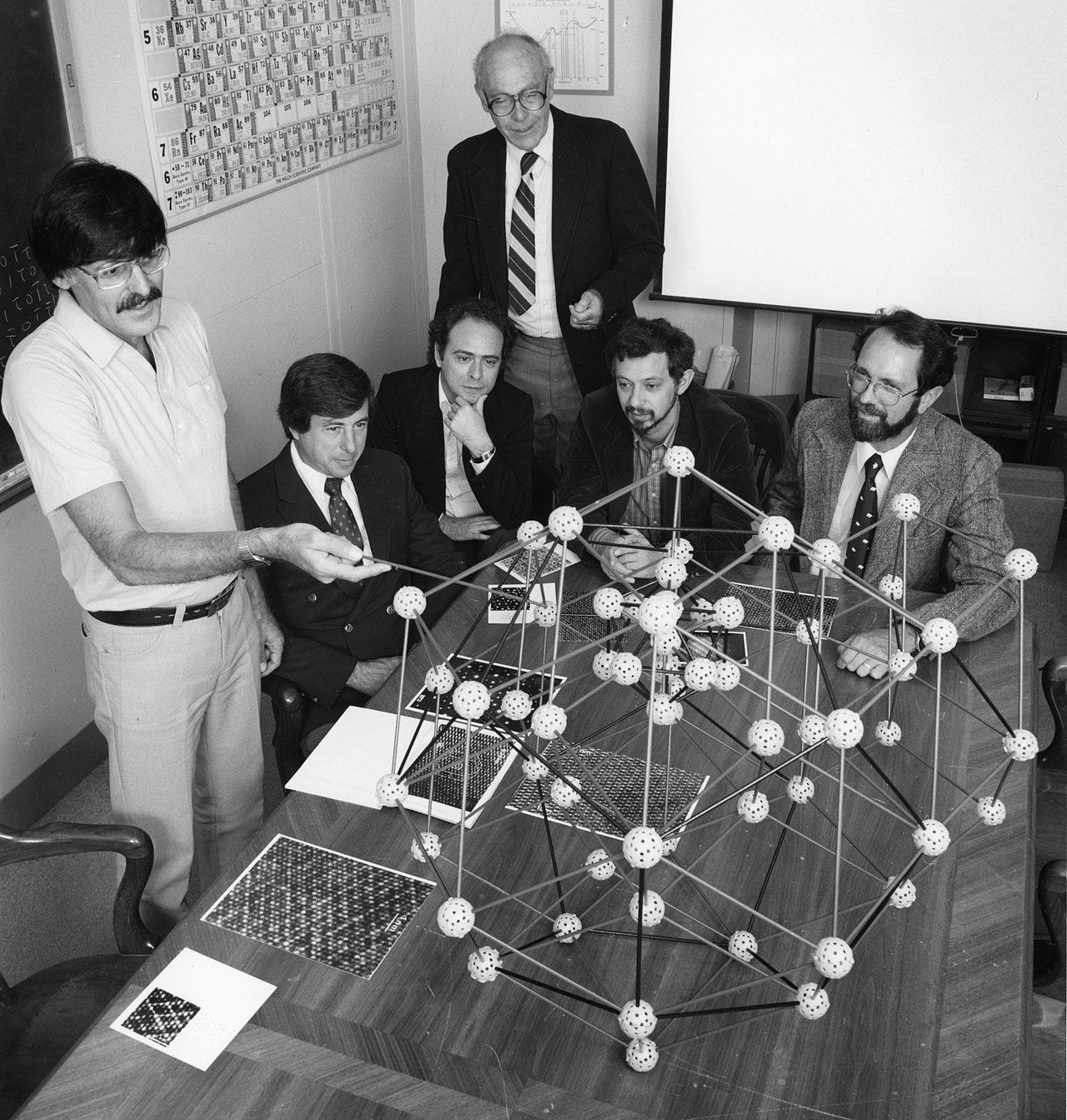
Shechtman and his colleagues published the original paper in Physical Review Letters in November 1984. The Nobel Committee awarded him the 2011 chemistry prize for the discovery of quasicrystals, ordered structures that are not periodic.
Popular accounts compress years of scientific dispute into a personal duel with Linus Pauling. Sources confirm that Pauling rejected the quasicrystal interpretation, but the field changed through replication, calculation and work by many other researchers as well.
Three question marks in a notebook
In 1982 Shechtman was working at the U.S. National Bureau of Standards and studying rapidly cooled alloys. The electron microscope produced a diffraction pattern with clear order and tenfold symmetry. He wrote 10-fold??? in his notebook because the pattern did not fit the accepted definition of a crystal. The atoms appeared ordered, but the order did not repeat at fixed intervals. This was not a blurred point in the sky. It was a measurement that could be photographed, repeated and attacked.
Why experts called it impossible
Crystallography then defined a crystal through a periodic lattice. Twofold, threefold, fourfold and sixfold rotational symmetries were compatible with periodic tiling; fivefold and tenfold were not. Experienced researchers therefore suspected crystal twinning, overlapping grains or experimental error. The resistance was not only conservatism. It rested on a mathematical framework that had worked for decades. The difficulty was that Shechtman's alloy had not read the textbook.
Linus Pauling, the winner of two Nobel Prizes and one of the twentieth century's most influential chemists, argued that the patterns came from complex periodic crystals and twinning. He is widely remembered for saying there were no quasicrystals, only quasi-scientists. The insult became the emblem of the dispute, but the question was not settled by wit. More samples, improved diffraction and a theory of quasiperiodic order accumulated until the alternative explanation lost force.
In November 1984, Shechtman, Ilan Blech, Denis Gratias and John Cahn published Metallic Phase with Long-Range Orientational Order and No Translational Symmetry. It described long-range orientational order without the periodic translation then considered essential. The International Union of Crystallography eventually broadened the definition: a crystal is a solid with an essentially discrete diffraction diagram, not necessarily a repeating lattice.
The Nobel lecture and official interviews let Shechtman describe the moment, the professional isolation and the value of persistence grounded in data. Here the video is not gossip surrounding the science. It is the researcher's testimony sitting beside a paper anyone can open. The video tells us how the fight felt; the diffraction pattern and paper tell us what was measured.
Shechtman's success is not an automatic license for every rejected idea. Most claims that conflict with established knowledge do turn out to be wrong. His case differed because the material was reproducible, made structural predictions and attracted independent confirmation. Scientific institutions can be mistaken, sometimes with magnificent arrogance, but correcting them requires better evidence rather than treating opposition itself as proof.
This is the story of a boundary that appeared rigid until nature broke it. Shechtman was right not because he was a romantic rebel but because he measured again and let others test the result. Pauling was a scientific giant who was wrong here, a reminder that authority is no substitute for another look through the microscope. The mystery is not supernatural. It is deeper: matter had found an order that science did not yet know how to say.