


Poppy 1.0: The Standard Giving AI Agents Their Own Door Is Live on Shopify
On 13 November, Sierra released version 1.0 of the Personal Agent Protocol, Poppy for short: an open standard for how a personal AI agent approaches a company on your behalf, says who it is, signs in to your account and asks what it is allowed to do. Shopify stores already serve it. Almost everyone else is still at the planning stage.

By Avi Moas
Sources and editorial method
Avi Moas, Researcher and Editor-in-Chief · Produced with an AI-assisted newsroom
A small file at a fixed address
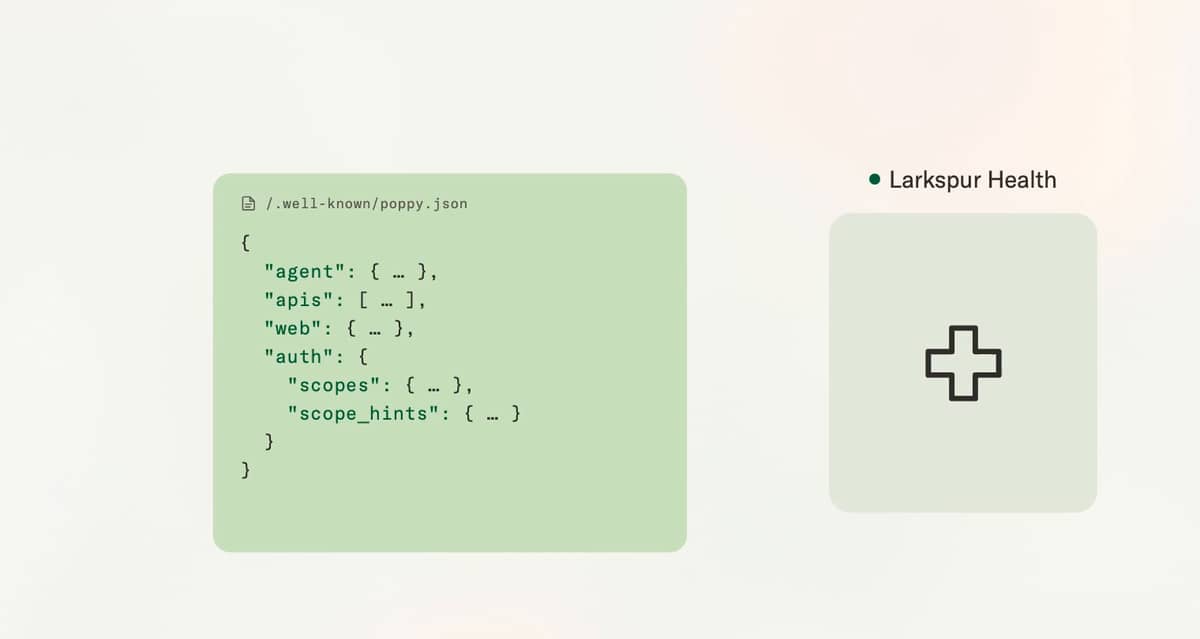
At allbirds.com/.well-known/poppy.json there is a short file that no human is meant to read. It is written for agents. It tells them who the company is, which channels they can use, and how to sign in. We fetched it on 15 November, along with the same file at Glossier, Gymshark and Everlane. Every one answered, and every one pointed the agent to the part of the store that handles shopping.
None of those merchants wrote the file. On 13 November a Shopify staff member posted on the company's developer forum that "Shopify's Personal Agent Protocol support went live today", and that every online store on the platform now serves a discovery file at that address. Sierra put it more bluntly: Shopify has enabled Poppy for every merchant on its platform.
One detail shows the job isn't finished. Every file we checked says protocol_version 0.4. Version 1.0 had been announced two days earlier, and the final spec was frozen on 14 November. The stores haven't caught up.
Who is behind it
The 1.0 announcement was signed by Bret Taylor and Clay Bavor of Sierra. They first showed the protocol alongside Meta on 6 October, at Sierra's own summit. Three days later came a public draft and 35 more design partners, OpenAI, Visa, PayPal and United Airlines among them.
Anyone who has watched an AI agent try to get something done on a real website knows the problem. The agent lands on pages built for people, guesses where the buttons are, and sometimes asks for your password. Poppy gives it a side entrance. The company publishes what it offers agents, through APIs, through its own website, or through its customer-service agent. The agent identifies itself, you sign in through the company's normal login, and you decide what it may do. You can change or withdraw that permission later.
The AI labs have spent the autumn pushing agents from conversation to completed work. Poppy is an attempt to organise the other side of the counter.
A hundred partners, one file that works
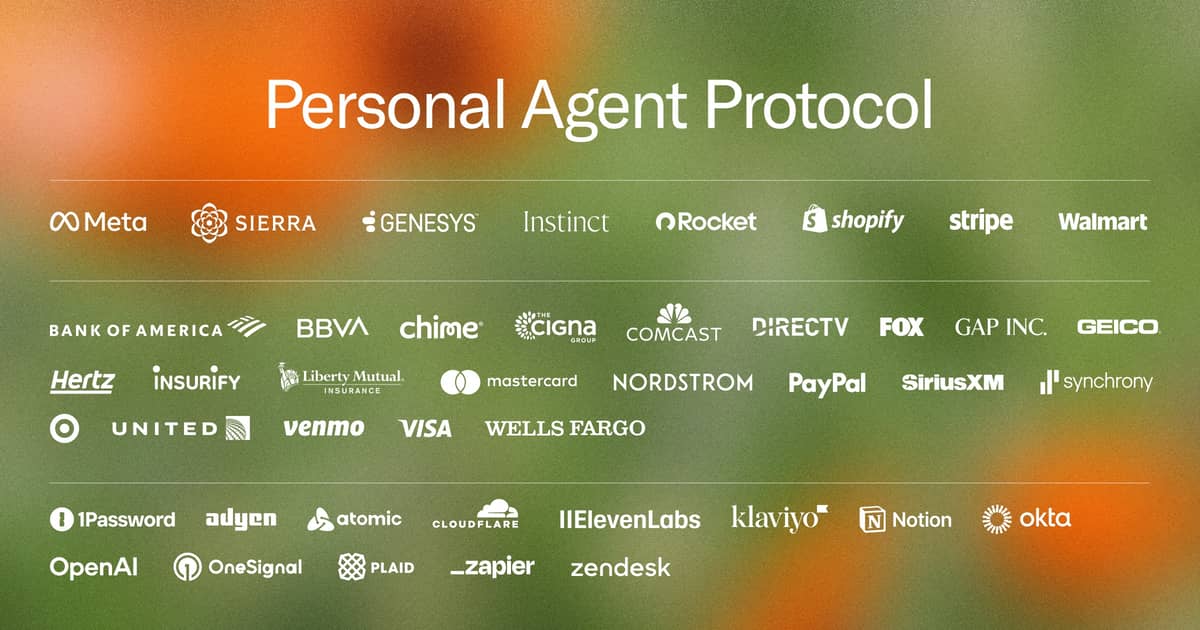
Sierra says 60 new companies have joined as design partners, taking the total past 100. The official list, updated on 14 November, has 103 names: four personal-agent companies and 99 businesses. OpenAI, Visa, PayPal, Walmart, United Airlines, Salesforce and Wix are all on it.
A design partner helps shape the standard. That is not the same as running it. A public check by Stacktree on 15 November, and our own checks that day, found no Poppy file on the main domain of Walmart, Stripe, Salesforce, Meta, OpenAI or most of the other names. They may be testing on another host or behind closed doors, but in public there is nothing there yet. Working files turned up at 12 Shopify stores, at Rocket Mortgage on version 0.3, and on a handful of smaller sites.
What an agent can already do
Sierra offers two examples. At Mercury, it says, an agent can check balances, review transactions and initiate a payment or transfer, with Mercury running every request through the account's approval policy before anything is sent. At Turkish Airlines, an agent can check fares, flight status and stopovers, and pull up a booking by reference and surname. Miles&Smiles members can have it hunt for business-class upgrades, which the customer approves before paying. Buying inside the conversation is still being built. Neither example could be confirmed from outside: in Stacktree's check Mercury's address returned a 404, and Turkish Airlines' server refused the connection, in our test too.
The most striking moment came on stage in October. Muse, Meta's agent, found Rocket's agent through Poppy, the user signed in, and the two agents produced a mortgage pre-approval letter together. It was a live demo, not a public service.
As for Muse itself, Sierra writes that Poppy is now on for everyone who uses it, and that Muse looks for Poppy first on every site it visits. We found that statement only on Sierra's side. From Meta itself, the only thing we found was the joint preview in October.
The money stays outside
If you read that your agent will pay on your behalf, the spec may surprise you: payments are not in version 1.0. Buying is handed to a companion standard, the Universal Commerce Protocol, and Sierra draws the line itself. UCP handles the shopping, the products, the cart and the checkout. Poppy handles what happens before that, when an agent shows up at a store, says who it is and finds out what it's allowed to do. The official roadmap says plainly that how payment works with the approvals extension is "open". According to Stacktree, Shopify's checkout permission does not let the agent pay.
The weak points are written into the spec too. A malicious company can write content that tries to steer the model, so the spec says agents must treat a company's content as data, not instructions: "Only the User decides what the Personal Agent does." A lookalike site can borrow another firm's name and logo and still pass discovery, because the domain is the identity. Critics have noted that Meta and Sierra, not a neutral standards body, are steering the work.
There is a clock running as well. The extension that lets an agent hold your password and sign in as you was always meant to be temporary. On the official roadmap, it is due to be removed on 17 March 2027.
