


Three people worked around lunar photographs. All three described what the public never saw
Three people working around lunar photography and the space program described material they said was filtered, removed or kept out of public view.
Avi Moas, Researcher and Editor-in-Chief · Produced with an AI-assisted newsroom
The witnesses in the original video
Source recording. Edited testimony published by Alien Avi, with Hebrew captions. Watch on TikTok

Inside the Langley photo room
Karl Wolfe did not enter the UFO world as a researcher. In his account, he was a U.S. Air Force technician with cryptographic clearance, working at Langley while the United States was mapping the Moon ahead of Apollo.
Decades later, he described one moment he could not leave behind.
He said a repair assignment took him to a facility processing photographic data. Another technician pulled him aside and showed him mosaics of the lunar surface. Wolfe described structures that looked artificial to him: towers, spherical shapes and large objects resembling antennas or dishes. The man beside him, he recalled, said they had found a base on the far side of the Moon.
Wolfe did not produce the prints. But he kept telling the story.
One detail belongs in the file: he sometimes dated the encounter to 1965, while the Lunar Orbiter missions that returned those photographs began in 1966. That unresolved gap is part of the testimony.
On 10 October 2018, aged 74, Wolfe died after a truck struck him while he was cycling near Lansing, New York. No reliable evidence establishes a connection between his death and his testimony.
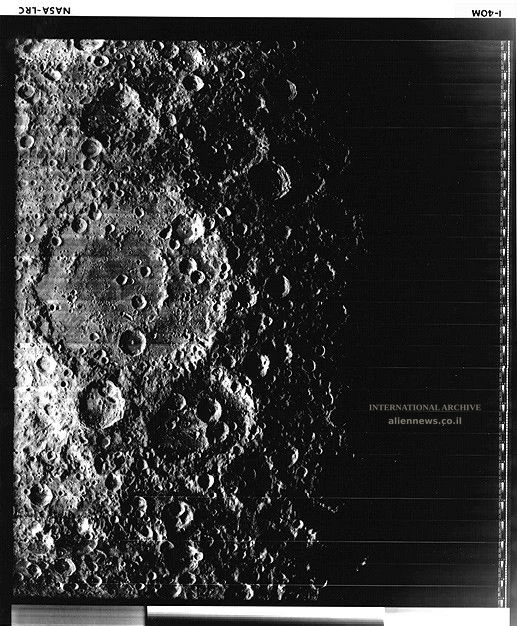
Donna Hare noticed a shadow
Wolfe was not the only person to describe a photography room.
Donna Hare said she worked for NASA contractor Philco Ford Aerospace between 1967 and 1981, mostly in Building 8 at Johnson Space Center. Her work included illustrations, lunar maps and planning displays. She said a Secret clearance gave her access to certain restricted areas.
During one visit to the photographic laboratory, she recalled, an employee showed her an aerial photograph. There was a round object in it.
Hare looked at its shadow. In her account, it fell in the same direction as the shadows of nearby trees. To her, that distinguished an object above the ground from a spot on the photographic emulsion.
She said the employee explained that such objects were airbrushed out before the photographs were released to the public.
Hare was not describing a lunar city in this episode. She was describing a laboratory procedure, one image shown to her and an employee's explanation of how photographs were treated. Her account sits at a particular point in the chain: the room where a picture becomes something other people will see.
The collection Ken Johnston kept
Part of Ken Johnston's background can be anchored in an Apollo era record.
The Apollo 15 Lunar Sample Information Catalog lists K. Johnston. NASA's public catalog entry names him alongside Patrick Butler, Marion Anderson and William Phinney among those responsible for the document.
Johnston said he held collections of Apollo prints while working for Brown & Root Northrop, the contractor operating within the Lunar Receiving Laboratory. As distribution of lunar material declined, he said, he was instructed to dispose of the remaining collections.
He did not quite do that.
In his account, an argument with his supervisor ended with him retaining one set of prints. The collection later became central to his claims about anomalies in lunar photographs.
One of his more unusual accounts concerned moving film. In an interview with George Knapp, Johnston described watching 16 mm footage from Apollo 14. As the camera approached a dark area inside a crater, he said, several domes appeared to be lit from within. He also described something resembling a plume of steam above them.
Johnston continued discussing these claims publicly for years.
What connects the three accounts
The Moon is only part of the connection.
Wolfe's story begins in a room where space photographs were assembled into mosaics. Hare's begins in a laboratory where images were prepared for release. Johnston describes a department handling prints, catalogs and Apollo material.
The settings and periods differ, yet the stories converge on the stage between the original exposure and the image delivered to the public. That is the possible connection explored here, rather than a claim that the three people witnessed one shared operation.
The record, the testimony and the open question
There is a public record of Wolfe giving his account and of Hare's filmed Disclosure Project testimony. Johnston appears in Apollo era catalog records associated with the Lunar Receiving Laboratory.
The structures Wolfe described, the removal of objects Hare recounted and the illuminated domes Johnston discussed remain witness claims.
No publicly established set of original photographs currently connects all three accounts and demonstrates that they describe the same process.
After all these years, the question they leave is not simply what was in the pictures. It is what happened to them on the way out.
Public testimony by Wolfe and Hare, and a NASA catalog entry naming Johnston among the people responsible for the Apollo 15 sample catalog.
Original photographs connecting the three accounts, and resolution of the discrepancy in Wolfe’s chronology.
Found another source or a detail to correct? Let us know.
