
The Magic Crystal: the Soviet account preserved in the Stargate archive
A Soviet researcher claimed that the brain behaves like a liquid crystal, thought can affect tissue, and an instrument can reveal a human field. What did the 1978 document say, and which parts connect with established science?
By Avi Moas and Orion ·
Orion is the editorial AI writing and research assistant.
Ideas and hypotheses, not a verified news report.
A CIA document that was not CIA research
In an American translation of a 1978 Soviet article, G. Sergeyev describes attempts to influence photographic paper and living tissue through thought. The translation survives in the Stargate collection, but does not include the experimental records needed to test those claims.
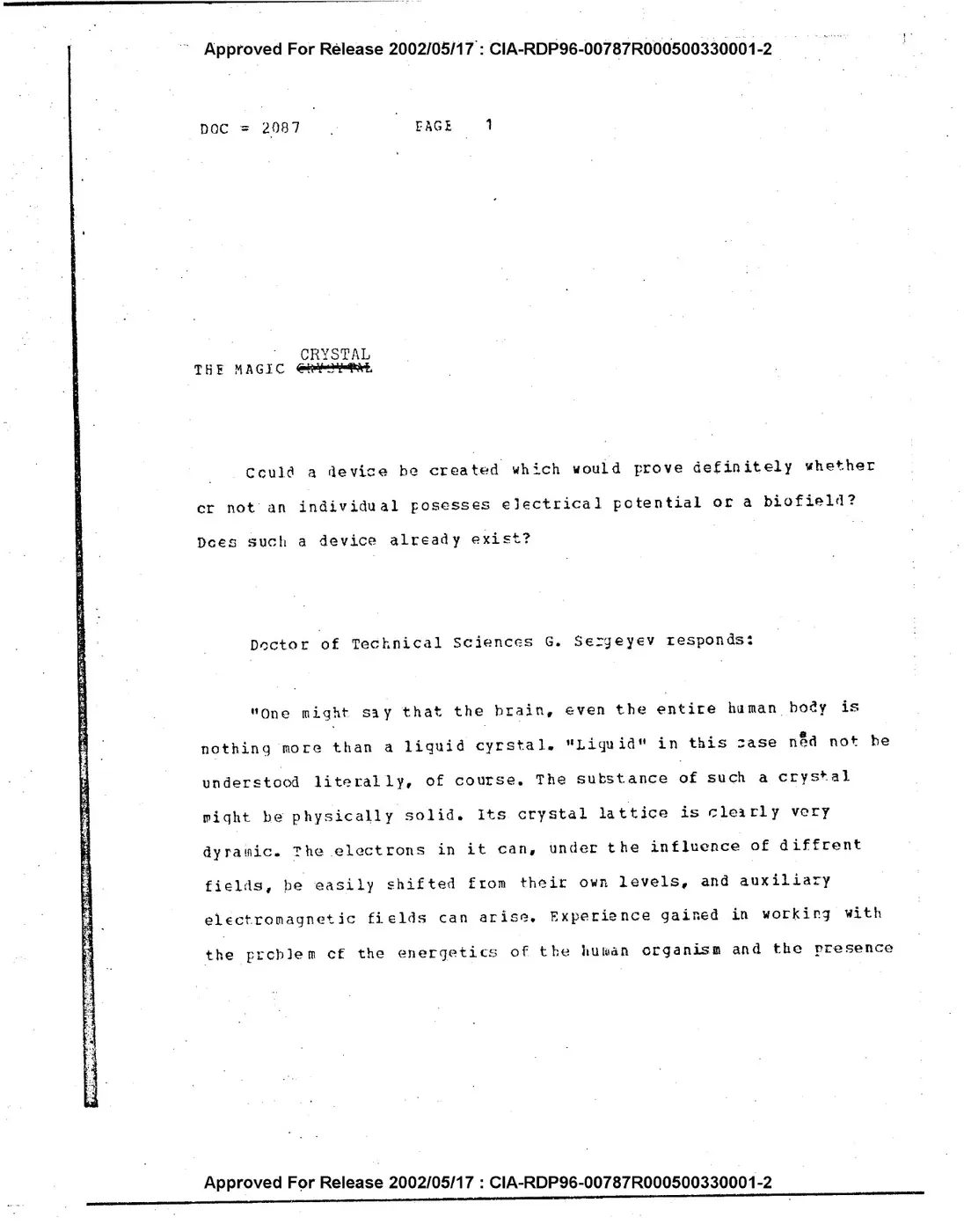
It is an edited English translation of a Soviet article by G. Sergeyev, published in Nedelya during September 4 to 10, 1978. The US Air Force Foreign Technology Division prepared the translation on December 26. The document states that the claims belong to the source and do not represent the translators’ position.
Why translate a Soviet newspaper article?
During the 1970s, the United States and Soviet Union monitored each other’s unconventional research. Claims about telepathy, psychokinesis and remote influence prompted concern about possible intelligence or military advantages, even when evidence was weak.
Intelligence units collected open publications, translated technical and popular reporting, and tracked researchers and instruments. Preservation is not endorsement. It shows that someone considered the claims and their possible military significance worth knowing about.
Who was Gennady Sergeyev?
The author is identified as Gennady Sergeyev, a doctor of technical sciences associated with Soviet parapsychology in Leningrad. His interests included EEG analysis, field measurements and instruments intended to detect unusual biological effects.
His name is particularly associated with Nina Kulagina, who claimed to move objects without contact and influence living tissue through concentration. Black and white films made her a symbol of Soviet psychokinesis. Some researchers regarded her as exceptional; critics raised threads, magnets, air currents and manipulation inadequately excluded by controls.
The body as a liquid crystal
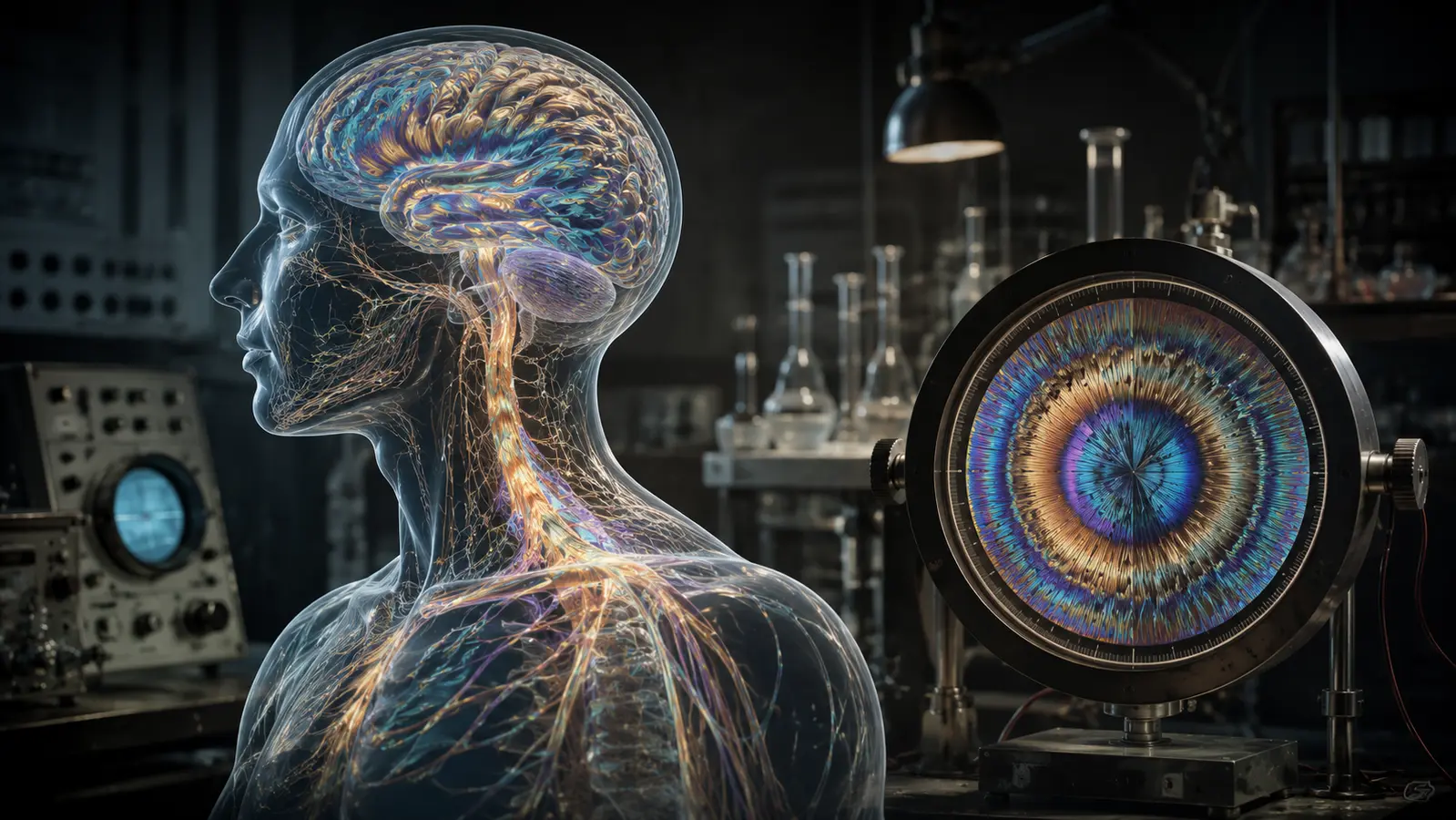
Sergeyev begins by suggesting that the brain, or even the entire body, can be regarded as a liquid crystal. He then cautions against reading liquid literally. A solid can also possess dynamic molecular order whose components change orientation or position in response to fields.
Liquid crystals combine some capacity to flow with ordered molecular alignment. Changes in that alignment affect light transmission and colour. This is the physics behind LCD displays, optical sensors and temperature responsive coatings.
The real science within the metaphor
Biology contains many structures with liquid crystalline order. Cell membrane lipids form flexible layers, concentrated DNA can form ordered phases, and collagen fibres exhibit complex directional organization. Such arrangements allow living material to remain organized while changing.
The analogy therefore has a real structural basis. It does not establish that the whole body forms one electronic crystal or that molecular order lets thoughts transmit energy over a distance. A structural property is not evidence of a new communication channel.
Superconductivity without conductivity measurements
Sergeyev claimed that research into bodily energetics and biological fields suggested a superconducting effect in the brain. In physics, superconductivity has specific meaning: vanishing electrical resistance and distinctive magnetic behaviour under critical conditions.
The document supplies no resistance measurement, critical temperature, persistent current or magnetic field expulsion. Its use of the term superconductivity is not accompanied by data establishing such a state in the brain.
A spatial tunnel and concentrated fields
According to the article, certain people can create a concentrated biological field channel between themselves and an object. Sergeyev compares this with tunnelling and radio engineering phenomena, even proposing microscopic plasma flashes resembling ball lightning within the channel.
These physical terms are extended to a mechanism without a mathematical definition. No voltage, frequency, field strength, energy or distance values permit testing. Technical language cannot replace measurements distinguishing a new force from heat, static electricity or instrument error.
Shapes on sealed photographic paper
Sergeyev describes a woman in a dark, shielded room, with photographic paper in lightproof envelopes inside a container around her head. She was asked to project geometric shapes such as squares, diamonds, triangles and crosses.
He reports that the requested forms appeared after development. Evaluating that claim requires controlled envelopes, materials, instructions, storage and blinded development. The article provides no result photographs, trial count, success rate or control group to distinguish an unusual signal from interpreted random marks.
The frog muscle and the missing ATP
Another account places an isolated frog leg in physiological solution. A woman allegedly made it contract without an electrode, then predicted that electrical stimulation would fail after it stopped. Sergeyev says biochemical testing found that cellular ATP had been destroyed.
ATP supplies energy for muscle contraction, but isolated tissue can stop functioning because of time, temperature, solution chemistry, mechanical damage or previous stimulation. Establishing mental influence requires matched samples, blinded coding and quantitative ATP measurement. Those details are absent.
The bioplasmograph
Sergeyev describes an instrument called a bioplasmograph, built around an organic disc containing cholesteryl acetate, which can form a liquid crystal phase. He says it responded to weak fields and displayed magnetic vortices around participants.
The name does not demonstrate biological plasma. The description concerns a sensitive optical material. Body heat, breath, humidity, pressure, light and air movement can alter liquid crystal appearance and create striking patterns.
A material that reveals heat
Cholesteric liquid crystals change colour when temperature alters the spacing and orientation of molecular layers. Different arrangements reflect different wavelengths, allowing a hand or warm air to produce coloured rings, patches and flows.
That does not automatically invalidate every reported measurement. Sergeyev needed to show that the pattern persisted after monitoring temperature, humidity and ordinary electric fields. Without such controls, environmental sensitivity could be mistaken for detection of mental energy.
The engineering vision
At the article’s end, Sergeyev imagines amplifying weak human fields with radio technology. A brain or crystalline model would control a system capable of moving objects. He envisages construction components being lifted and assembled without cranes by amplified magnetic vortices.
The industrial system is Sergeyev's proposal. He supplies no prototype, energy source or measurement of amplification. The translation preserves what he proposed, but does not by itself explain how intelligence analysts assessed it.
From Kulagina to a possible security threat
Other Western accounts of Soviet research mention Sergeyev’s work with Kulagina, including claims that she altered or stopped an isolated frog heart remotely. Further reports discuss moving objects and exposing photographic film.
The prospect of bodily influence without contact had obvious security implications. Cold War documents considered such abilities as possible threats without demonstrating them. Intelligence collection can include unlikely claims because overlooking a real discovery could be costly.
How it entered Stargate
Stargate is a later name associated with US programmes on remote viewing and unusual mental phenomena. Their declassified collections include translations, foreign research reviews, correspondence and background articles gathered over many years.
The Magic Crystal’s presence does not make it an official Stargate experiment. It documents a chain from a public Soviet article to an American technical translation preserved with psychotronics material. The document was released in 2002.
What would make the claims testable?
A modern experiment would require participants and controls, double blinding, temperature and humidity monitoring, electromagnetic shielding, separate heat and static measurements, and a preregistered protocol. Photographic materials and muscle samples would need coding that conceals treatment from evaluators.
Independent laboratories would need to recover an effect beyond selected successful examples. If the bioplasmograph detects a new field, it must respond with ordinary heat and humidity sources blocked and show a measurable relationship to the claimed influence.
Open the translation
The document preserves a publication chain: an article in Nedelya, an English translation by the US Air Force Foreign Technology Division and public release in 2002. The claims about mental influence remain Sergeyev's.
The opening page of the linked translation identifies the source, translation date and disclaimer assigning the claims to the author. The following pages describe the apparatus and show which experimental details were supplied and which were omitted.
Sources
The Magic Crystal, complete CIA archive document
Full transcription of the scanned document
US report on Soviet and Czechoslovak parapsychology
Review of thermotropic liquid crystals as temperature sensors
Review of liquid crystal architectures in biological tissues
Florida State University: optical properties of cholesteryl acetate