
The researcher who sought connections between brains and disappeared: Jacobo Grinberg
He measured brain signals between isolated people, studied a healer who claimed to replace organs and proposed a theory of shared reality. In December 1994 he disappeared. His wife later vanished too, and his laboratory was dismantled.
By Avi Moas and Orion ·
Orion is the editorial AI writing and research assistant.
Ideas and hypotheses, not a verified news report.
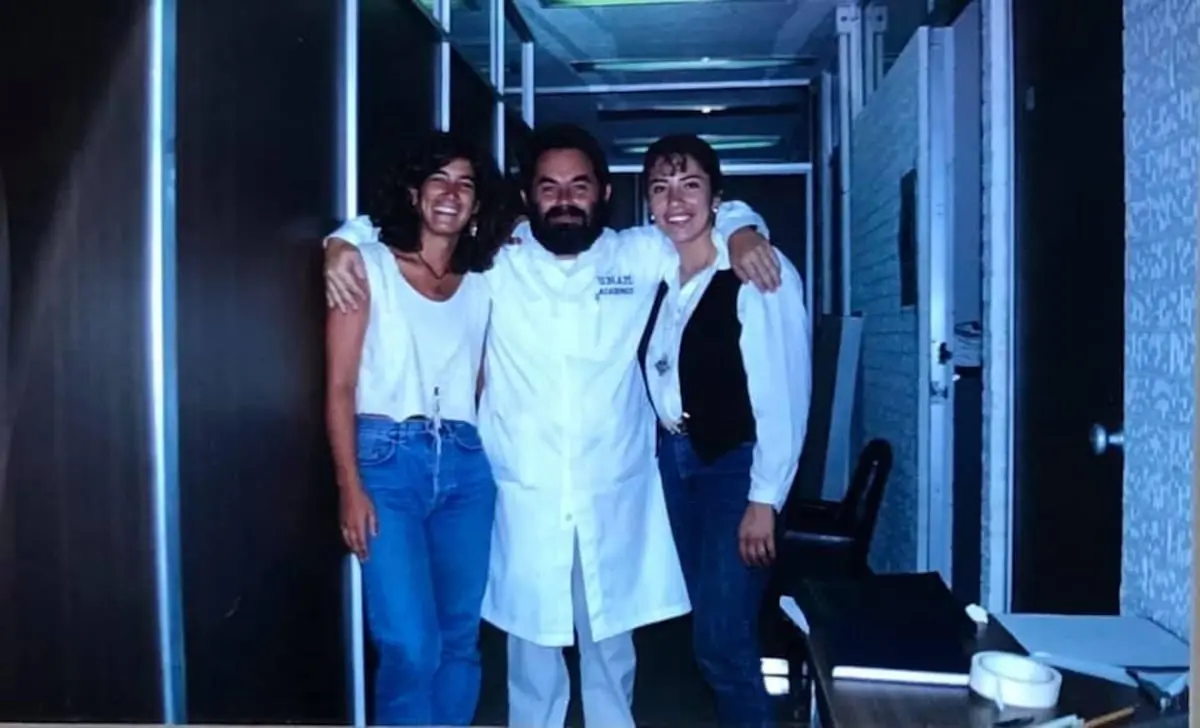
Four days before his birthday
According to Ilan Stavans's investigation in The American Scholar, Jacobo Grinberg was last seen on December 8, 1994, and missed his birthday celebration four days later. This account draws on investigations and testimony; the complete police file is not attached to those publications.
He had recently discussed travelling to Kathmandu to meditate. Police investigator Clemente Padilla found no flight record, departure from Mexico or witness placing him in Nepal. No body, travel document or authenticated sign of life has since resolved the disappearance.
The child who began looking for consciousness
Grinberg was born in Mexico City on December 12, 1946, to a Jewish family of Polish origin. His mother died from a brain tumour when he was 12. Relatives connected that loss with his interest in what happens to consciousness when the body is damaged or dies.
As a teenager he stayed at an Israeli kibbutz, encountered séances and Jewish mysticism, and visited Safed. He later studied psychology at Mexico’s National Autonomous University, UNAM, and psychophysiology at New York University’s brain research laboratory, examining electrical responses to forms and colours.
A laboratory at academia’s edge
Returning to Mexico in 1977, he taught at UNAM and studied memory, visual perception and brain electrical activity. His interests gradually expanded to meditation, telepathy, shamanism and experiences beyond ordinary senses. In 1987 he established INPEC, the National Institute for the Study of Consciousness, with support from UNAM and Mexico’s science and technology council.
He published more than fifty books as well as academic papers. Students recalled a charismatic, demanding teacher receptive to unusual ideas. Colleagues admired his boldness while questioning experimental controls, statistics and the difficulty of verifying some results elsewhere.
The lattice behind reality
Grinberg’s syntergic theory centred on a lattice, a fundamental informational substrate distinct from visible matter. In his model, complex neural activity generates a neuronal field whose interaction with the lattice produces the perceived world.
Grinberg proposed that the brain helps generate experience through contact with a shared information structure. When the activity of two brains becomes coordinated, he suggested, they might affect that same structure. This was his proposed explanation for correlations that did not pass through ordinary senses.
The experiment with two brains
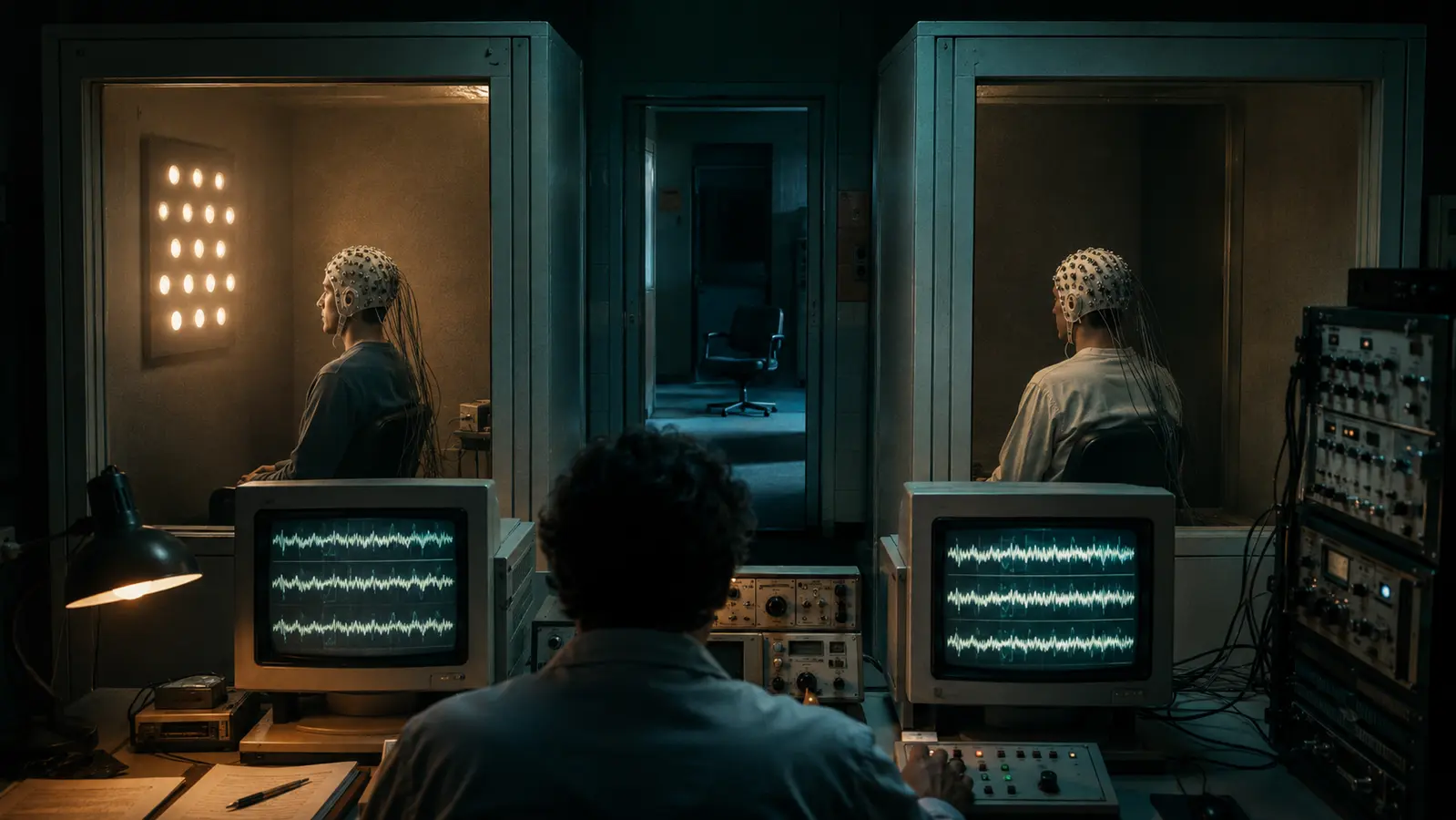
Grinberg and colleagues connected pairs of participants to EEG equipment and allowed them to develop a connection through sitting together and meditating. The participants then entered separate partially electrically shielded chambers 14.5 metres apart. Only one received a hundred light flashes.
The stimulated person showed an expected evoked potential. In some pairs, researchers reported a similar signal in the unstimulated participant. They called it a transferred potential and interpreted it as a possible nonlocal connection.
The paper appeared in Physics Essays in December 1994. It is a real, detailed publication, but involved a small sample, inconsistent occurrence across pairs and no stable independent replication. It warrants further testing rather than establishing telepathy or quantum entanglement.
Different from Penrose and Hameroff’s microtubules
Online accounts sometimes claim Grinberg studied microtubules and anticipated Orch OR. His principal writings do not substantiate that connection. Roger Penrose and Stuart Hameroff separately developed a model involving quantum processes in neuronal microtubules.
Both proposals consider consciousness beyond ordinary neural computation, but their mechanisms differ. Grinberg’s lattice and neuronal field are not Hameroff’s microtubules. Comparing them does not establish one as a verified precursor to the other.
Pachita and the extraordinary operations
In the 1970s Grinberg met Bárbara Guerrero, known as Pachita. During healing rituals she claimed to open bodies with a simple knife, remove damaged tissue and replace it with organic material or a new organ. Grinberg attended sessions and wrote that his observations challenged his understanding of reality.
He attributed her alleged ability to direct access to the lattice and alteration of the structure underlying perceived matter. Independent medical documentation, tissue tests and adequate controls are lacking. The strong historical evidence is that he was convinced, not that impossible transplants were scientifically demonstrated.
Why his name appears in CIA archives
Declassified Stargate materials include documents bearing Grinberg’s name and discussing syntergic theory, psychophysiological communication and Latin American parapsychology. His work was known to organizations collecting material on remote viewing and unusual consciousness phenomena.
An intelligence collection is not an employee roster. Stargate gathered papers, translations and reviews from many sources. No public document establishes his recruitment, CIA assignments or abduction by the agency. The documented connection is intelligence interest in his work.
The Kathmandu journey without a record
He told his daughter he planned to visit Kathmandu. Relatives also reported that he felt threatened. Messages to one brother alleged that his second wife, María Teresa Mendoza López, was pursuing him. Family accounts describe arguments and jealousy, and his expressed fear of being killed.
His family found a voluntary departure difficult to accept: he was attached to his daughter and actively engaged with his laboratory, students and writing. The separate claim that he vanished before a conference where he would reveal a discovery lacks a contemporary programme or document.
The woman who gave different accounts
Drawing on Padilla's investigation report, Stavans writes that Teresa cashed a thousand dollar cheque from Grinberg's book distributor after the disappearance. In his account, she told a guard that Grinberg had flown to Guadalajara, then told his stepmother he was in Campeche and that they planned to travel to Nepal.
The same investigation describes belongings being removed from the house and phone contacts with a man with a paramilitary background. According to Stavans, Teresa was later seen near Rosarito and called her mother in May 1995; her trail then also disappeared. These are details reported in his investigation, not findings we checked in an open police file.
The criminal investigation
According to the investigation, Padilla examined Teresa's actions as part of the disappearance inquiry. The accounts attributed to her and the removal of possessions are investigative details, not a finding that she harmed Grinberg.
Later investigations describe the inquiry ending under unclear circumstances. No indictment, burial location or official determination of either person’s fate has been published. The historical case remains unresolved even if not actively investigated.
Was the laboratory secretly erased?
The claim that unknown people emptied the laboratory overnight and removed all research lacks a reliable source. Student and assistant Ruth Cerezo described a gradual process: students stopped coming, the university prevented continuation of projects, and the laboratory emptied before being dismantled.
Cerezo described research stopping and the team dispersing after its leader disappeared. Her account concerns what happened to the laboratory afterward; it is not evidence of a covert operation to remove research results.
Scientist, believer, or both?
Critics described a sincere, highly imaginative researcher sometimes drawn to conclusions before adequate tests. His former teacher, neuroscientist E. Roy John, said he knew which controls were required but did not always implement them. Karl Pribram regarded the potential implications as enormous while demanding confirmation elsewhere.
Grinberg was a scientifically trained researcher who tried to investigate experiences and beliefs with neuroscience. He did not establish that brains communicate through a quantum field. The debate about his work includes the gap between his explanation and what the experiments can support.
What can be tested now?
The transferred potential experiment can be repeated with improved isolation, preregistration, blinding, precise clock synchronization, vibration and electrical monitoring, and analysis conducted without knowing stimulus times. Several independent laboratories would need to recover the same signature.
A repeatable signal at the correct time in an isolated participant, without an ordinary communication channel, would be important. A negative result could instead clarify the roles of accidental synchronization, filtering or technical interference.
Two separate records
The paper about two brains and the reports of Grinberg's disappearance are separate bodies of material. The paper describes what was measured in the experiment; it does not explain what happened to its author.
To return to Grinberg's own work, open the linked Physics Essays paper on transferred potential. It sets out the experiment and the signal the team reported.
Sources
Original transferred potential paper, Physics Essays
The American Scholar: investigation of the disappearance
El País: the laboratory, students and closure
El País: Grinberg’s books and UNAM laboratory
Syntergic theory document in the CIA Stargate collection