


Orange Orbs Above the Rotor, Then "Chasing" Fighter Jets: A Senior Intelligence Officer's Pentagon UFO Account
In late 2025 a ground team's thermal camera caught a "super-hot" object that split in two. The Department of War published the infrared and night-vision imagery from that night, along with a senior intelligence officer's helicopter account: a swarm of orange orbs, two orbs flaring above the rotor, and orbs that kept pace with fighter jets. This is his account, in his own words, from document ODNI-UAP-D001.

By Avi Moas
Sources and editorial method
Avi Moas, Researcher and Editor-in-Chief · Produced with an AI-assisted newsroom
Thuds in the mountains
In late 2025 a ground team's thermal camera caught a "super-hot" object that split in two. The Department of War published the infrared and night-vision imagery from that night, together with a first-person account by a senior intelligence officer who flew a helicopter over the test range.
The document is short, two pages, and written in the first person. "In late 2025, during early evening daylight hours," it begins, "I – a senior U.S. intelligence officer – along with a colleague and two pilots, departed our Joint Operations Center (JOC) in a helicopter."
It was posted on May 22, 2026, in the second release of the Department of War's UAP files, one of 64 records in that batch. It comes from the Office of the Director of National Intelligence, under a plain title: USPER Narrative, Senior USIC Official, meaning the account of a U.S. person who is a senior member of the intelligence community. The Department of War's catalog describes the author as still serving. A corrected version went up on May 26, fixing a single word: the name of a low-level flight profile, mistyped as "map-of-the-earth" instead of "nap-of-the-earth."
The mission began with a noise. Loud thuds had been heard in the mountains on the test range, on the same nights that unidentified objects were reported in the sky. The crew set out to search remote mountain areas for debris or objects that might explain the orb-like sightings.
A cave with no visible end
For several hours the helicopter flew nap-of-the-earth through the range. Several times they spotted debris and went down for a closer look. Each time it turned out to be the remains of rockets and other projectiles that had crashed during years of weapons testing.
Then, near the areas of reported orb activity, they found "a large cave entrance with no visible end in sight." There was no safe place to land, so the officer had the pilot orbit it several times. They noted the location and pressed on.
Running low on fuel, they dropped the colleague with a ground team and flew to a tanker on the range. The plan was to head back to base, but the JOC asked them to check another mountain where a ground team had seen debris. The sun had set. The pilots switched to Forward Looking Infrared and night vision goggles; the officer kept using his naked eye.
The mountain turned up nothing, and they turned for home. Then the JOC called: radar had hits several miles up range, in the same area where the objects had been seen on prior nights. They changed course to intercept. "What followed," the officer wrote, "was a series of close UAP encounters lasting over an hour."
A "super-hot" object that split in two
On the way, ground teams reported an object on their infrared camera. They called it "super-hot," low to the ground, moving east and then south at high speed. Then it split into two and changed direction.
The helicopter arrived and scanned the area with everything it had. Suddenly the ground team radioed that the object had risen from the ground, come within ten feet of the helicopter, dropped below it and sped away. The pilots saw it through their goggles, and saw it split in two as a smaller object emerged, before it accelerated out of sight. They gave chase briefly and broke off. The helicopter could not match its speed.
Countless orange orbs
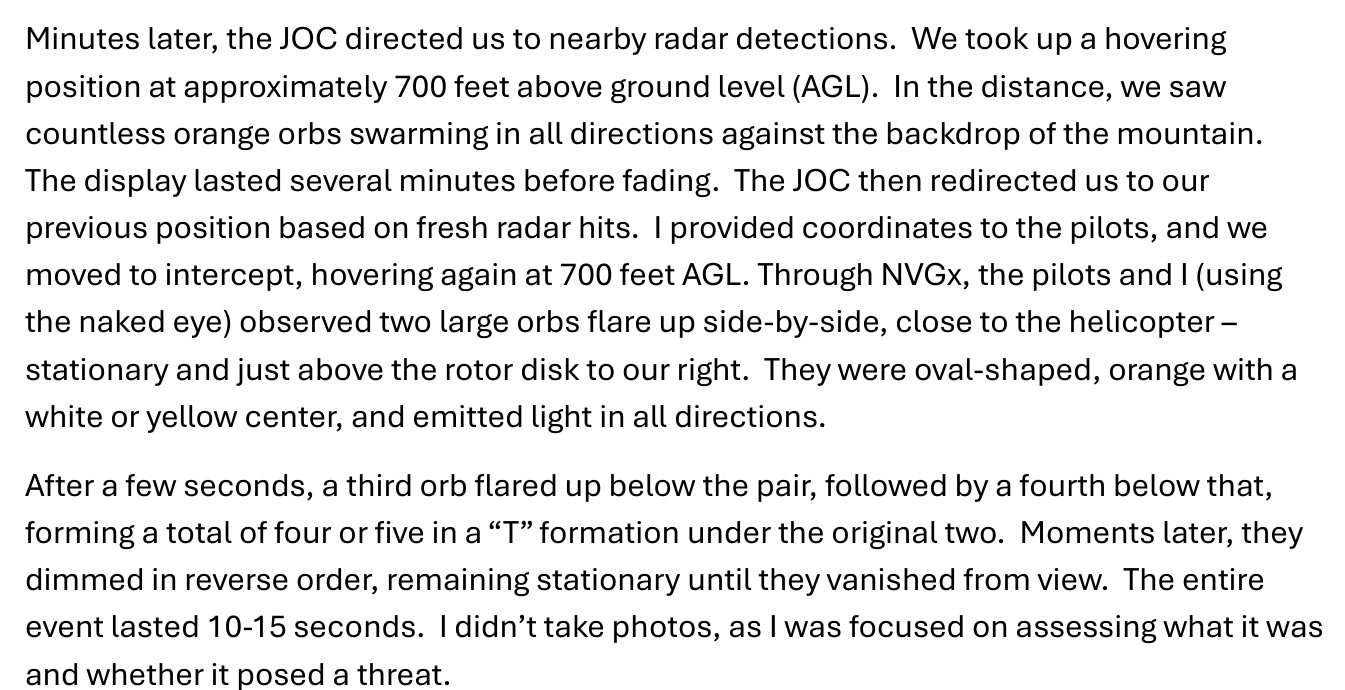
The JOC reported that several fighter jets had launched on a training mission in the area and asked them to help identify the objects. Minutes later the helicopter was sent toward fresh radar detections and settled into a hover about 700 feet above the ground. "In the distance," the officer wrote, "we saw countless orange orbs swarming in all directions against the backdrop of the mountain." The display lasted several minutes before fading.
Then came the strongest moment in the document. New radar hits sent them back to their previous position, again hovering at 700 feet. The pilots through their goggles, and the officer with his own eyes, watched two large orbs flare up side by side, close to the helicopter. They were stationary, "just above the rotor disk to our right": oval, orange with a white or yellow center, throwing light in all directions.
A few seconds later a third orb flared up below the pair, then a fourth below that, four or five in all, forming a "T" under the original two. Moments later they dimmed in reverse order, never moving, until they were gone. The whole event lasted 10 to 15 seconds.
"I didn't take photos," the officer wrote, "as I was focused on assessing what it was and whether it posed a threat."
The pilots briefly considered landing, the objects were that close, but chose to stay in the hover and keep watching.
"Chasing" the fighters
Then the fighter jets came into view high above them, picked out by their blinking navigation lights. Directly above the jets, the same kind of orbs appeared. They flared up one at a time in a horizontal line, "matching the jets' speed and flight path," and after 10 to 15 seconds dimmed one by one and disappeared.
It happened again and again as the jets crossed the airspace, until they landed. "I remarked to the pilots," the officer wrote, "that it seemed the same orbs we had encountered were now 'chasing' the fighters."
Around the helicopter, orange orbs kept flaring up and down for several minutes, and before they vanished they formed a distinct triangle.
Low on fuel again, the pilots headed back to the JOC. After landing, the officer spoke with them only briefly, mostly to thank them. "We were virtually speechless after these observations," he wrote. He went in for a quick debrief and drove home.
What the ground saw
This night had already surfaced in the files. The first release, on May 8, 2026, included an FBI record of an interview with the same official, logging the night minute by minute: the cave entrance at 17:51, the report of the super-hot orb at 22:02, and the two orbs above the rotor at about 22:27. According to that record, five military aircraft were in the airspace, and the ground team estimated the super-hot orb was some 20 miles from the helicopter's position as the helicopter broke off the pursuit.
The same record carries the line: "The orbs appeared to break off from [the helicopter] and pursue the [military aircraft]." The official also noted there that the pilots said they were recording, but many sightings were above the helicopter, outside the angle of its infrared camera.
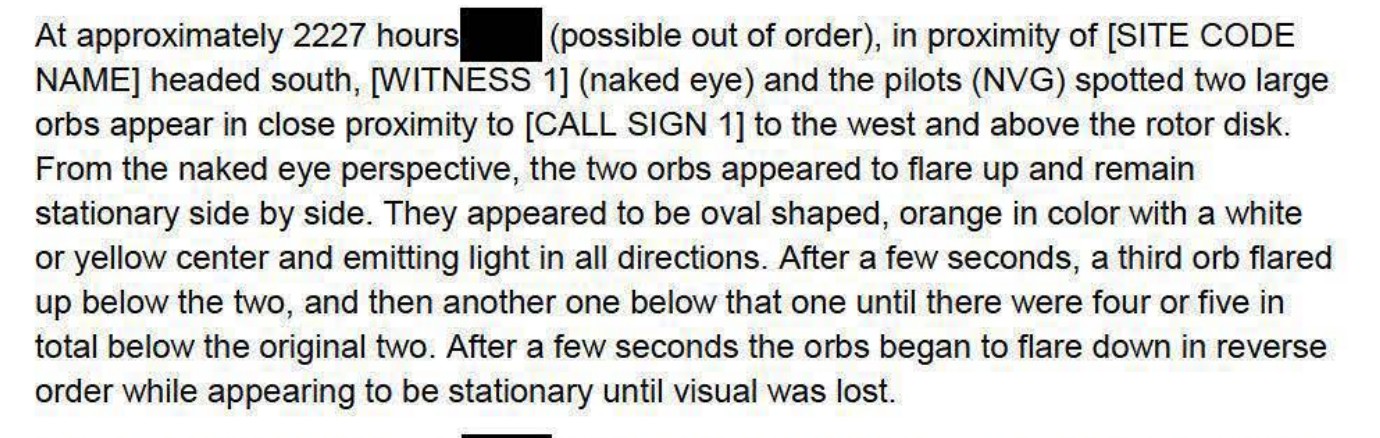
A set of photos taken by ground personnel through night vision devices was released with that interview. According to the Department of War, the photos of the objects underneath the helicopter come from this same set of observations. The catalog entry for the new document says it is accompanied by the infrared imagery from that night.
What only infrared reveals
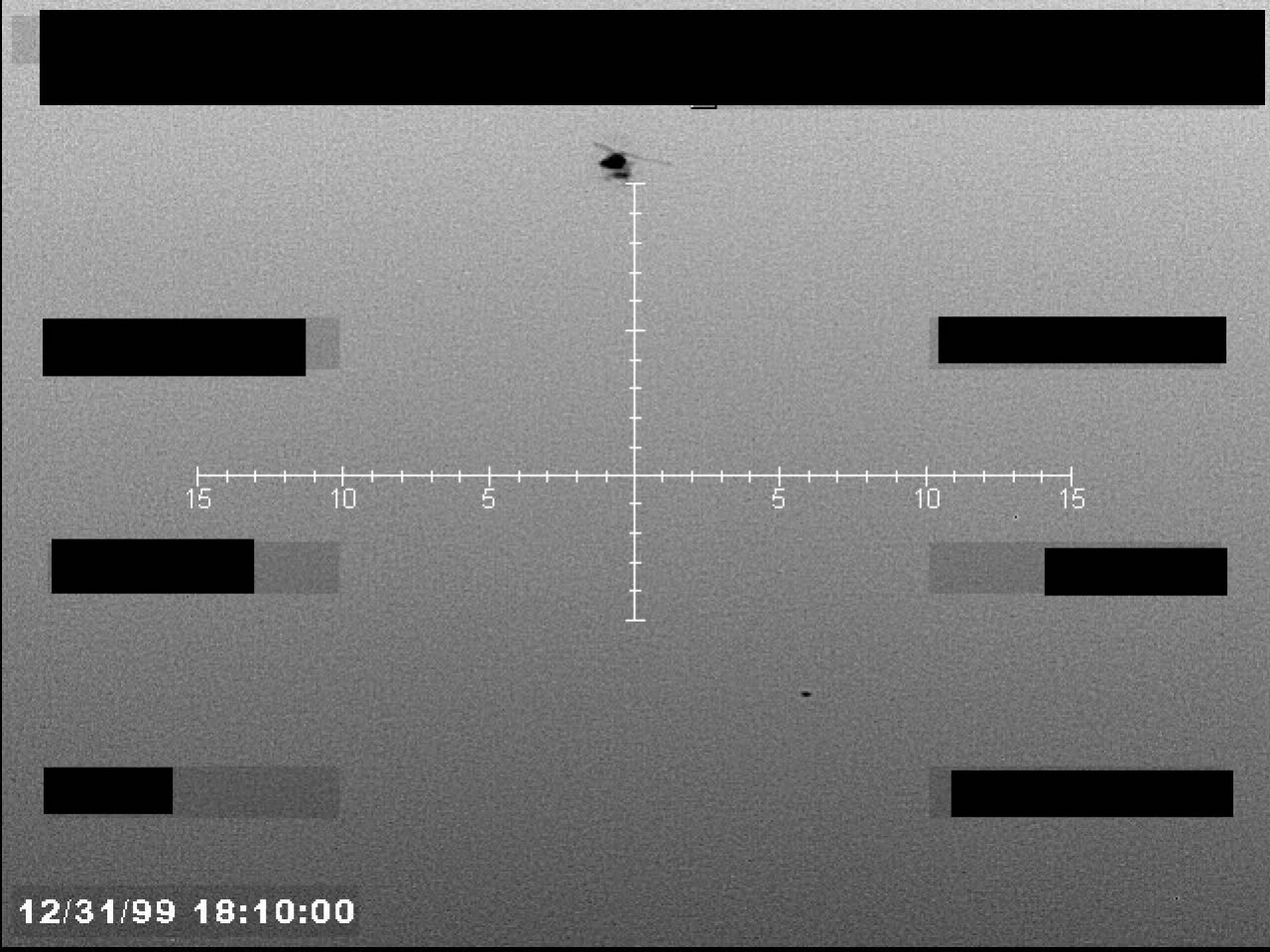
That night, everyone was looking through something different: the officer with his eyes, the pilots through night vision goggles, the ground team through a thermal camera. The Department of War published the infrared and night-vision imagery from that night, taken from the ground during the same exercise. The idea that the sky holds things only invisible light can reveal goes back much further, to the California desert, and to Trevor James Constable's infrared photographs of 1957.
Trevor James Constable's earlier hunt for what the eye can't see
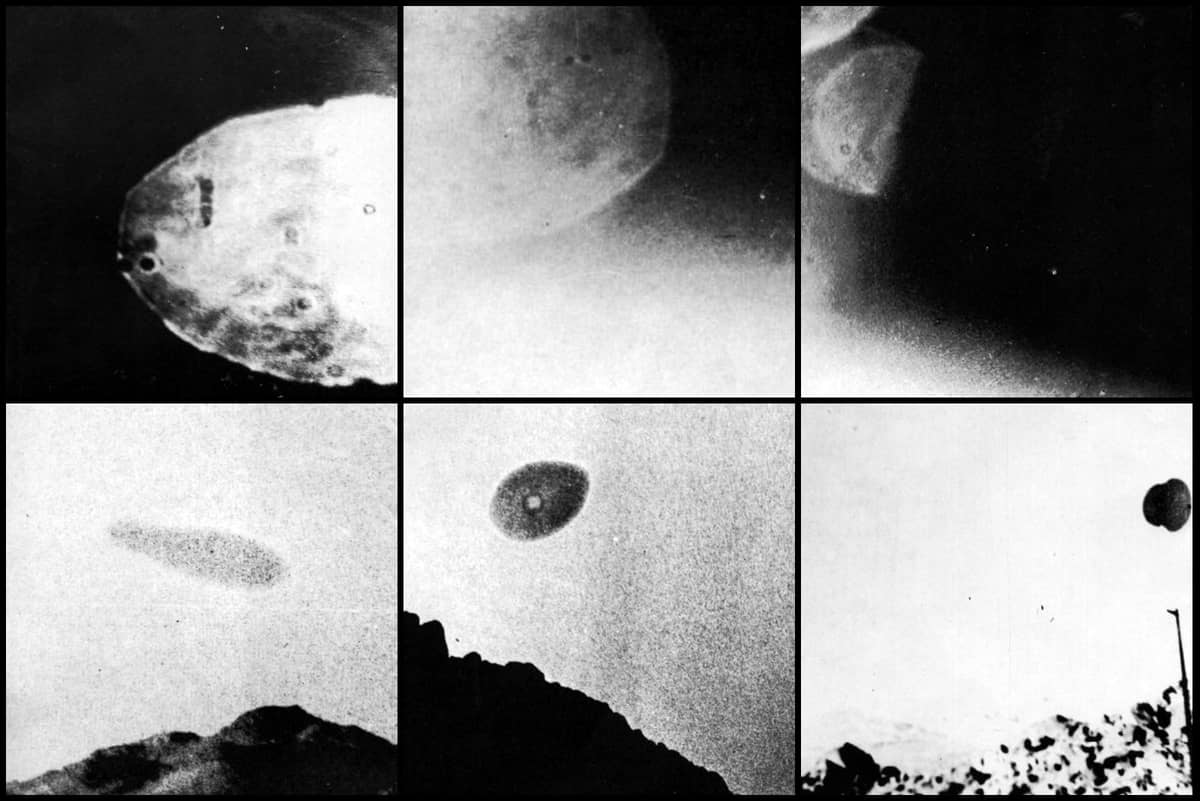
Trevor James Constable was born in Wellington, New Zealand, in 1925 and spent years at sea as a radio officer in the U.S. merchant marine. According to Constable, on the morning of August 25, 1957, while eating breakfast at his camp in the Mojave Desert, he felt a pulsation directly overhead. He grabbed a Leica already loaded with Kodak high-speed infrared film, fitted with an 870-nanometer filter that blocks visible light, and shot six frames in a row. In them, he said, a huge amoeba-like form moved above the camp.
Constable described these as living creatures of the atmosphere, visible only in the infrared. He kept photographing in the desert with his friend James Woods and published the pictures in They Live in the Sky (1958), The Cosmic Pulse of Life (mid-1970s) and Sky Creatures (1978). In the sixth frame of the 1957 series, according to Constable, two different forms appear side by side.
Related reading
- Pentagon UFO Files 2026: every PURSUE release and what it revealed
- Gulf of Oman: 25 cold spheres in the fifth PURSUE release
- The eighth release of the Pentagon UFO files
- Guam 1956 F-86D UFO Chase: Air Force Report IR-7-57
Frequently asked questions
What is document ODNI-UAP-D001?
A two-page, first-person account by a senior U.S. intelligence officer of a helicopter flight over a weapons test range in late 2025. It comes from the Office of the Director of National Intelligence and was posted on May 22, 2026, in the second release of the Department of War's UAP files.
What did the officer see?
A "super-hot" object that split in two and came within ten feet of the helicopter, a swarm of orange orbs against a mountain, two large orbs above the rotor with more below them in a "T" formation, and orbs that flared up above fighter jets and matched their speed and flight path.
Are there photos from that night?
Yes. According to the Department of War, ground personnel photographed through night vision devices, and the photos of objects underneath the helicopter were published in the first release, on May 8, 2026.
