


6,771 UFO reports from Germany: most were solved, and 21 were never explained
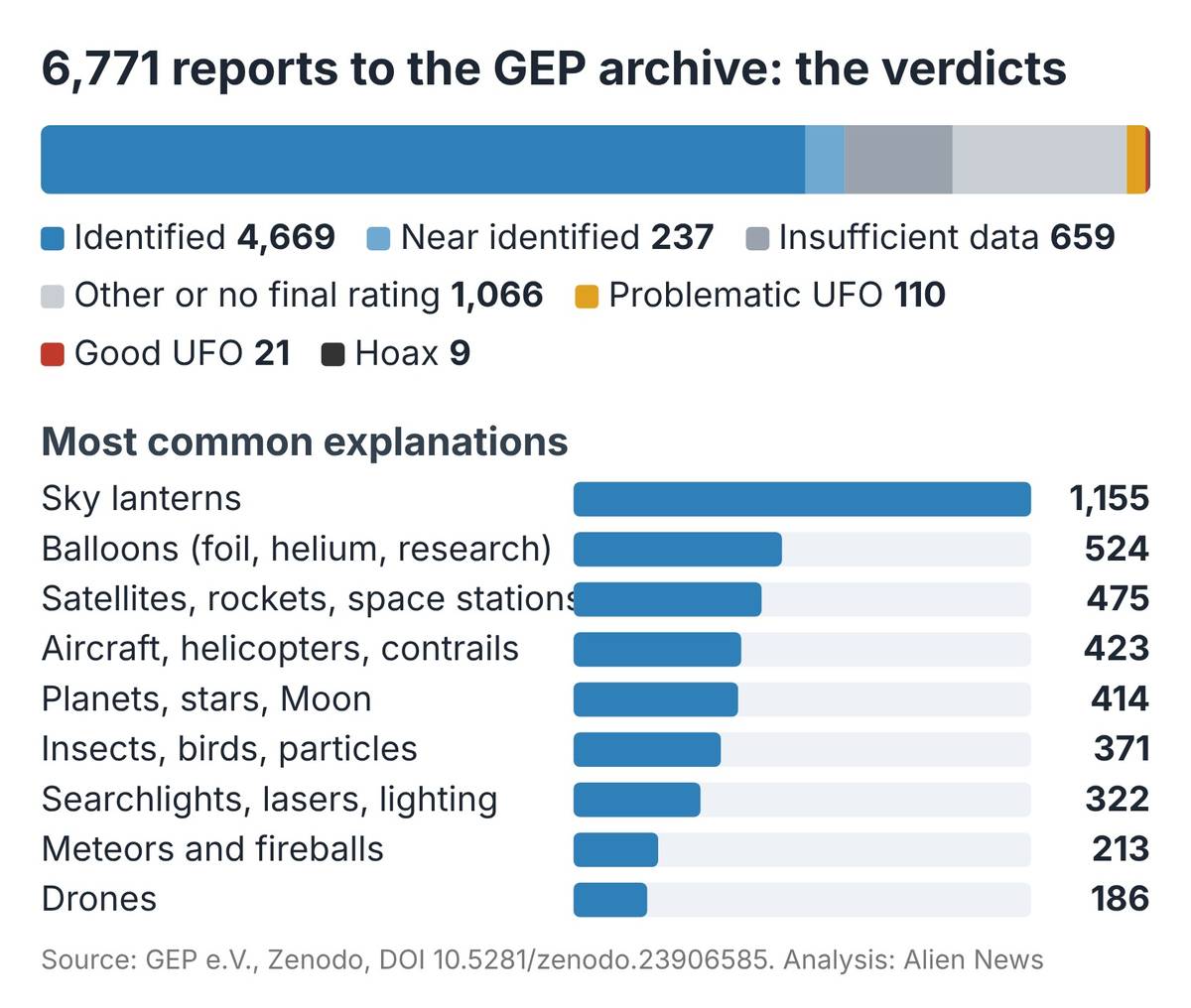
A German UFO research society has opened its case files to the public: 6,771 reports from half a century, each with the investigators' verdict. Nearly 70% turned out to be sky lanterns, balloons, satellites and aircraft. Only 21 earned the top grade, a good UFO with no explanation at all. We read every one of them.

By Avi Moas
Sources and editorial method
Avi Moas, Researcher and Editor-in-Chief · Produced with an AI-assisted newsroom
An archive opens
Since 1972, a volunteer society in Germany called GEP, short for Gesellschaft zur Erforschung des UFO-Phänomens (the Society for the Study of the UFO Phenomenon), has been the place people turn to when they see something they can't name. The reports came in by letter, phone and fax, then by email, and lately through Facebook. Its investigators tried to work out what each witness had actually seen.
In November 2026 the society put the whole caseload on Zenodo, the open research repository, under a licence that lets anyone reuse it. The file has 6,771 rows. Each row is one report: date, time, place, a short summary of the testimony and, at the end, the investigators' conclusion. Witness names have been removed. Most of the reports, 6,036 of them, come from Germany, with hundreds more from Austria and Switzerland and a scattering from 70 other countries where Germans happened to be on holiday and looking up.
What got solved
The first thing the file says is that most strange things in the sky are not strange at all. 4,669 reports, almost 69%, were classed as identified objects. Another 237 were rated "near IFO": a likely explanation without full proof.

The single biggest culprit is a party decoration. 1,155 reports turned out to be sky lanterns, the small paper balloons with a flame inside that people release at weddings and birthdays. Next come foil, helium and research balloons (524), satellites and rockets (475), aircraft, helicopters and contrails (423), planets, stars and the Moon (414), insects, birds, particles and droplets (371), and searchlights, lasers and lighting (322). Drones, which did not exist when the society was founded, already account for 186.
The year the sky filled with lanterns
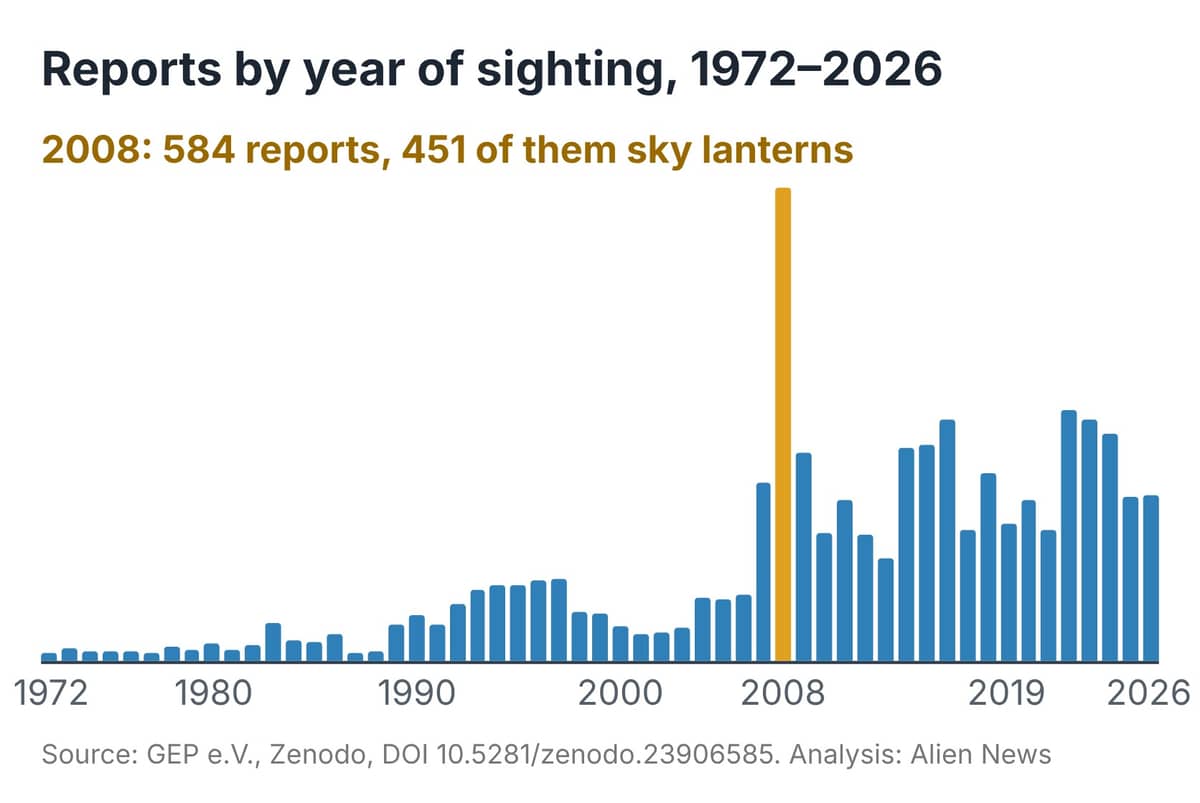
Plotted by year, the reports stay fairly calm for decades. Then, in 2008, the line jumps. That year has 584 sightings, more than any other in the archive, and 451 of them were sky lanterns. It was the craze of the moment in Germany, and people who saw a row of silent orange lights drifting up over the rooftops picked up the phone. Within a few years the fad faded. In 2019 the archive logs just one lantern.
Other lights took their place. Up to 2018, no year had more than 21 sightings traced to satellites. In 2019 and 2020 there were 56 each, and in 2024 there were 61. 2019 is also the year the first Starlink satellites went up, and in the days after each launch they fly in a long, bright line. The archive never names them, but the timing is hard to miss.
What was left
Strip away the explanations and three piles remain. 659 reports had too little information to decide. 110 were rated "problematic UFO": unexplained, but with something in the testimony too weak to lean on. And at the top sit 21 files graded "good UFO": a detailed account, a credible witness, and no explanation that worked. That is fewer than one report in 300.
One more number is worth knowing. Only nine reports in the entire archive ended with the verdict "hoax". Most people who contacted the society really did see something. Most of the time it was simply something ordinary.
The investigators also use the scale devised by the American astronomer J. Allen Hynek, which grades encounters by how close the object came. 183 reports were close encounters of the first kind, a sighting at short range. 53 were of the second kind, where the object left some physical effect. 39 were of the third kind, where the witness describes figures. These are the most gripping files in the whole stack, translated here as faithfully as the archive records them.
Hochheim, April 1974: the missing hours
It is about two in the morning. Two couples are driving from the village of Wicker towards Hochheim, a small wine town on the River Main between Wiesbaden and Frankfurt. Above a field, 50 to 100 metres away, they see a disc-shaped object standing in the air about 50 metres up.
They park and watch. Lights rotate around the object, and a tight beam, like a searchlight, sweeps the ground beneath it. Only later will they learn that a transformer box stood on that spot at the time.
Then the beam turns on them. When it hits, they feel frozen and struggle to breathe. The light vanishes, the lights on the object spin faster, and it climbs away at an angle in jerky movements until it is gone. Only then do their bodies loosen, and they drive on. To them, the whole sighting lasted 15 to 20 minutes. When they reach home, the trip has taken two to three hours longer than it should have.
Weißenburg, September 1979: the police told to watch the sky
This report reached the society only in 2022, 43 years later, passed on by the University of Würzburg. On the night of 18 September 1979, it says, a police officer and his colleague were told by their control room to watch the sky near Weißenburg, a small town in Bavaria south of Nuremberg, and to report any "objects".
Two patrol cars drove to a spot with an all-round view. From there the officers saw two glowing silver objects approach without a sound. As the objects passed overhead, they could see that they spun like a child's spinning top, and were shaped like one too. Air traffic control said it had not registered them. The officers kept watching the manoeuvres until, in the report's words, "a long fiery tail, like a rocket launch" appeared behind one object and it moved off "at insane speed" towards Ingolstadt. The investigators found no explanation, but graded the file "problematic" rather than "good".
Goldbach, October 1989: the silence
Quarter past five in the morning in Goldbach, a village near Aschaffenburg in the north-west of Bavaria. A couple on their terrace see four bright lights. Half an hour later they drive past them, stop, and wind the windows down. Four white lights, each about three metres across by their estimate, arranged in a diamond, hang roughly ten metres above a field.
What unsettled them most was the silence. No sound came from the lights, and everything else had gone quiet too. No animals, and not a single car, although at that hour the road is normally busy with commuters. The lights were very bright, yet oddly they did not dazzle and did not light up the ground below. Around them the couple could make out a dark outline suggesting a tilted disc. After about five minutes the woman grew frightened, and they drove away.
Ronneburg, January 1991: the wave
Ronneburg is a small town in eastern Thuringia, in what had been East Germany until a few months earlier. At nine in the evening a 38-year-old woman is in the market square when a loud noise, "as if a war was starting", makes her look up. She sees an arrangement of lights and takes it for a squadron of aircraft.
As she walks on, a strange feeling comes over her. The street is empty, there are no cars, and even the street lamps are dark. Suddenly an unnaturally strong wind rises and throws her against a tree, and she has to fight not to be swept away. Some 20 to 25 metres away, above the street, hangs a large, orange, bell-shaped object. She raises her arm and waves, and the object tilts onto its side.
In the windows of its dome she sees three figures in helmets and silver suits, and thinks she can make out instruments and a monitor inside. One figure points a black rod at her. A second steps beside him and points with the rod from left to right, and within seconds the object, still tilted, flies off to the right. This is one of the 21 files with the archive's highest grade.
Mörfelden-Walldorf, May 1991: the camera that wouldn't work
Mörfelden-Walldorf is a town pressed up against the southern edge of Frankfurt Airport. At three in the morning a baker's apprentice is cycling to his training workshop. First there is a very loud hum. Then, from the direction of the forest, a round object comes in low, straight at him.
At an empty crossroads it stops directly above him, 40 to 50 metres up. It looks metallic and disc-shaped, "like a cake with domes on top", and he puts its diameter at 30 to 50 metres. White-yellow lights seem to rotate around it. He throws his bike aside and grabs his camera, but the camera fails. After about a minute the object turns slightly and heads towards the nearby church, the hum grows louder, and suddenly it shoots straight up so fast that within seconds it is out of sight.
Stade, July 2000: a triangle that hid the stars
A quarter to midnight in Stade, an old Hanseatic port town near the Elbe, west of Hamburg. A man named Torsten B. is on his balcony when he sees a triangular object. By his estimate it spans about three full Moons. In each corner burns a large orange light. There are no ordinary anti-collision lights.
The body itself was dark, with no visible structure. He could tell it was a triangle only because it blotted out the stars behind it as it passed. It moved slowly and seemingly low, from the north-west through the west towards the south-west, for two to three minutes, without a sound. Then comes the line that puts this file near the top of the pile: according to the archive, a radar image from Germany's air navigation service confirmed the flight of an unidentified object.
Friesenheim-Oberweier, September 2024: the signal
The newest of the 21. Oberweier is a small village in the Rhine valley in south-west Germany, near the town of Lahr. It is 5:34 in the morning. A woman outside her house hears a loud, strange noise. Looking for its source, she sees in the clear southern sky a very bright white "wave-shaped" form, with a bright "colon", two dots, in front of it.
After about five seconds the object and the noise vanish together. Her husband, inside the house, also heard a noise but described it differently. What makes this brief account a good UFO is one sentence at the end: a GEP member runs a passive radar system, which picks up reflections of existing radio and TV broadcasts off objects in the air, and at the time of the sighting it recorded a signal.
What the numbers say
The archive also tells a story about memory. Of reports from the 1970s, only about 28% were classed as identified. For the 2000s the figure is 80%. The likely reason is simple. A report that arrives the same night, with an exact time and a phone photo, can be checked against satellite passes, flights and weather. A story that arrives 30 years later can't be checked against anything.
That is exactly why the 21 matter. They went through the same filter that caught the lanterns, the balloons, Starlink and the drones. And in Stade and Oberweier, at least, what remained was not only a witness. There was also a signal on a screen.
