Basel 1566: the black spheres above the city
Five years after Nuremberg’s broadsheet, a Basel leaflet showed a troubled sun, spheres in the sky and a city looking upward. A period source opens a window onto the spectacle and the concern surrounding it.
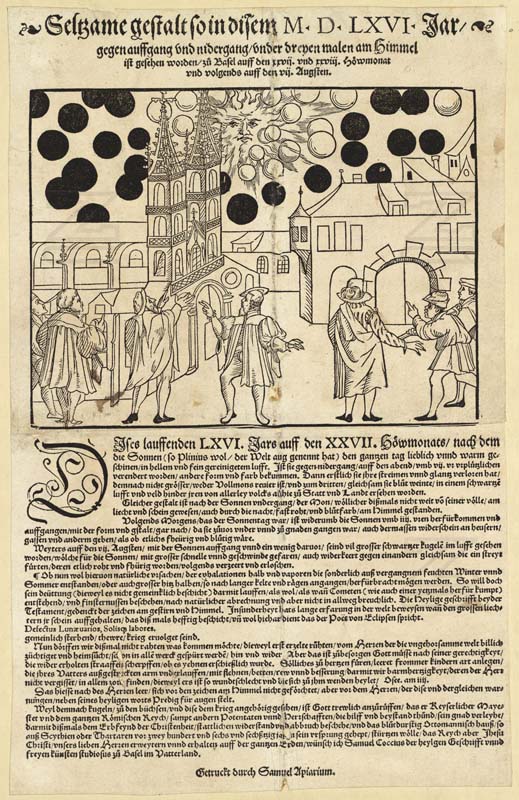
Five years after Nuremberg’s broadsheet, a Basel leaflet showed a troubled sun, spheres in the sky and a city looking upward. A period source opens a window onto the spectacle and the concern surrounding it.
This article distinguishes the source material, participants’ accounts and later interpretations.
More than one morning
The leaflet refers to appearances reported on 27 and 28 July and 7 August 1566. Its familiar image depicts the final episode, with dark and light spheres around the sun above Basel. Calling it simply “black suns” loses some of that distinction. The text describes several appearances, while the picture concentrates the story into one scene.
Who put the sky on paper
Samuel Apiarius and Samuel Coccius are associated with the leaflet preserved in Zürich. The Swiss National Museum notes that its makers relied on accounts rather than witnessing the manifestations themselves. The information passed through observers, retellings, artist and printer before reaching the surviving page.
An image that can be examined
The print includes rooftops, the cathedral, people below and a sun with a face. Those choices place the spectacle in a human city and give it emotion and direction. Reading them is visual analysis of a document; it is not equivalent to counting objects in a camera sequence.
A sign in the sky, a question today
The original text provides a religious frame. Modern readings range from atmospheric phenomena to an unfamiliar encounter. Discriminating between them would require observations of a kind not preserved here. What remains is a rich page through which sixteenth-century and contemporary interpretations of extraordinary skies can be compared.