


Italy, 1950 and 1954: Facchini in the field at Abbiate Guazzone, Rosa Lotti in the woods at Cennina, and how a UFO is reported today
Bruno Facchini went to check sparks near a power line. He said he found suited figures repairing a huge craft and walked up to offer a hand. Years later, people were still asking him what happened next.
Avi Moas, Researcher and Editor-in-Chief · Produced with an AI-assisted newsroom

Bruno Facchini said he thought they were pilots.
A storm had just blown through Abbiate Guazzone, near Tradate, on the night of 24 April 1950. He noticed sparks and went to check what he took to be trouble with a nearby power line. He was a factory worker, about forty. What he described finding in the field was a huge object shaped like a flattened ball.
Horizontal and vertical strips divided its surface into a grid. A ladder led to a bright rectangular opening, and from four or five meters away he could make out another ladder inside, pipes, a row of cylinders and pressure gauges. He put the height of the whole thing at roughly ten meters.
Someone was working on the pipes
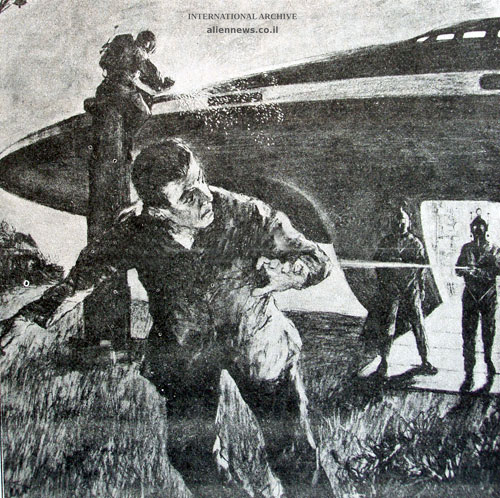
Two figures stood by the ladder. A third was up on something like a mechanical lift, working on a bundle of pipes outside the craft. Welding, Facchini thought. That was where the sparks were coming from.
Their suits resembled diving gear, covering them from head to foot, with a tube near the mouth. The later dossier describes very pale faces behind transparent eye sections and what appeared to be liquid inside the masks. That detail differs from the 1952 newspaper interview, in which Facchini said he could not make out their faces. The dossier puts them at roughly human height.
He offered to help
Facchini walked up and asked whether they needed a hand. The answer was a series of guttural sounds and gestures. Frightened, he ran.
One of the figures lifted an object hanging from its neck and pointed it at him. He described a beam striking his back and knocking him to the ground. Then the occupants climbed aboard, the opening closed, the hum grew louder and the craft took off at speed. The case summary gives their number as three or four.
Four marks in the grass
The next morning, he returned. He reported four circular marks, each about a meter across, arranged in a square. There were scorched patches of grass and pieces of metal nearby. He collected some of the fragments.
Those pieces would pass through several hands. Renato Vesco arranged tests that described the material as antifriction metal. In the late 1950s, the Milan investigator Umberto Corazzi visited Facchini and came away with a small piece of the supposed debris. That one was subsequently lost. The dossier records the test description, but supplies neither the laboratory report nor a finding that establishes where the metal came from.
A visitor in the vegetable garden
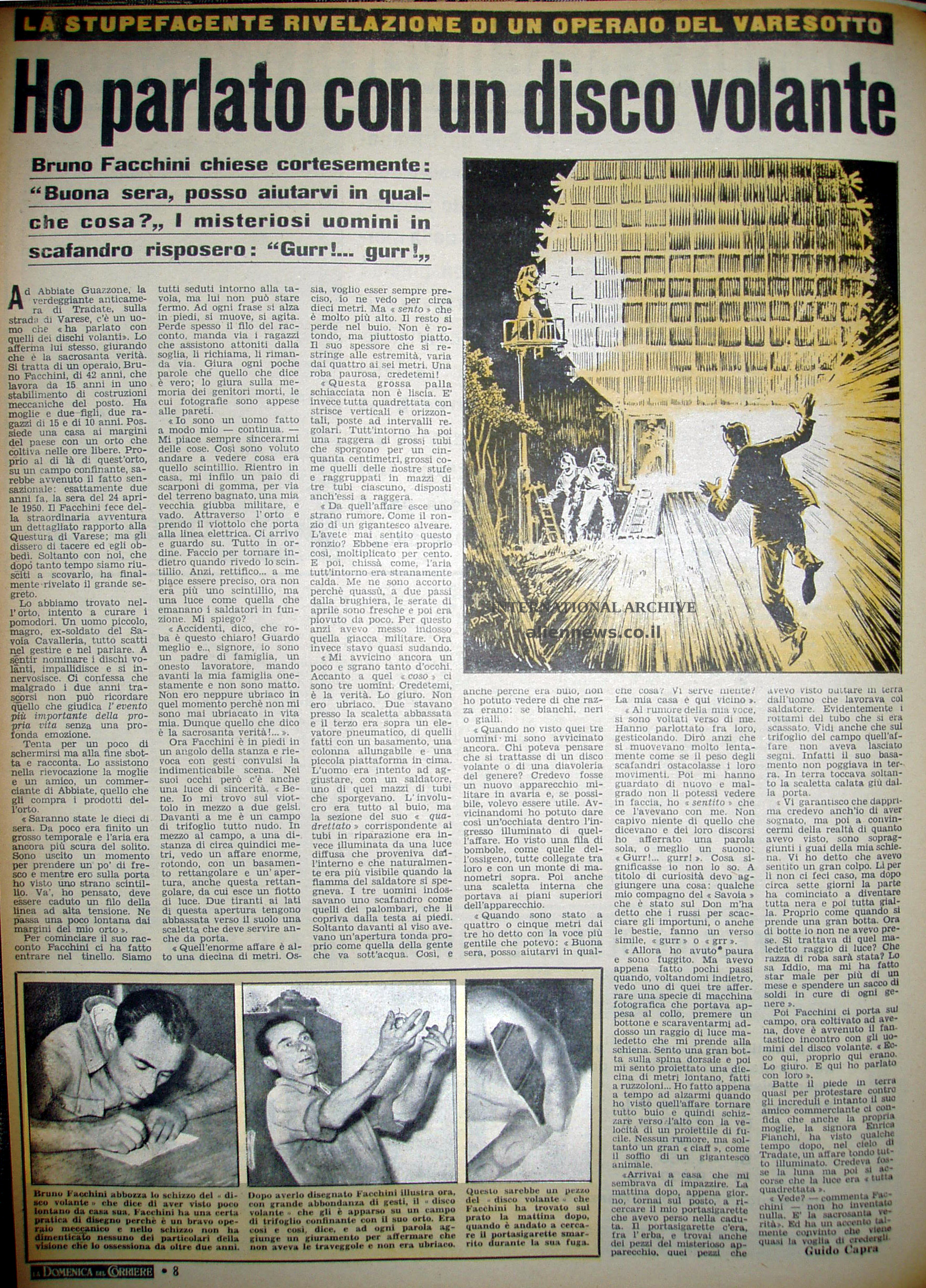
Guido Capra wrote that he found Facchini tending tomatoes. The factory worker then brought him inside to tell the story. The resulting page in La Domenica del Corriere, dated 24 August 1952, carries Capra's byline, an illustration of the encounter and photographs of Facchini drawing the object and explaining it with his hands. Beside them is a photograph of what the paper presented as a fragment.
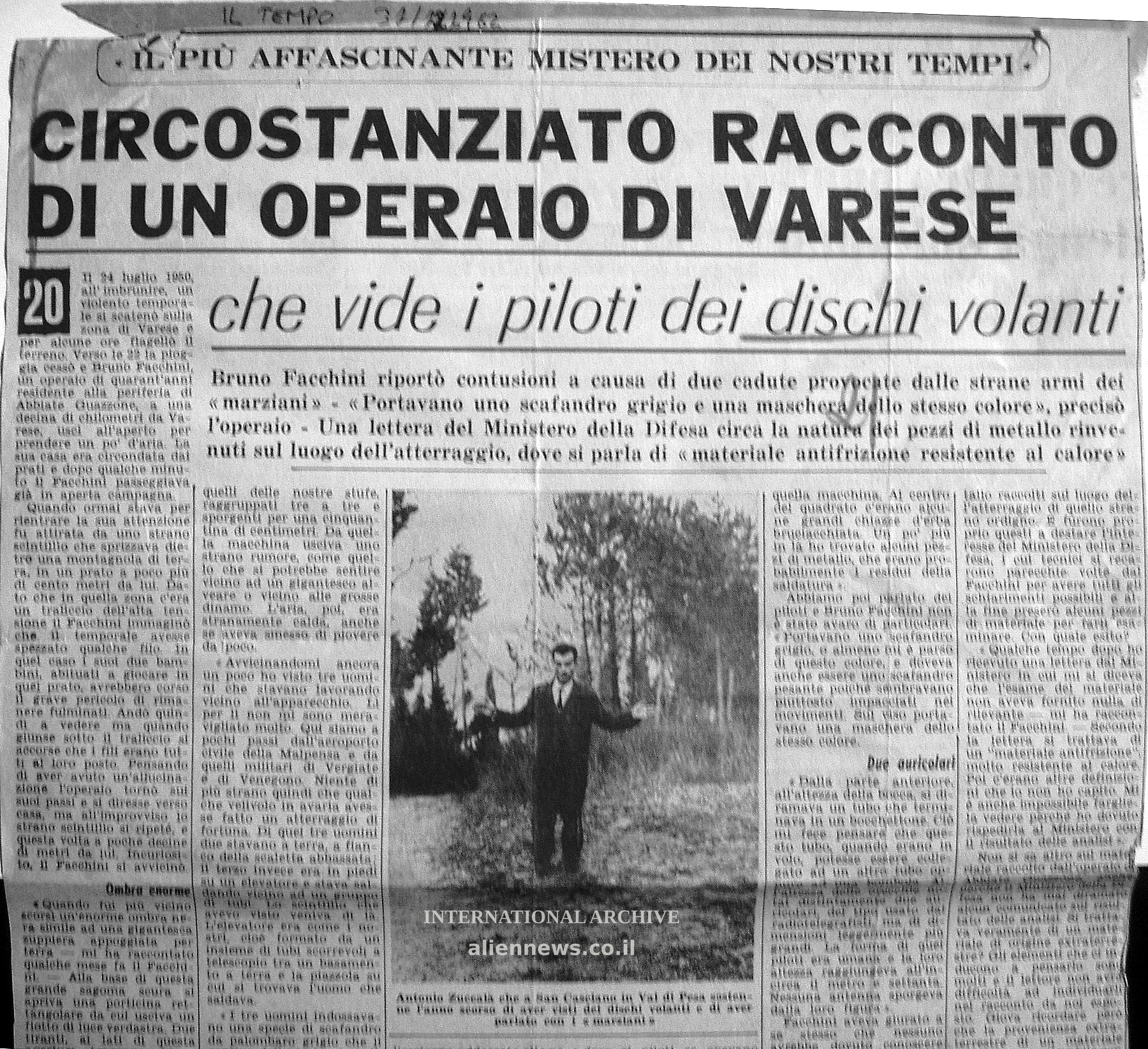
This is the earliest press item in the dossier's bibliography, more than two years after the reported encounter. A detailed investigation appeared in Dischi Volanti in 1960. Two years later, journalist Bruno Ghibaudi came to see Facchini for La Settimana Incom. His article introduced more people who supposedly had something to say about that night.
How did the story first reach a journalist? Relatives questioned in 2008 remembered an acquaintance passing it along, followed by a radio reporter arriving for an interview that apparently never aired. Those recollections did not settle when this happened.
The questions kept coming
Ghibaudi's 1962 article mentioned unnamed neighbors who had supposedly witnessed the episode but wanted to stay out of it. It also described a son's interest in flying saucers, something one of Facchini's sons did not confirm in 2008.
His sister remembered seeing him a few days after the reported encounter. In her 2008 interview, she recalled his yellowish face and how he kept apart from people. Facchini said he regretted talking about what he had seen. The story had brought ridicule in the village as well as visitors with questions.
It began, in his telling, with someone apparently having trouble with a machine. He went over to offer a hand. Years later, people were still coming to him to ask what had happened in that field.
Cennina, 1954: Rosa Lotti and the double cone
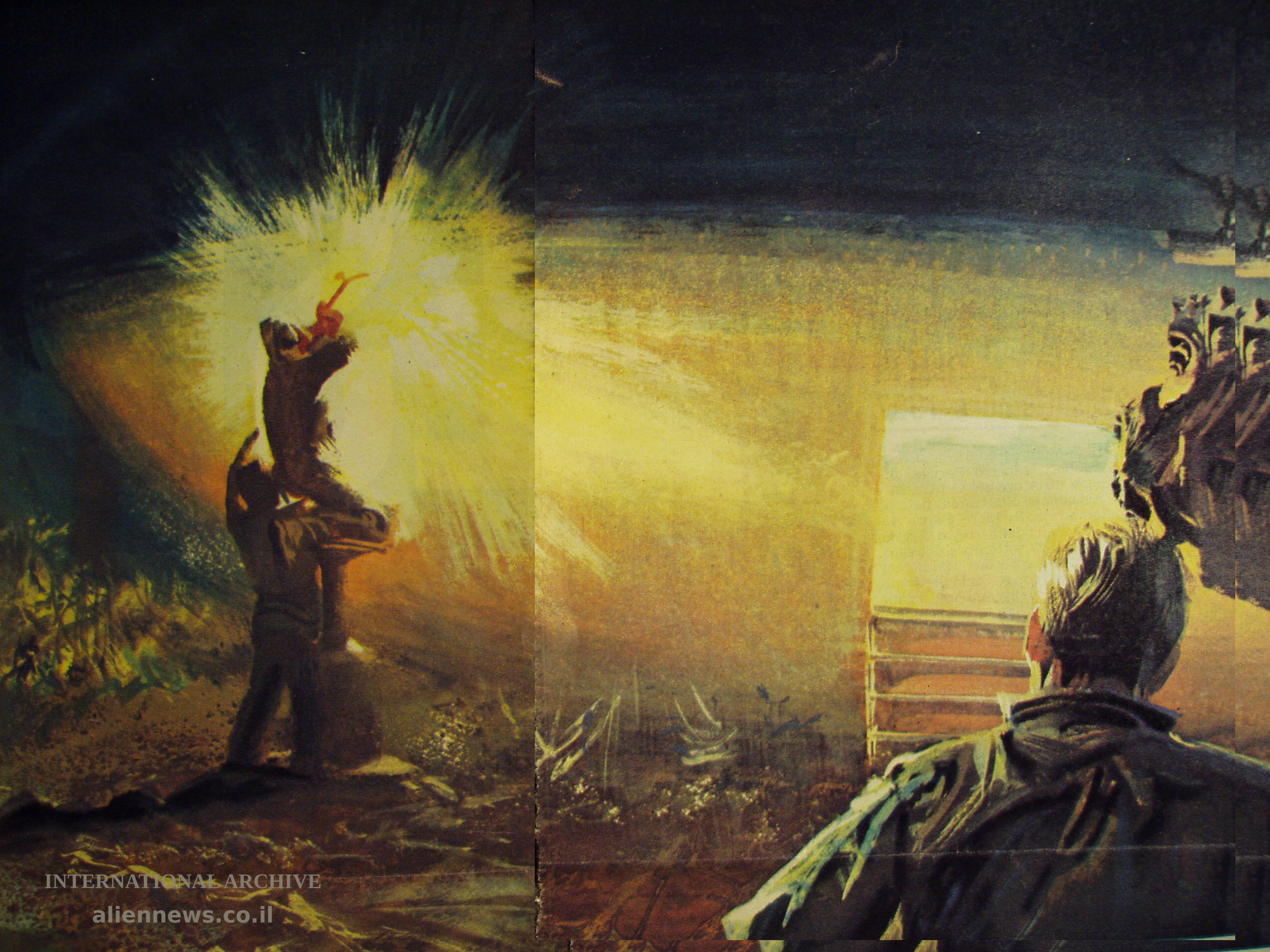
Four years after Facchini's night, at the other end of Italy, a story appeared that echoes it strangely. On the morning of 1 November 1954, at about half past six, Rosa Lotti set out for church in Cennina, Tuscany, carrying flowers, shoes and stockings. On a path through the woods she noticed a brown object standing upright in the ground: two cones joined at their bases, about two metres long, with two round windows and a glass door.
By her account, two figures about a metre tall, in short jackets with shiny buttons, small capes and helmet like headgear, came out of the bushes and blocked her way. They smiled and spoke in a language she did not know. One took her bunch of flowers and a stocking, and some of the flowers were returned. Then the figure took out a brown cylinder about twenty centimetres long, and Lotti took fright and moved away. She estimated the encounter lasted about ten minutes. Villagers who went to the spot reported a hole about ten centimetres across.
On 14 November 1954 the scene appeared on the colour cover of La Domenica del Corriere, the weekly that had carried Facchini's story two years earlier. In another interview in 1993, Lotti said many people had come to see her, among them a woman from Genoa who claimed a similar experience.
Two stories, one structure
When I put the two stories side by side, I see the same structure. An ordinary person, on the way to work or to church, comes upon a craft standing on the ground. Beside it are figures in suits, busy with something. A brief contact follows without a shared language: Facchini offers help, Lotti loses flowers and a stocking. And after the craft is gone, marks remain in the ground, four round marks at Abbiate and one hole at Cennina.
I find the pattern far from Italy too. In the village of Grivkovichi in Belarus, in 1990, a man set out three glasses for two visitors in green suits. Jacques Vallée wrote about this likeness between modern accounts and folk tales, and I went through what he wrote in his file.
How a UFO is reported in Italy today
Facchini and Lotti told journalists, because there was no one else to tell. Today Italy has a set route. After the wave of reports in 1978, Prime Minister Giulio Andreotti assigned the subject to the Italian Air Force. A civilian who wants to report fills in a form and hands it in at the nearest Carabinieri station, where the reporter's details and the time and place of the sighting are recorded.
From there the Air Force opens a technical check, looks for a match with human activity or natural phenomena, and consults other bodies as needed. Only when the check finds no technical or natural explanation is the event recorded as a sighting of an unidentified object. The work is done today by the General Security Department of the Air Staff, and the official site lists reports by year, from 1972 to 2026.
If Facchini saw the craft in the field today, he would go to the Carabinieri. And I would be looking for his file on the Air Force list.
Editorial clarification ·
The article was rewritten. It now distinguishes the faces described in the later case dossier from the obscured faces in the 1952 newspaper interview. Both sources remain linked.
- Colour reconstruction: scan via UFO.it. Illustrator, original publication and date unverified. Image source
- Monochrome illustration: La Settimana Incom, 1962, according to Ufopedia’s caption. Individual illustrator unverified. Image source
- Newspaper page: La Domenica del Corriere, 24 August 1952, according to the matching Ufopedia caption. Byline: Guido Capra. Scan via UFO.it. Image source
- Press clipping: scan via UFO.it. Publication date remains unverified. Image source
Found another source or a detail to correct? Let us know.
