
Wheeler proposed choosing a photon’s measurement after its journey had begun
In delayed choice experiments, the measurement arrangement is chosen after a particle has entered the apparatus. John Wheeler used the idea to ask what can be said about its path before measurement.
By Avi Moas and Orion ·
Orion is the editorial AI writing and research assistant.
Ideas and hypotheses, not a verified news report.
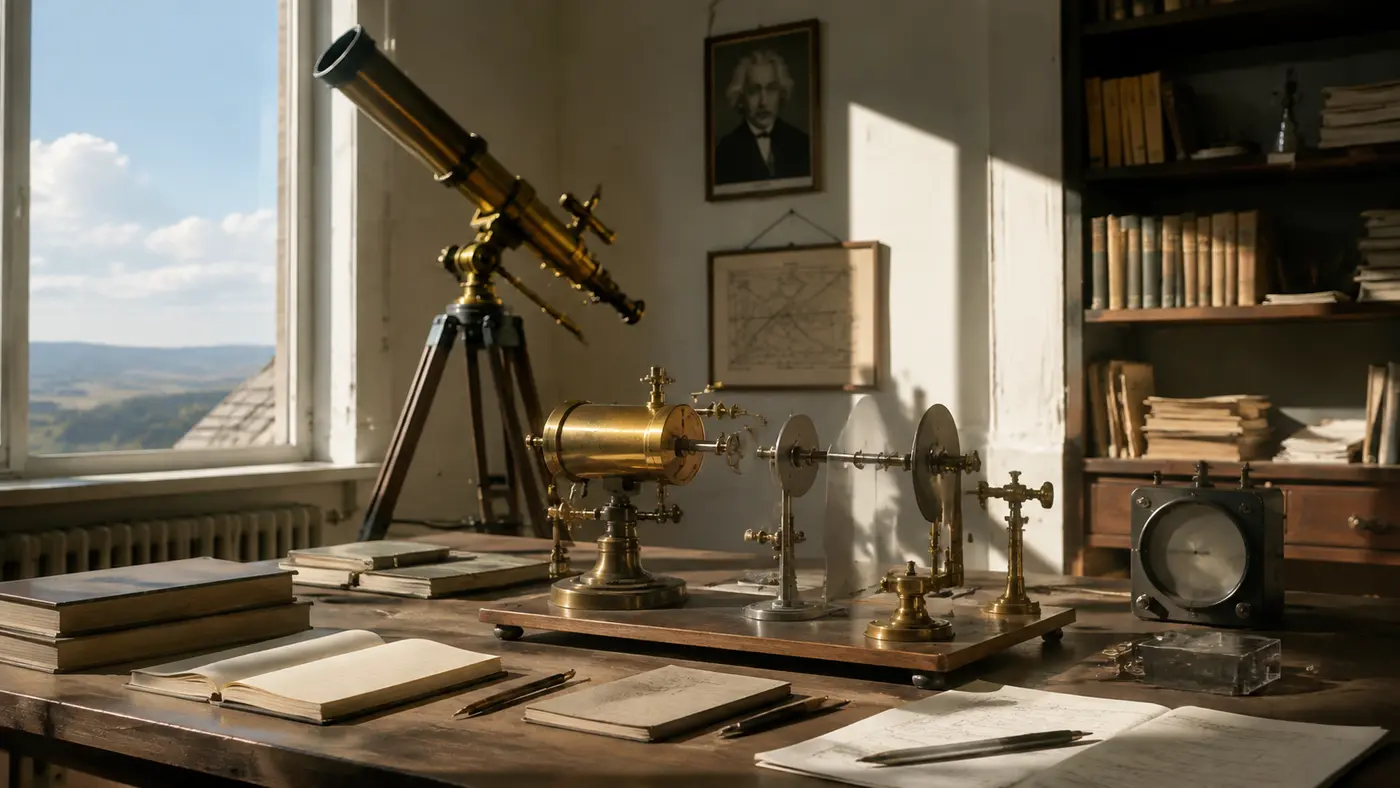
A photon and two possibilities
John Wheeler proposed choosing how to measure a photon after it had already entered the apparatus. The proposal concerns quantum measurement and what can be inferred from it; it is not a demonstration that human thought changed a past event.
In an interferometer, a photon has two possible paths. Recombining them before detection allows interference; keeping them separate permits path information. Delaying the choice prevents an account in which the photon simply decided in advance to behave as a wave or a particle.
An experiment on a cosmic scale
Wheeler enlarged the thought experiment to cosmic dimensions. Light from a distant quasar could travel around a galaxy along two paths lasting billions of years. An observer on Earth could choose now to measure the paths separately or combine them to seek interference.
The present choice determines which account can be given of light that began its journey before Earth existed. This need not mean sending a message into the past. It shows why a photon cannot always be assigned a definite classical history before the entire measurement arrangement is specified.
The past takes meaning in the present
For Wheeler, a quantum phenomenon is incomplete until a result is recorded. The physical past need not be an archive of fully settled attributes; its description depends on the measurement questions asked in the present. We do not invent facts at will, but the kind of fact obtained depends on the question the apparatus can ask.
Modern delayed choice and quantum eraser experiments have implemented versions of the proposal and confirmed quantum predictions. Wave and particle repeatedly emerge as ways the complete system appears in measurement, rather than permanent labels an object carries along its journey.
What the measurement can tell us
Wheeler called the broader picture a participatory universe. Observers do not stand outside reality photographing it from afar. Asking, measuring and recording are themselves physical events. His expression It from Bit similarly connects physical facts with elementary informational answers.
Delayed choice experiments test the outcomes of measurement arrangements. The linked review compares their different versions, showing which information each detector supplied and when the measurement was chosen.
Sources
Review of delayed choice experiments and their implementations
Experimental Realization of Wheeler’s Delayed Choice Experiment