



The room is familiar. The presence is not.
In accounts collected by sleep researchers, people described a shadow or figure beside the bed while remaining aware of the room around them. They tried to move a hand or call for help, but their body did not respond.
In some accounts the figure stands near the door; in others it approaches the bed. Some people hear a voice or feel weight on their body, while others sense a presence without seeing it. The furniture is familiar, and even after movement returns the experience may remain vivid in memory.
What people reported seeing
Accounts describe human shadows, indistinct figures or an intruder approaching the bed. Some include footsteps or voices. Others involve neither an image nor a sound, just a strong sense of presence. Researchers group these experiences under an intruder factor. Not everyone sees a figure, and a presence is not always hostile.
Other accounts include chest pressure and a sensation of suffocation, sometimes with the impression that someone is sitting on the body. Some describe floating, flying or leaving the body. Allan Cheyne and colleagues identified three recurring clusters in reports: an intruder presence, pressure on the body, and experiences of movement or floating.
Contemporary nighttime stories also feature the Hat Man: a shadow with the outline of a person wearing a hat. The figure recurs in stories and online culture, and is the subject of the PBS Monstrum episode included below.
Touch can feel just as real
People report limbs being pulled, chest contact, vibration or buzzing in the head. A research report on Susan Blackmore’s website includes such sensations alongside voices, floating and presence. Touch and bodily sensations are an important part of these accounts, alongside the appearance of a figure in the room.
Sleep and perception researchers examine changes in bodily experience around sleep transitions and how a sense of presence may arise. Models of the brain’s representation of the body offer one research direction. The sources reviewed here do not provide a reliable population estimate specifically for forehead contact or an electrical sensation in the forehead.
The Hat Man in culture and nighttime stories
The Hat Man: PBS Monstrum
An English language episode about the Hat Man and its folklore. An explanatory video, not footage of a figure in a bedroom.
How many people experience this?
In 2011, Brian Sharpless and Jacques Barber pooled data from 35 studies involving 36,533 participants. In general population samples, 7.6% reported sleep paralysis at least once in their lives: roughly one person in thirteen. Among students, the figure was 28.3%. These figures concern at least one lifetime episode.
A broader 2024 review included 76 studies, 167,133 participants and 25 countries. Its pooled estimate for sleep paralysis was 30%. Populations and methods varied greatly and publication bias was detected, so this is not a precise count of one third of humanity or evidence of an increase since 2011. Both reviews show a widespread phenomenon studied across many populations.
The experience of someone weighing on the chest has also been studied separately. A 2017 review by Molendijk and colleagues estimated an 11% lifetime prevalence in general population samples for the incubus phenomenon, involving paralysis and a sense of a presence pressing on the body. That measures this particular experience, rather than the proportion who saw a figure or felt forehead contact. Percentages from these studies should not be added together.
How does sleep enter the picture? During REM sleep, voluntary muscle activity is suppressed. In sleep paralysis, a temporary inability to move or speak persists into awakening or appears while falling asleep. A sense of wakefulness and dreamlike content can overlap. This mechanism provides a basis for investigating the familiar room, presence and bodily sensations described in these accounts.
The nightmare before flying saucers
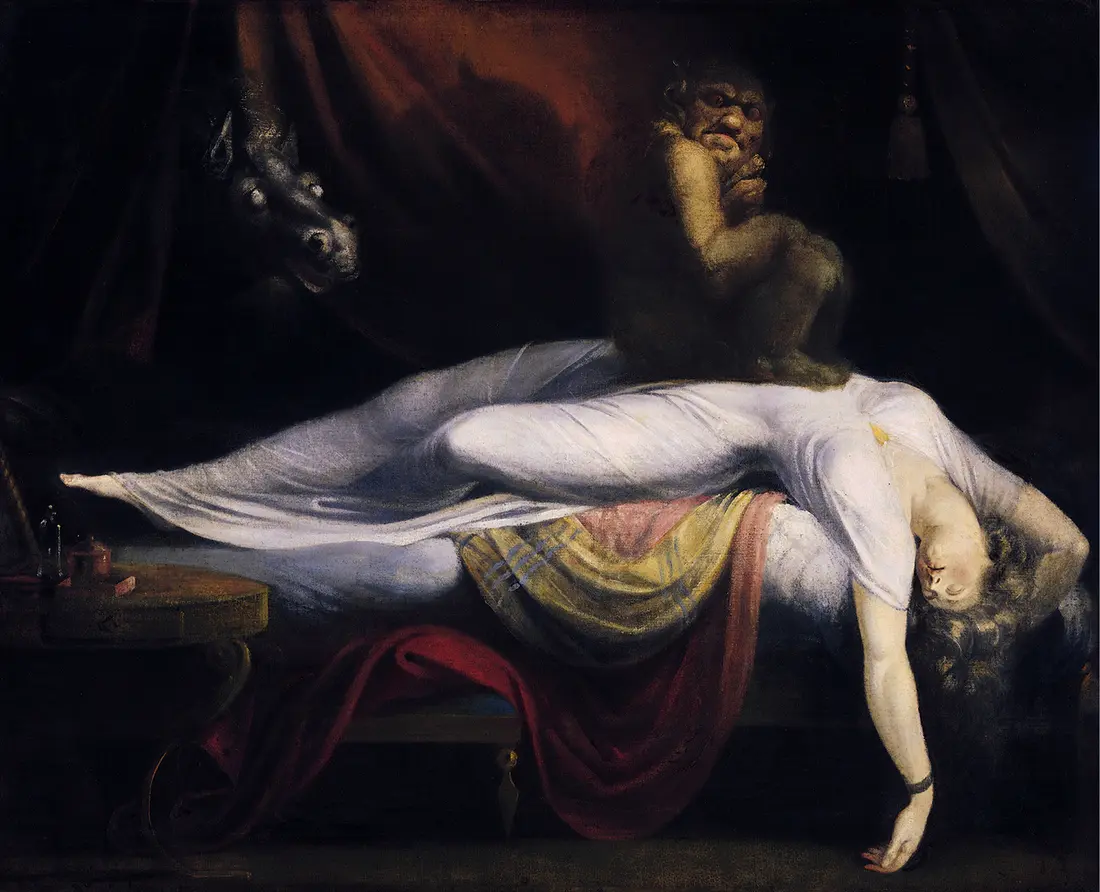
Henry Fuseli’s 1781 painting The Nightmare shows a woman on a bed, a creature sitting on her body and a horse’s head emerging between curtains. The artwork gives form to weight, helplessness and a presence in the room, in an image that remains recognizable centuries later.
The painting long predates the large eyed alien of modern culture. Comparing art, traditions and contemporary accounts lets us trace how people have given a face to nighttime fear and presence.
A local name for the presence
In Japan, researchers studied the phenomenon as kanashibari. An Egyptian study found that 48% of participants in its general population sample attributed their sleep paralysis to the Jinn. That figure describes the sample, not everyone in Egypt.
Researchers in Turkey examined Karabasan beliefs, while an Italian study explored the local Pandafeche tradition. These names connect experiences with culture, but do not form a rigid dictionary: not every Japanese person sees a spirit, every Egyptian a Jinn or every Westerner an alien.
Culture may shape interpretation, expectation and fear. The studies do not establish that a particular film caused a particular person’s vision, or that witches were universally replaced by aliens at one historical moment.
When faces draw close: the scanning motif
Abduction literature contains another striking motif. In journalist C. D. B. Bryan’s account of researcher David Jacobs discussing Mindscan, a reported figure bends very close to a person’s face, close enough that their foreheads might touch, and looks into their eyes. The account associates this with different feelings, including calm and fear.
Scanning was Jacobs’s interpretation of the accounts he collected. The closeness of the faces, the gaze and the touch make this motif relevant to comparisons with nighttime experiences. Understanding those similarities requires preserving each account’s circumstances and how it was reported and collected.
What the abduction research actually studied
In 2005, McNally and Clancy summarized research involving ten people whose abduction accounts were linked to apparent sleep paralysis episodes. They proposed that figures experienced around awakening had been interpreted as aliens. This was a small group selected for its characteristics, which defines the scope of the findings.
The paper cannot therefore establish that everybody reporting abduction experiences more sleep paralysis. It identifies a possible pathway in a small, selected group. A sky observation made while awake and a nighttime event beginning with paralysis require different investigations.
When the memory begins in childhood
A child’s account of a figure in the room deserves careful listening. Sleep paralysis involves inability to move around sleep transitions. During a night terror, a child may scream and move while asleep and usually has little recollection afterwards. A nightmare is a distressing dream from which someone wakes and may remember. The figure’s frightening appearance does not distinguish these events.
When someone returns to a childhood experience, useful questions concern what they remember, what they said at the time and whether an early account survives. How questions were asked over the years also matters. Research on hypnosis and memory warns that suggestive questions and memory retrieval procedures can introduce false details. Open listening and recording the narrator’s own words help preserve the account without adding details from outside it.
After movement returns
Sleep paralysis provides an established explanation for certain experiences around sleep transitions. It does not automatically settle every encounter story. The relevant questions concern the particular event: when it began, whether movement was possible, what was recorded soon afterwards and whether independent information exists.
If episodes recur, create fear of sleep or accompany significant daytime tiredness, consult a doctor. The NHS also recommends sufficient sleep and regular sleeping hours. An experience can be taken seriously and investigated without deciding in advance who stood beside the bed.