


A microprocessor pioneer proposes that quantum fields are conscious
Federico Faggin, a leader of the team behind Intel’s first microprocessor, proposes that consciousness is a fundamental property of reality. His path to that idea passes through an engineering question, a personal experience and a surprising feature of quantum information: an unknown state cannot simply be copied at will.
By Avi Moas ·
Editor-in-Chief: Avi Moas. Written with AI agents.
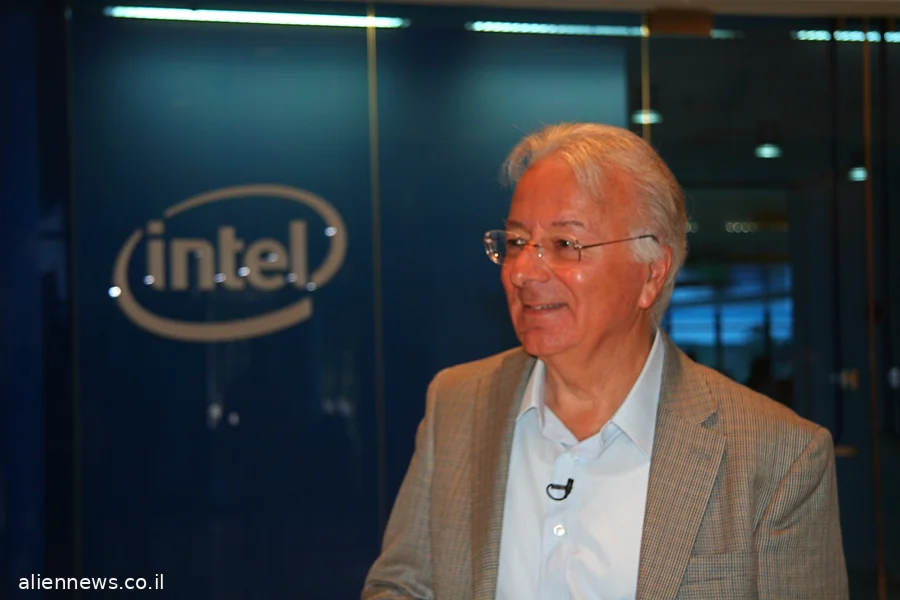
Who is feeling? Faggin in an Alien News video
A short Alien News video on Federico Faggin's idea. The article below explains the idea and its sources.

The question that came out of the laboratory
Federico Faggin wanted to build a computer that could learn. When he turned to books on the brain and biology in the mid-1980s, he found descriptions of cells, signals and responses. One thing kept troubling him: how does that activity become something felt? A machine can identify something and respond to it; what would it take for the encounter to be experienced? This is how he describes the beginning of his interest in consciousness.
It was a question from someone who already knew how to turn ideas into working machines. Faggin led chip design on the Intel 4004 project, introduced in 1971, alongside Ted Hoff, Stan Mazor and Masatoshi Shima. The project began with an order for a Japanese calculator. Its innovation was a processor that could be programmed for different tasks, rather than requiring a dedicated circuit for each one.
He later co-founded Zilog and Synaptics, the company associated with touchpads and touchscreens. Yet knowing computers did not settle the question of experience for him. In the proposal he developed with physicist Giacomo Mauro D’Ariano, consciousness enters at the foundations of the account of reality. Their starting assumption is that a system experiences the information it carries and processes.
Less than a minute at Lake Tahoe
A personal event became part of this engineering journey. In December 1990, during a Christmas holiday at Lake Tahoe, Faggin woke in the night. He says he felt intense energy rising from his chest. He described light, love and a sense that the separation between himself and the world had disappeared. The experience lasted less than a minute.
In his account, this was when he became convinced that inner experience belonged to reality from the beginning. It was the personal origin of a change in his outlook; the physical explanation he later developed needs arguments and tests of its own.
A computer can identify a rose. Who smells it?
Faggin uses the example of a rose. Molecules reach receptors in the nose and generate neural signals. Imagine a device whose sensors recognize the pattern and display the word rose. Where, in that chain of signals, is the scent as we experience it?
A list of coffee’s ingredients does not convey the bitterness of the first sip. We can identify a piece of music without being moved by it. An explanation of consciousness needs to connect information about a thing with the way it is experienced.
These felt qualities are called qualia: red as it looks, pain as it hurts. David Chalmers formulated the question as the hard problem of consciousness. Even if we explain how the brain distinguishes a color and enables us to name it, we can still ask why those activities are accompanied by experience.
Faggin and D’Ariano’s model starts with experience itself as a fundamental property. Rather than assuming it appears when computation becomes sufficiently complex, they ask what kind of information could describe its characteristics.
What cannot be copied at a click
The first characteristic they examine is privacy. We can describe pain or joy to someone else, but the description does not give them direct access to that same inner moment. In the model, this boundary is fundamental, rather than merely a consequence of lacking a sophisticated measuring instrument.
This is where the no-cloning theorem enters. A file can be copied while retaining the original. Quantum laws allow no universal machine that takes any unknown quantum state and produces a perfect copy. A known state can be prepared again; the restriction concerns perfectly copying an arbitrary state whose identity we do not know.
A quantum state is the mathematical description used to calculate the probabilities of measurement outcomes. Faggin and D’Ariano identify experience with a pure quantum state: one that is not a statistical mixture of different states. Even a pure state can yield probabilistic measurement outcomes.
From outside, limited information becomes available; for the system itself, they postulate, there is its particular experience. This is their proposed connection between physics and consciousness. The no-cloning theorem does not establish that a quantum system feels anything; experience is an additional foundational assumption.
What would it mean for a field to be conscious?
In quantum field theory, particles are described as excitations of fields that fill space. A photon, the particle of light, is an excitation of the electromagnetic field. A ripple on water offers a useful analogy: the ripple appears to be a particular thing, yet it is a movement within a larger system.
Faggin proposes that fields also have an inner aspect: they experience and choose. In an interview about the model, he stresses that the fields are the conscious entities, while particles are their states. His account therefore does not require imagining every electron as a tiny person with thoughts. The body is the means through which a conscious entity encounters and acts upon the world.
The account is called Quantum Information Panpsychism. Panpsychism is a family of views that place experience at nature’s foundations. In this version, experience is the inner aspect, and quantum information describes it. From there, the model connects to the world of signals and measurable outcomes.
Conversation offers an illustration: spoken words can be recorded, while the meaning experienced by the speaker is not present in the file in the same way. Faggin extends that distinction to nature as a whole, treating interactions between fields as expressions of meaning too. This is an interpretation he adds to the physical account.
One experience, many ingredients
If experience exists at a fundamental level, how does one person emerge who sees, hears and thinks? In a café, we experience the voice of the person opposite us, the taste of the drink and the appearance of the room together. How do different ingredients become one subject’s experience? This is panpsychism’s combination problem.
Faggin and D’Ariano turn to quantum entanglement, in which the state of a whole system cannot be described as a collection of independent states of its parts. They propose mathematical conditions under which such a system counts as one experiencing subject. Connecting those conditions to the biological system that implements human experience still requires work.
What about memory, if experience cannot simply be copied? In the model, long-term memory is classical information: data that can be stored and retrieved. Recall uses that record to prepare a state of experience again. It resembles reconstruction from a record, rather than replaying a perfect copy of the original moment. The authors also calculate how attention and repetition might improve the fidelity of that reconstruction.
From feeling to choosing, and back to computers
Faggin wants experience to make a difference: fear can prompt withdrawal, and understanding can change a decision. In the model, the transition from a quantum state to a public outcome plays the role of choice. From outside, the outcome is described through probabilities; from within, the authors interpret it as the experiencing entity’s action, connected to its history of experiences.
This is a demanding step. An inability to predict an outcome does not by itself explain how someone chose it. The connection between experience, intention and action is part of the authors’ proposal, rather than a conclusion that quantum mechanics requires us to accept.
This also leads to Faggin’s position on computers: successful calculation or reporting is insufficient, in his view, to create experience. A chatbot that says it feels excited returns us to the rose: what distinguishes producing the appropriate answer from the feeling itself? A quantum computer offers no automatic answer either; its system would need to be shown to satisfy the model’s conditions for a single experiencing subject.
How could the idea be tested?
The joint paper, posted to arXiv in December 2020 and revised in January 2021, includes concrete directions for research. One example is memory experiments examining how attention, the delay before recall and the type of experience affect recall fidelity. The authors suggest comparing results with quantitative relationships derived from their model.
Another direction is to look for quantum characteristics in perception. Yet a change in how a picture appears to us, or a resemblance between a quantum formula and human behavior, is insufficient. Researchers need to define exactly what is measured, what outcome is expected and how it differs from another explanation. The paper itself identifies major experimental difficulties. It presents research proposals, rather than an experiment demonstrating that a field has experience.
For Faggin, the question remains the one raised by the rose: we can trace the molecules, signals and response, and still want to understand the scent itself. He proposes putting experience at the beginning of the explanation. The next challenge is to show what this move allows us to explain and predict about our conscious lives.